 Paul Demont (2010). Tirage au sort et démocratie en Grèce ancienne. laviedesidees.fr http://www.laviedesidees.fr/Tirage-au-sort-et-democratie-en.html
The Dutch weighted lottery for admission to, for example, the studies of medicine and dentistry, is rather famous, and yet largely unknown regarding its important characteristics, its history, or the public debate surrounding it and flaring up every other ten years or so. My intention in this project/webpage is to make that information available in English. There have already been attempts to let the outside world know how the Dutch are trying to solve some pressing problems in admissions, resulting from a shortage in available places—or from a lack of funding, which is rather the same thing—in higher education. Wim Hofstee presented a paper in a 1980 congress in Antwerp, which was published in 1983 html and made available on this website with his permission. Flora Goudappel (1999) [paid pdf] describes the work of the Drenth Committee, in the nineties, and the changes in the law following their report. But that is it, more or less.
Now there is the book by Conall Boyle, of course.
Conall Boyle (2010). Lotteries for education. Origins, Experiences, Lessons. Imprint Academic. info
national studies
Academic studies in the Netherlands legally are national studies; the study of medicine in Rotterdam, for example, is equivalent to the study of medicine in Maastricht. Methods of instruction in Maastricht differ radically from those of the other studies in medicine in the Netherlands, yet the study is equivalent in all legal and professional aspects and in that sense a national study.
Secondary education'’s final examinations legally are higher education’s admissions examinations
The big secret of the education system in the Netherlands is that secondary education’s examinations legally grant admission to higher education. There is a restriction, of course, to secondary education that prepares for higher education: VWO [Voorbereidend Wetenschappelijk Onderwijs; Preparatory Arts and Sciences Education]. The regular system of admissions selection for higher education in the Netherlands, therefore, is the system of final examinations in secondary education peparing for higher education.
It is a big secret, because many of the individual Dutch commentators on the lottery system never seem to recognize this very basic fact. In contrast, all or almost all of the official committees that studied the question of how to select candidates in the situation of a numerus clausus, start their deliberations with the description of the law that stipulates that the mentioned secondary education examinations grant admission to higher education, regardles of gpa. In reality, there are practical restrictions in terms of particular courses that should have been followed in order to be admitted to a particular study.
Therefore the weighted lottery system used in admissions to studies legally designated ‘closed’ really is only a second stage admissions procedure.
what is a numerus fixus
The law stipulates that every study in every university (or vocational university, HBO) should admit every candidate in possession of an adequate diploma of secondary education. There is a law taking exception to this law, in case of particular studies that will make available a strictly limited number of places, a numerus clausus, stubbornly called a numerus fixus in the Netherlands, as I will do in the sequel. In order to gain the right to participate in the admissions procedure to a numerus fixus study, one should be in the possession of an appropriate diploma of secondary education (excepting some special categories of candidates, summed up in the law).
I was just wondering, would it be a good idea to set up a kind of calendar of events/contingencies in The Netherlands concerning its special admissions procedures to higher education, also the kinds of arguments brought forward by different groups of stakeholders, as well as differences of opinion within those groups.
The line of events will start with the following topics
- how the law regulates admission to universities in the sixties: passing your examination makes one admissible to higher, gives one the right to enter the university course of choice.
- the department of medicine is having difficulties, then, providing enough places in hospitals for its students. The result is growing waiting lists. After Paris 1968 students do not accept such infringements of their right to get proper and timely instruction: a lawsuit of the student labor union SVB [Studenten Vak Bond] against a university is won by the union (Szirmai, 1971).
- Government then - appr. 1972 - is forced to adapt the law, to be able to restrict admission to the study of medicine according to the number of students the particular department will be able to handle without placing them on waiting lists. Installing a selection procedure, a special examination, or what have you, on such a short notice was impossible, and would surely not be acceptable to the candidates applying for admission the same year and the following year. Therefore a lottery procedure was chosen to effect the necessary reduction in numbers, such a procedure being regarded as not unduly favouring any particular subgroup, and already some years in use to decide who was to be placed on a waiting list. In higher vocational education instutions, who were not restricted by law in their admissions procedures, lotteries then were one of the instruments they used to reduce excessive numbers of applicants. In Germany already in the sixties departments of medicine were allowed to install a numerus cluaus, using lotteries to effect the reduction in numbers necessary.
There was some discussion on the question whether the subgroup having a grade point average of 7.5 or higher would be excepted from the lottery, the kind of debate that continued also in the Drenth commission. Newly surrected centers for educational research at the universities regarded it as their task to inform the public on the limited potential of selection procedures to contribute to whatever it is that one might call the efficiency of instruction at the university (Hazewinkel, on errors of decision in selection). Hofstee, accepting his chair in psychology in 1969, warned against way too optimistic ideas of the positive effects selection would have on the quality and/or efficiency of instruction in the department involved.
A curious phenomenon in the late sixties was that politicians and advisors of the government would like to see selective admissions introduced, while at the same time it was acknowledged that participation in higher education should grow still further (there had been already a tremendous growth in participation from the baby boom generation). A little thinking will lead to the conclusion it is rather pointless to pursue both policies at the same time. Yet that is exactly what polticians in the Netherlands in this new century again are trying to do. Even university presidents fall into the trap, not understanding that selectivity in itself will result in less students, and therefore less funding also. How stubbornly common sense can one be?
Cynthia Farrar (2009). Taking our chances with the ancient Athenians. In Alain-Christian Hernandez: Démocratie Athénienne - Démocratie Moderne: Tradition et Influences (167-217, discussion 218-234
Paul Demont (2010). Tirage au sort et démocratie en Grèce ancienne. laviedesidees.fr http://www.laviedesidees.fr/Tirage-au-sort-et-democratie-en.html
R. Stewart (1998). Public office in early Rome. Ritual procedure & political practice. University of Michigan Press. isbn 0472107852
Thomas Gataker (1627/2008). The Nature and Uses of Lotteries. A Historical and Theological Treatise. Modernised with notes and bibliography by Conall Boyle. Imprint Academic. isbn 9781845401177
Patricia Crone & Adam Silverstein (2010). The ancient Near East and Islam: The case of lot-casting. Journal of Semitic Studies, 55, 423-450. pdf
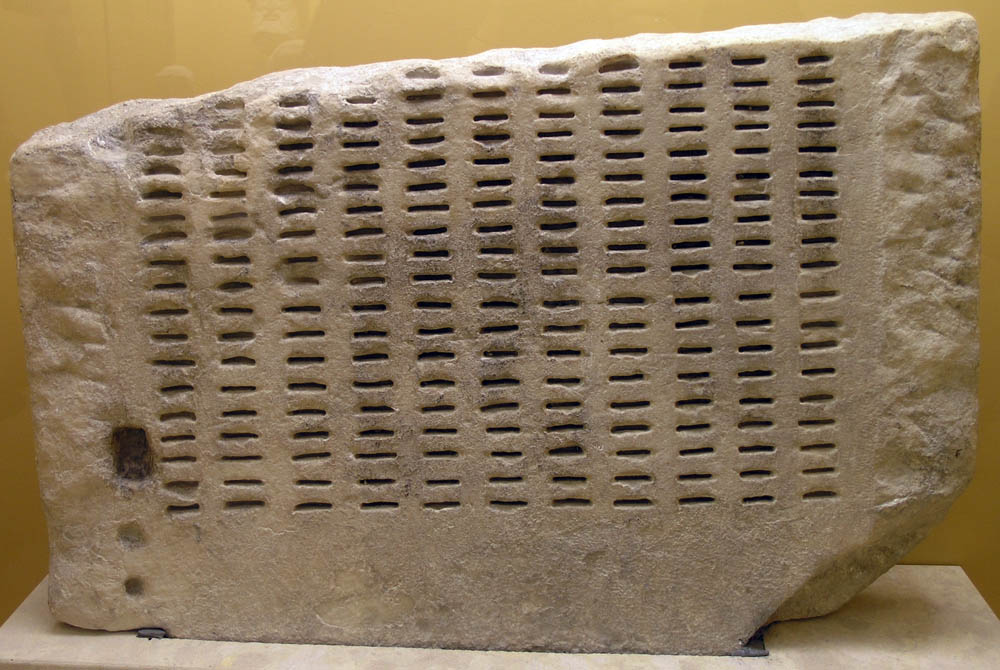
Oliver Dowlen (2008). 'The political potential of sortition. A study of the random selection of citizens for public office.' Imprint Academic. isbn 9781845401795 Table of contents — Introduction — Plates [look this up! The lotterystone — kleroterion — above is from commons.wikimedia.org]
In the binary system in the Netherlands in the sixties separate laws see on the universities and technical universities on the one side, and vocational colleges on the other side. Admission to university studies is restricted to applicants having passed the right examinations in secondary education. Some exceptions are allowed (colloquium doctum, or the route via a vocational college). Having the right examination papers, the choice of study as well as of the institution is free, admission is unrestricted. The situation is quite different for the vocational colleges: the colleges are allowed to select their applicants and many of them do, using all kinds of procedures and instruments, including lotteries for some or all applicants. After all, the sixties see an enormous growth of participation in higher education, some studies grow harder than others, most of them in the vocational sector (the arts, journalism, hotel school). Medicine, dentistry and especially veterinary studies have difficulties to accommodate the growing number of students.
There is a general historical context as well, as one might suspect: the sixties and early seventies saw a lot of student protest and revolt, much of which had to do with chances to be admitted to higher education by candidates from poorer etc. backgrounds. In this climate the possibility to decide on admissions in particular situations using a lottery, next to other instruments, was not only much discussed, but practiced as well. Within the social democratic party there was a strong current of somewhat radical ideas, in the ranks and files, as well as in the executive committee and among cabinet members (Ger Klein among them). The Klein bill was defended in the social democratic fraction in the Lower House by Kees Kolthoff. Kolthoff is a psychologist, he had been head of the small research center on higher education of the University of Amsterdam. In fact, he was my first employer.
By the beginning of the 70's every university had its own center for research on higher education. These centers were nationally united in a kind of executive platform (CRWO is its acronym). This platform used to take a stand on issues regarding higher education. The admission to numerus fixus studies was such an issue, Hans van der Vleugel and I conceived the vision on the matter that was endorsed bij the platform before it was taken to print. (Onderzoek van Onderwijs, april, 1974).html
Dutch parliamentary documents have been made aavilable online on http://www.statengeneraaldigitaal.nl/, a site maintained by the Royal Library (Koninklijke Bibliotheek, kb.nl).
The problem was, in 1971, that the emergency law restricting admission to, in particular, medical courses, really was an emergency law: students in secondary education were not prepared for it. Therefore it was deemed fairest to use a lottery system, and grant the very best candidates immediate access (in 1972 this number was 8% of the group of applicants).
The document on the law giving trajectory of the emergency law is: Totstandkoming van het wetsontwerp inzake tijdelijke beperking van toelating van eerstejaarsstudenten aan de faculteit geneeskunde. It is archived by the National Archive, The Hague [ Nationaal Archief, Den Haag, Afdelingen Hoger Onderwijs, Hoger Onderwijs en Wetenschappen en het Directoraat-Generaal voor de Wetenschappen van het Ministerie van Onderwijs, Kunsten en Wetenschappen, (1911) 1918 - 1975, nummer toegang 2.14.58 inventarisnummer 203-205. ]
Also:
Nationaal Archief NL-HaNA, OKW / Hoger Onderwijs, 2.14.58, inv.nr. 221. Totstandkoming en uitvoering van de wet van 6 juli 1972, Stb. 355, houdende voorzieningen van tijdelijke aard met betrekking tot de inschrijving van studenten aan Nederlandse universiteiten en hogescholen (Machtigingswet Inschrijving Studenten). 1971-1974
I do not have copies of these documents. They are not available online.
A numerus fixus will be in place for the year 1972-1973. The admissions procedure is as simple as possible, granting the very best candidates a place, and offering the other candidates for teh remaining slots a straight lottery. The best candidates are the candidates with a gpa on the final examination of at least 7½. The bill was accepted in the Lower House, 29 June 1972. The enabling law of 1972 [Machtigingswet] did not specify which opportunity there would be in 1973 for candidates failing to obtain a place in 1972.
Wijnen, W. (1973). Wie mag in 1973 naar de universiteit? Universiteits Krant Groningen 31-1-1973.
An academic committee chaired by H. J. A. Duparc, proposed 25 November 1974 a weighted lottery, instead of a straight lottery as preferred by the Academic Council [Academische Raad] [Commissie Algemene Vraagstukken VWO-WO (November 1974). Selectie-procedure bij de hantering van een numerus fixus. Academische Raad [74/74-3]
- The Dutch Parliament in 1975 discusses the way the restriction of numbers - called 'numerus fixus' instead of the better term 'numerus clausus' - should be effected for the years to come, until the problems with the restricted numbers of places available were solved (of course, that never happened). During that debate one of the Christian parties proposed the weighted lottery as a compromise between the position of the parties on the left (unweighted lottery) and those on the right (selection for all). The result was a weighted lottery scheme winning the support of all parties in Parliament.
"The 1975 weighted lottery
The first example, which will be discussed at some length, is the weighted lottery model for admission of students to closed (numerus clausus) studies, such as medicine, dentistry, and veterinary science. One particular solution under this model was proposed by Vermaat, a Dutch professor of mathematics and member of parliament, and the general model is easily derived from that proposal. It states that in cases of restricted admission, an applicant's chances of being admitted - that is, the number of lottery tickets he or she receives - is a monotonically increasing function of his or her score (for example, a secondary school grade point average). Clearly, the model fills the gap between straight lottery selection and comparative selection.
The model may be formalized to a certain extent as follows: An applicant with score x receives a chance of admission f(x) where f is a monotonically increasing function such that
Σ f (x) p(x) = R
or
∫ f (x) p(x) dx = R,
with R the selection ratio and p(x) the empirical score distribution summing to 1.
In the special case of a straight lottery,
f (x) = R for all x,
whereas in the case of comparative selection,
f (x) = 1 for x > a
and f (x) = 0 for x < a
the cutoff point a being defined by
∫ axmax p(x) dx = R.
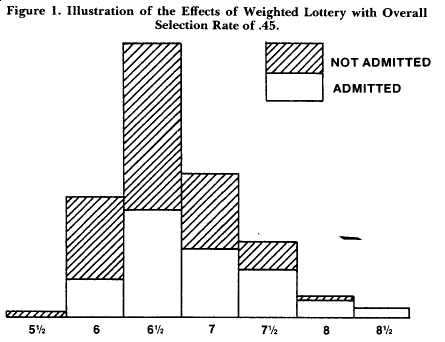
Figure 1 illustrates the model. Weighted lottery selection has been applied in The Netherlands on a national scale as an admission policy for studies such as medicine. In practice, applicants are classified according to grade point average, and ratio weights representing the relative proportion admitted to each class are established a priori."
Willem K. B. Hofstee (1983). The Case for Compromise in Educational Selection and Grading. In Scarvia B. Anderson and John S. Helmick (Eds) (1983). On educational testing. San Francisco: Jossey-Bass Publishers. p. 109-127. html
I have a 1975 document describing the exact procedure (Letter to the chairman of the Second Chamber of Parliament, 13 May 1975).
The technique is interesting, separating the lottery procedure from the allocation procedure. In an early stage, even before the gpa's will be known, the candidates will receive a rank number determined by lottery. As soon as it is possible to allocate some candidates in some or all categories, as soon as the result of the final examinations are in, part of the available slots will be filled with the candidates in possession of the lowest numbers. Definitive results of the examanitions will only come in much later, the remaining slots will then be filled by, again, admitting the students having the lowest numbers in the particular category concerned.
In this way, some candidates will know already before the final examinations that they probably will be admitted (if they succeed in passing the examination, regardles of their gpa), or not.
For more details, see the appendix to my (1975), the Ger Klein letter to teh Lower House here
This kind of system wil have been in use throughout the 90's, and probably will still be in use today.
The weighting in the lottery persisted in its original quantification, the one in the Vermaat amendment. The law was changed after de Drenth committee had reported its advice, the particular weighting system now being used is described on the website of the IB-Group in Groningen here [in Dutch only, regrettably]
In his (1983 html) Willem Hofstee summarizes the different positions of participants in the debate on admission to numerus fixus studies, i.e. closed studies. Of special interest is the opinion of secondary school students, the one group having the highest personal stakes in the method of admission chosen by government. See the box below.
The opinions of secondary school students
"A final argument in favor of using lotteries is that they are more acceptable than comparative selection, at least to Dutch secondary school students. In a study by Hofstee and Trommar (1976), secondary school students in their last year were asked the following question: If you could advise the government on admission policies, which would you recommend? Since the investigation was carried out under the auspices of the advisory committee referred to earlier, our respondents were indeed indirectly advising the government. The straight lottery method received 40 percent of the votes, comparative selection only 10 percent; the remaining 50 percent went to weighted lottery. These results have been replicated in at least three other unpublished studies."
Willem K. B. Hofstee (1983). The Case for Compromise in Educational Selection and Grading. In Scarvia B. Anderson and John S. Helmick (Eds) (1983). On educational testing. San Francisco: Jossey-Bass Publishers. p. 109-127. html
W. K. B. Hofstee and P. M. Trommar "Selectie en Loting: Meningen van VWO-Eindexaminandi." Heymans Bulletin, No. 25 1, Department of Psychology, University of Groningen, 1976.
At least partly an effect of the weighted lottery procedure is that the number of females admitted is larger than that of males, because of better gpa's. This state of affairs will have an enormous impact on the medical sector, because women doctors prefer not to work fulltime.
I do remind the reaer of the fact that, previous to the admissions preferentially honoring candidates having higher gpa's, the medical studies were chosen by academically less brilliant candidates, compared to, for example, students choosing physics. (data from the Central Bureau of Statistics). So there has been a sizeable impact on the allocation of scarce talent to medical studies versus studies in the sciences.
Another point of some importance is the fact that a numerus fixus artificially seals of the labour market for medics. There is big market disturbance. This is, by the way, one of the arguments nowadays within some plitical parties and even ministries to do away with the instrument of a numerus fixus altogether. As you will know, one way or the other, enormous costs are involved in artificially 'protecting' a highly specific labour market, as well as in admiiting too many applicants to studies as costly as medicine.
Because GPA is an ingredient of the procedure, the allocation can be made only after the GPA has become available somewhere in June, or even after some candidates have taken second chances on their exam, somewhere in August. Yet it possible to give many candidates many months before a clear idea about their being admitted with a high probability, or not being admitted with a high probability. I will try to sketch the procedure, but because it is a highly unusual one I recommend perusing the original document (in Dutch) to get a better idea of what is going on here.
Immediately in 1975 this allocation has been separated from the lottery procedue. Much earlier all registered candidates will be assigned a unique number, say in February, effectively putting a rank order on the candidates. A low number signifies a high probability to be admitted, a high number a low probability, in between there is a range of uncertainty. That is, already before the exams, many candidates can be pretty sure about being admitted, other candidates of not being admitted, while a group in between will still be highly uncertain. How is this possible, because GPA is not yet available? It is possible because a candidate eventually will be assigned a particular lottery class on the basis of the GPA obtained, the allocation of places then will be in order of the candidates having te lower number, until all slots made available to that category at that moment, have been filled. (The procedue is rather involved. See the original document transcription, in Dutch, about the details here). I have a 1975 document describing the exact procedure (Letter to the chairman of the Second Chamber of Parliament, 13 May 1975).
The technique is interesting, separating the lottery procedure from the allocation procedure. In an early stage, even before the gpa's will be known, the candidates will receive a rank number determined by lottery. As soon as it is possible to allocate some candidates in some or all categories, the available slots will be filled with the candidates in possession of the lowest numbers.
This kind of system has been in use ever since 1975.
I will select the crucial passages for presentation here (in Dutch, but you will be able to follow the numerics)
here.
Peter Karstanje (1981). Selection for higher education in the Netherlands. European Journal of Education, 16, 197-208. preview
In the Netherlands, only the Parliament can decide to restrict access to universities. This restriction is an encroachment on the legal right of pupils with a VWO-certificate to sit university examinations. A bill, proposing a temporary numerus clausus for medical studies in 1966 was rejected on the grounds that graduates from pre-university schools had legal freedom of choice. In 1972, however, a bill that made it possible to restrict the number of students, on the grounds that there were an insufficient number of places, was passed. Though initially regarded as a temporary measure, it has since been prolonged every year.
To date two different criteria for admission exist. Until 1976 students with an average of at least 7.5 [note: Marks are awarded from one to ten with six required for a pass] in the VWO examination were admitted. The rest of the candidates were subject to lottery. One reason for direct admission of pupilswith better examination results was the proven correlation between examination results ..and success at unlversity.
This procedure, however, met with strong opposition, especially fromthe responsible Secretaryof State [Ger Klein, PvdA. b.w.] in the former Socialist/Christian Democratic coalition who strongly resisted conferring privileges on certain groups of students. The correlation between examination results and success in university was very low, he pointed out. Indeed, research which correlated secondary school examination results with early university examination showed correlation coefficients of 0.22 to 0.4 a predictive value of no more than 20%.
Another reason for the Secretary of State's resistance to direct admission of pupils with better examination results had to do with the consequences for secondary education. As it was, the government had taken measures to broaden curricular development in secondary education and to postpone selection. The Secretary of State feared that the admission criteria would result in an even greater emphasis on examination subjects at the expense of other important educational goals.
Since 1976, however, the Parliament has decided in the annual debates about admission policies upon a second principle, namely weighted balloting.The higher one's examinationmarks, the higher the chance of being admitted.
A third admission policy has been presentedin a Bill by the present (Conservative) minister of education [Arie Pais, VVD. b.w.]. In this Bill the intake problem is (for the first time officially) seen as a structural problem, and not as a temporary one. The proposed admission policy is rather complicated. In short, one-third of the places is available, without further selection, for the applicants with the best examination results.Other applicantssit an extratest in two importantsubjects.The average of the test marks and the VWO-examination results is then computed. One-third of the available places is then given to the students with the highest marks. The remaining third of the places is assigned by lottery in sucha way that girls (and boys who have finished military service) have a higher chance of being drawn. A small percentage is reserved for applicants without the required certificates and for foreign students.
204-205
Vilhelm Aubert (1980). Chance in social affairs. In Jack Dowie & Paul Lefrere (Eds) (1980). Risk & Chance. Selected Readings (74-97). Open University Press. isbn 0335002625 [on lotteries]
John R. Boyce (1994). Allocation of goods by lottery. Economic Enquiry, 32, 457-476.
Christine Aziz (19 July 1996). Star student challenges lottery. Times Higher Education, html

The report of the Drenth Committee is available [in Dutch, pdf] here. This pdf is without the appendices.
The Cabinet put pressure on the Drenth Committee, and the the Committee succumbed to it. After the release of the report, Chairman Pieter Drenth publicly confessed to this state of affairs, deeply ashamed.
The feeling among psychologists like myself, in the nineties, was that the law would eventually grant immediate admission to candidates having really high gpa's. In this opinion the events in the later '90's were inevitable. The question was not whether, but when; a highly visible case would be the trigger, and so it happened. It really was a minor change in the weighted lottery procedure. The Drenth committee retained the lottery as an essential ingredient, as all committees previously had done. The minister eventually presented a bill that was closer to the old bill than the proposal by the Drenth committee was.
Admission to the study of medicine in the Netherlands is regulated by law because the number of slots is strictly limited to to a numerus fixus. Under this law applicants scoring a GPA of 8 or better on their secondary school examination will be admitted without any further selection.
P. J. D. Drenth (1999). The selection of medical students in the Netherlands — Reconciling the incompatibles. Commission on the Points System Research Paper No 3 Department of Education, Dublin: Irish Government. [no longer online. An incomplete version available, mail me]
Szirmai, Z. (1971). Wachtlijsten. Nederlands Juristenblad, 4-9-1971. [waiting lists]
Hyland, Áine (2011). Entry to Higher Education in Ireland in the 21st Century. Discussion Paper for the NCCA/HEA Seminar, September 21, 2011. pdf. Last accessed November 14, 2011.
Peter Stone (2013). Access to Higher Education by the Luck of the Draw Article in Comparative Education Review researchgate.net .
Peter Stone (2013). A Renaissance for random selection? In Kari Palonen a.o. (Eds.) (2013). Redescriptions. Yearbook of political thought, conceptual history, and feminist theory. Vol. 16, 2012/2013 (125-136). pdf (whole book)
Here the classical study by Cronbach and Gleser (1957) is still the most important source. Selection is but a special case of the more general problem of optimal placement. Both are typically treated as institutional problems, meaning that what is 'optimal' is regarded so as from the perspective of the institution (shop, school, army, country, humanity). The complementary part, of course, is what is in the interests of the candidates seeking admission to jobs, places, careers, life fulfillment. By now it will already be clear that selection is a rather narrow and even biased concept, a fact that typically not many participants in debates on admission procedures are even remotely aware of. The point being, of course, that selecting institutions basically do not care shit about what will happen to the candidates the institution rejects. Well, there is some equity talk: rejected applicants should get away with the feeling they have been rejected justly. Which is a terrible thing to do to rejected applicants.
The justice theory hinted at in the title of course being that of John Rawls.
Conall Boyle (2010). Lotteries for education. Origins, Experiences, Lessons. Imprint Academic. isbn 9781845402105 paperback
Flora Goudappel (1999). The Dutch system of lottery for studies. European Journal for Education Law and Policy, 3, 23-27. pdf
Hofstee, W. K. B. (1983). The case for compromise in educational selection and grading. In Anderson, S. B., & Helmick, J. S.: On educational testing. San Francisco: Jossey-Bass. 109-127. Gaat vooral in op loten als selectiemiddel. [html]
Nienke R. Schripsema, Anke M. van Trigt, Susanna M. Lucieer, Anouk Wouters, Gerda Croiset, Axel P. N. Themmen, Jan C. C. Borleffs, Janke Cohen-Schotanus (2017). Participation and selection effects of a voluntary selection process. Advances in Health Sciences Education, 22, 463-476. open access
Publications not mentioned in the text above.
Frijhoff, W. (1992). The Netherlands. In Clark, B.R., & Neave, G.R. (Eds.)(1992). The encyclopedia of higher education. Oxford: Pergamon Press. I, 491-504).
Th. J. ten Cate en H. L. Hendrix (2001). De eerste ervaringen met selectie voor de artsopleiding. Nederlands Tijdschrift voor Geneeskunde, 145, 1364-1368. html
Louise C. Urlings-Strop, Theo Stijnen, Axel P. N. Themmen & Ted A. W. Splinter (2009). Selection of medical students: a controlled experiment. Medical Education, 43, 175-183.
DeWitt, L. B. (1971). A lottery system for higher education. Notes on the Future of Education, volume 2 issue 3, summer 1971, 9-12. A publication of the Educational policy Research Center at Syracuse.
Simpson, M. A. (1975). Selection of medical students by lottery. Journal of Medical Education, 50, 417-418.
Access policy and procedures and the law in U.S. higher education. New York: The International Council for Educational Development. 1978.
ERIC 1982-1991Ravelo-Hurtado,-Nestor-E.Nitko,-Anthony-J.Selection Bias According to a New Model and Four Previous Models Using Admission Data from a Latin American University.
Sutton Trust (2007). Ballots in School Admissions pdf
Laura Buratti (4-5-2016). Les étudiants en médecine franciliens seront choisis par tirage au sort. LE MONDE | 04.05.2016 à 19h32 • Mis à jour le 10.05.2016 à 10h55 | page
Peter Stone (submitted) Review of: Oliver Dowlen (2008). The political potential of sortition: A study of the random selection of citizens for public office. Imprint Academic. Philosophical Quarterly
Focus on: Sortition. The Mammalian Daily, January 17, 2013. html
Sortition has its origins in some of the oldest Human societies. After completing an exhaustive study of ancient Human political systems, Jor concluded that the basic tenets of zoocracy would best be maintained through the use of sortition rather than by direct elections. With the assistance of a panel of consultants, Jor made modifications to some of the original rules of sortition and crafted the system that has been in continuous use since the establishment of zoocracy.
Peter Stone (submitted). A renaissance for random selection? History of Political Thought Review of
Rosenblatt, J. R., & Filliben, J. J. (1971). Randomization and the draft lottery. Science, 111, 306-308.
Willms, D. C. (1974). Georgia's land lottery of 1832. Chronicles of Oklahoma 52: 52-60. Mentioned in Jon Elster's Solomonic Judgements. Weighted lottery! niet in UBL. [I have not seen a copy of this text]
Sher, G. (1980). What makes a lottery fair? Nous, 14, 203-216.
ERIC 1982-1991Jassem,-Harvey-C.Glasser,-Theodore-L.Random Allocation of Licenses and the Public Interest in Ownership Diversity.1981
Wasserman, D. (1996). Let them eat chances: probability and distributive justice. Economics and Philosophy, 12, 29-49.
Elster, J. (1989). Solomonic judgements. Studies in the limitations of rationality. Cambridge: Cambridge University Press.
Filimon Peonidis (2009). Bringing direct democracy in a representative assembly: The case of allotted MPs. pdf
Conall Boyle (1998). Organizations selecting people: how the process could be made fairer by the appropriate use of lotteries. The Statistician, 47, 291-321. pdf
Peter Stone (2011). The Luck of the Draw. The Role of Lotteries in Decision Making. Oxford University Press. isbn 978-0-19-975610-0. See the OUP site voor its contents. [I have not yet seen this one] review on the Kleroterians site.
George Tridimas (in print august 2011). Constitutional choice in ancient Athens: The rationality of selection to office by lot. Constitutional Political Economy. Available at SSRN: http://ssrn.com/abstract=1916053
Ben Wilbrink. Bibliography of publications and articles in the media regarding theuse of lotteries in admisisons. Most entries are Dutch ones, of course, but there are some highly relevant and more general English ones on lotteries and justice. html
Kleroterians blog site Equality by lot http://equalitybylot.wordpress.com/
Conall Boyle has a website dedicated to the topic of lotteries used to make decisions—or rather 'let them happen'—in education as well as in other domains, such as the economy or economical affairs. site. Also on his site: lottery in political theory, lottery and democracy (think of the jury system in law as an example).
How the San Francisco School Lottery Works, And How It Doesn’t. By Katrina Schwartz JANUARY 11, 2018 web page
Dylan Wiliam (2003). Constructing difference assessment in education. In L. Burton (Ed.) Which way social justice in mathematics education? (pp. 189-207). Praeger Press.
Peter C. Fishburn (1978). Acceptable social choice theories. abstract. In Hans W. Gottinger, and Werner Leinfellner (Eds) (1978). Decision theory and social ethics. Issues in social choice. Reidel. isbn 9027708878, pp 133-152 info
Hofstee, W. K. B. (1990). Allocation by lot: a conceptual and empirical analysis. Social Science Information, 29, 745-763. 10.1177/053901890029004004 preview & researchgate pdf
Rebecca Zwick (2007). College admissions in twenty-first-century America: the role of grades, tests, and games of chance. Harvard Educational Review, 119- scihub [NB: Zwick heeft geen flauw idee van de specifieke situatie van de Nederlandse numerus fixus. Ook in haar latere boek (2017, 'Who gets in?') verspreidt ze misverstand op misverstand over de gewogen loting in Nederland. Ik begrijp dat wel: het is verdraaid lastig om onderwijsstelsels in andere landen/culturen goed in beeld te krijgen.]
Gil Delannoi, Oliver Dowlen, Peter Stone (2013). The lottery as a democratic institution. Policy Institute.
Peter Stone 2022 In the shadow of Rawls: Egalitarianism today. Ethical Theory and Moral Practice https://doi.org/10.1007/s10677-022-10272-1 academia.edu
Ben Wilbrink (2023). A thumbnail history of admission by lottery in Dutch medicine studies. Translated from the original Dutch by Lambert Schuwirth. blog
 http://www.benwilbrink.nl/projecten/lottery.htm
http://goo.gl/MQmvN
http://www.benwilbrink.nl/projecten/lottery.htm
http://goo.gl/MQmvN