Mathematics education
An inventory
Ben Wilbrink
See also the special page on word problems, the prototype question for everything that can go wrong in designing achievement test items.
My intention in creating these 'education pages' is to assemble materials from several disciplines to investigate how they are handling common sense ideas, folk ideas, naive ideas, whatever they might get called, that are inconsistent with the scientific ideas in that particular discipline. The prime example is the folk physics of pupils that is frustrating their learning the classical mechanics of Newton, while most programs or teachers do not explicitly handle this problem, or even are aware of it. While this kind of problem evidently is frustrating the efficiency of education, it also touches on what is valid assessment of knowledge of physics. Designing physics tests should touch on this issue.
There is a flipside to this kind of issue: there are also intuitions etcetera that are consistent or might be regarded as consistent with scientific ideas. They could be of great significance in education, because they might make it possible to introduce complex ideas much earlier, much simpler. Among others Andrea DiSessa is running some projects along this line, in matheducation. For a more general approach to research on intuitions see for example the work of Gerd Gigerenzer (site).
One reason to have separate pages for clusters of disciplines is the following. In primary education the two most important subjects are language and arithmetics. The difference between these disciplines is that the first one comes hard-wired in the brain, while the second one has to be built by the student almost from scratch by exercise. It is really amazing how enormous this difference is, even without my slight exaggeration, and yet schools and teachers spend almost the same amount of time on language as on arithmetics. Apart from that, it seems evident that designing test items must be rather different in these two domains. I do not yet know if such necessarily is the case.
-
mother language Comes with mother, pre-wired in the brain, already well exercised at the time of school entry. special techniques needed: reading, writing, grammar, sytactics. The relation between language development as such, and proficiency in the techniques mentioned, might be rather strained in daily school practice
-
second language Learning a second language should be possible in a natural way, to begin with. Exercise must be important here. Some special techniques will be needed, for instance spelling. How should obne learn grammatical and syntactical rules: in a natural way (how do you learn to ride a bike?) or in an artificial way (first learn the rules by heart, then practice them?)
-
arithmetics, mathematics This is an artificial discipline, in the sense that it has to be learned in school mainly, while our brain is not particularly adapted to it in the way it is to the learning of language.
-
physics This is a marriage between our natural environment as we experience it, scientific method, and mathematics. This must be a difficult discipline to master in an appropriate way, and so it has proved to be
-
history What kind of discipline is this? Listening to stories, reproducing those stories? Or is it to actively construct an understanding of the world as it is related to past events? Partly natural (finding one's way in society), partly cultural (discovering andassimilating knowledge of past events)
-
humanities Kind of a combination of scientific method and the characteristics of history? Some mathematics, of course. Our social and cultural environment as we experience it?
-
life sciences Kind of a combination of the characteristics of physics and history?
Alan Schoenfeld articulates exactly what kinds of problems are manifest in assessing mathematical proficiency. Take a few minutes off, to skim the chapter pdf. Thanks. Knowing the kinds of problems involved, you are better prepared to absorb the information in this webpage.
Alan H. Schoenfeld (2007) Issues and Tensions in the Assessment of Mathematical Proficiency. In Alan H. Schoenfeld:. Assessing mathematical proficiency (pp 3-21). Cambridge University Press. pdf
Never take anything for granted
2 + 2 = 4 /
2 apples + 2 apples = 4 apples /
2 apples + 2 persons = ??? /
2 cm + 2 cm = 4 cm? /
2°C + 2°C = .. °C?
The clumsy example is my own. The sum in cm is contextual, the sum in °C highly so. This example was triggered by Catherine Sophian's (2007) emphasis on the units referred to by particular numbers (see her book, mentioned below), in a way turning arithmetics into 'physical arithmetics'. The sum in °C, of course, is a variant on the physical experiment of mixing water of 0°C and 100°C, definitely an adding operation, yet the result is (better: should theoretically be) 50°C, not 100°C (on inventing temperature see the book by Hasok Chang (2008) under that title here. It is different, though, because one can't possibly tell what the answer of 2°C + 2°C = .. °C? should be, without knowing the context or intention the questioner had in mind. Research into word problems (Lieven Verschaffel, a.o.) does not seem to touch on the kind of problem in this example. My sum in °C is definitely not in the same class as that of the 'What is the age of the captain' problem.
There is a deep problem involved in the case in the box above.
Can this be true? Wat is mathematical truth anyway?
2/3 + 3/4 = 5/7
Most teachers would recognize this as a familiar kind of mistake. Is it necessarily a mistake? Can you think of an adequate justification given by the student?
By the way, always grant your students the opportunity to justify their answers, especially on MC items and short answer items. Better still: ask them to always do so in non-trivial cases.
Morris Kline, 1980, p. 94. For the answer, see here.
Arithmetics as taught in our schools, as a cultural artefact, is not quite in touch with the world at large. Might not this be somewhat confusing to young minds trying to grasp what their teachers are after? What is the particular slice of reality their teachers are talking about? Think of Euclid's world of points and lines; where does it make contact with the world as we experience it in daily life (does Robin Hartshorne, 2000, comment on this issue? (here). Morris Kline does, see his 1980, p. 95)? At the level of mathematical analysis, Rafael Núñez sees inconsistencies between mathematician's ways of talking about or explaining mathematics as movements, and the thorougly static character of rigorous mathematics itself: nothing moves at all (here). Strange things happening everywhere. Think of it: naive arithmetics and school arithmetics have in common that they are predicated on the bying and selling of goods in the market place, as shown by arithmetics books in the seventeenth century, such as the Dutch one by Bartjens (see pictures cyfferinge). Important as that is, there are lots of other things and events that do not behave in the 2 + 2 = 4 counting fashion. Economics is an example. Taking stock of happiness is not the same as taking stock of financial assets. Welfare economics is an example. Comparing quantities is more basic than counting them, why then is it that in eduation we disregard the comparison of quantities? By the way, Catherine Sophian (2007) doesn'tbelow.
Suppes and Zinnes do not (take anything . . .. )
". . . as elementary science students we are constantly warned that it 'does not make sense' (a phrase often used when no other argument is apparent) to add numbers representing distinct properties, say, height and weight. Yet as more advanced physics students we are taught, with some effort no doubt, to multiply numbers representing such things as velocity and time or to divide distance numbers by time numbers. Why does multiplication make 'more sense' than addition?"
Patrick Suppes and Joseph L. Zinnes (1963). Basic measurement theory. In R. D. Luce, R. R. Bush, and E. Galanter: Handbook of mathematical psychology. Volume 1 (the quote is from its opening paragraph). Wiley. Reprinted in Bernhardt Lieberman (Ed.) (1971). Contemporary problems in statistics. A book of readings for the behavioral sciences (39-74). London: Oxford University Press. pdf
vv
Patrick Suppes, in the source quoted in the box, is not in the business of teaching arithmetics to primary school kids (elsewhere he is, though, in the Stanford projects on developing courseware for arithmetics). Yet children find themselves confronted with some of the problems that Suppes and Zinnes discuss at a very fundamental level. Small kids having very fundamental problems, is that possible? Yes, it is. Conceptual learning is rather difficult, notwithstanding that it is a natural thing to do. It is especially difficult in formal territories such as arithmetics and mathematics in general. We had better be aware of these difficulties. Catherine Sophian (2007), and a host of other researchers mentioned in this web page, are aware of at least some of these problems, and are developing adequate instructional strategies to handle them.
Suppes treats the subject of representing parts of the world in numbers and structures of numbers comprehensively in his 2002.
Patrick Suppes (2002). Representation and invariance of scientific structures. MIT Press. Yes, it is online, it is a very large pdf: pdf 8 Mb
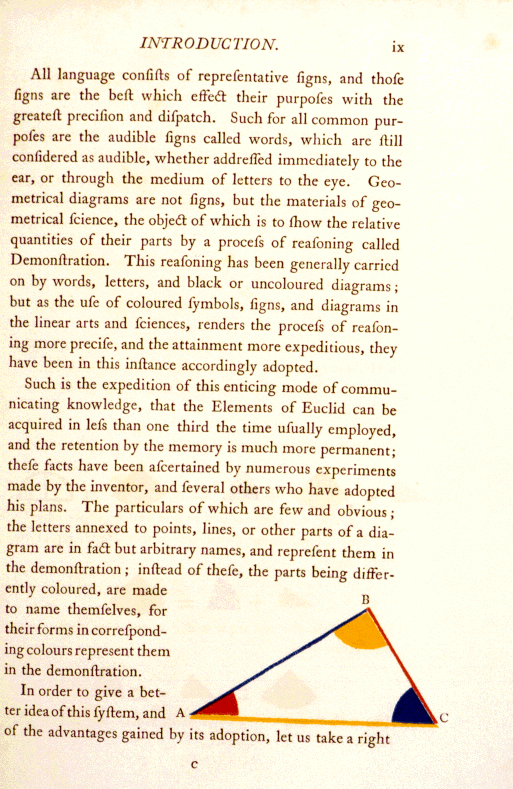
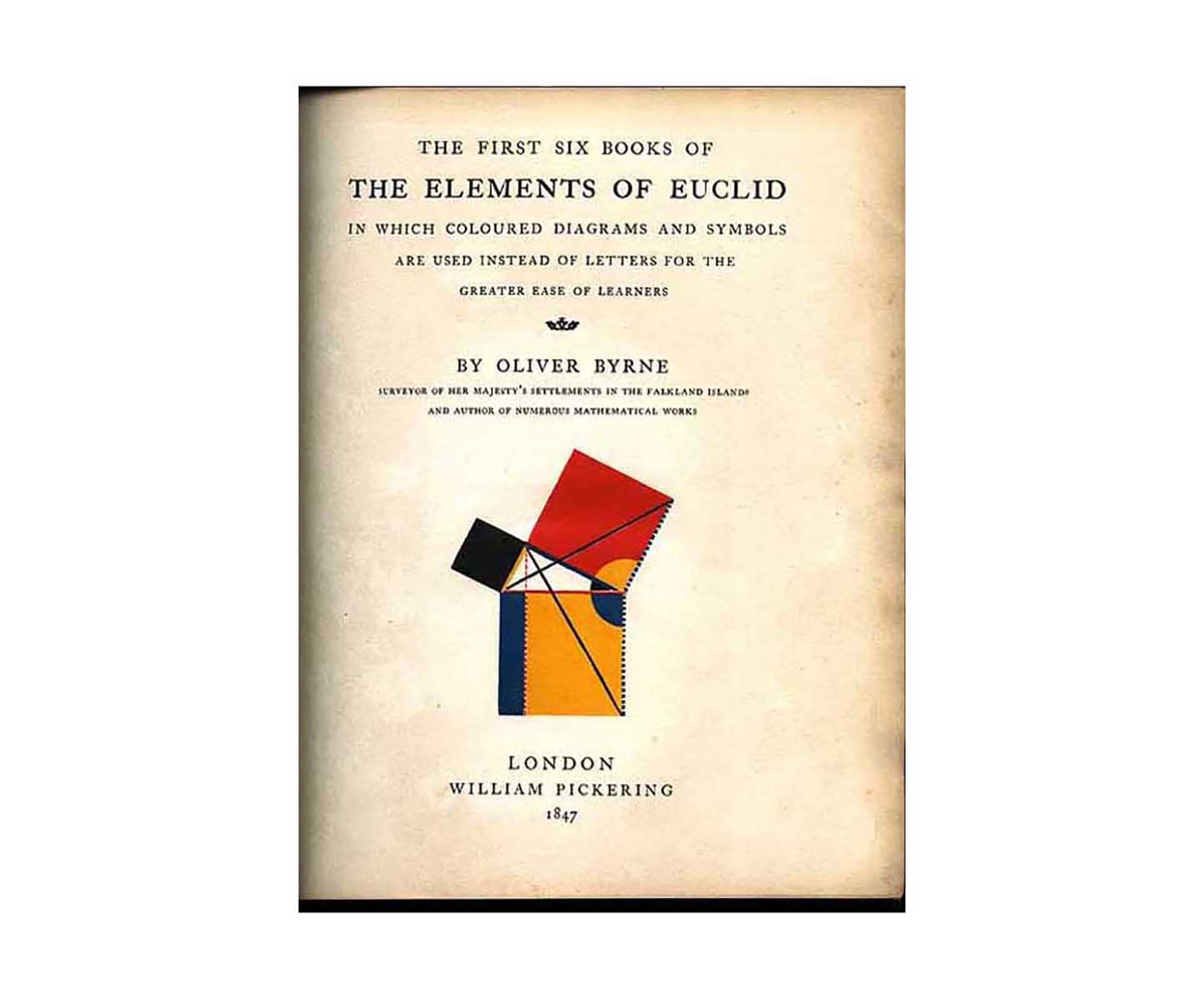
Oliver Byrne (1847/2010). The First Six Books of the Elemensts of Euclid with coloured diagrams and symbols. London: William Pickering. Taschen facsimile reprint. isbn 9783836517751, boxed with Werner Oechslin’s Essay Byrne’s edition page by page html
- The figure of his page ix is on the website referred to. I do not know whether his claim about the efficiency of his teaching method is true (see the middle of the page, if you can’t read it, click on it). Page 134 is a scan on page http://www.fulltable.com/vts/b/byrne/101.jpg
- For another colourful way to present the books of Euclid, see David Joyce, below, and his website)
Stephan Körner (1960/1968/1986). The Philosophy of Mathematics. Dover.
- some older views
- m. as logic
- m. as the science of formal systems
- m. as the activity of intuitive constructions
- the nature of pure and applied mathematics
The last chapter is of special interest. The first section is on ‘exact and inexact conceptsrsquo;. Of course, this is philosophy of mathematics, not psychology of doing mathematics. It might be useful, nevertheless, to be clear about some basic issues regarding what pure mathamatics is as differentiated from applied mathematics. Or is there no such demarcation?
Morris Kline (1980). Mathematics. The loss of certainty. Oxford University Press.
- p. 94. 2/3 and 3/4 are batting averages in two games. The batting average over two games then is 5/7, not 1 and 5/12. Also, a batting average of 4/6 is not the same as an average of 2/3. Some fractions might be averages.
- p. 95: "Thus the sad conclusion which mathematicians were obliged to draw is that there is no truth in mathematics, that is, truth in the sense of laws about the real world. The axioms of the basic structure of arithmetic and geometry are suggested by experience, and the structures as a consequence have a limited applicability. Just where they are applicable can be determined only by experience. The Greeks' attempt to guarantee the truth of mathematics by starting with self-evident truths and by using only deductive proof proved futile."
- p. 92: See also Hermann von Helmholtz (1887/1930). Zahlen und Messen, in Philosophische Aufsätze. / Counting and measuring. Translated by Charlotte Lowe Bryan, with an Introduction and Notes by Harold T. Davis. New York, Van Nostrand, 1930. [not yet available on the www, as of nov 2008?]
Mathematics—I want to say—teaches you, not just the answer to a question, but a whole language-game with questions and answers.
May 2008 I bought a nice antiquarian copy, opened it, and the first thing I read was, believe it or not, the passage cited here. The book, of course, is:
Ludwig Wittgenstein (1956/1964). Bemerkungen über die Grundlagen der mathematik. Remarks on the foundations of mathematics. Oxford: Basil Blackwell. p. 173e.
The inventory will contain studies, web pages etc. that in one way or another might touch on the topic of designing mathematics/arithmetic test items. The literature on mathematics teaching is quite extensive, I will use the principle of serendipity in regard of the literature in general: items in my library or that I have seen otherwise.
September 2007 I do need a kind of basic position or outlook in tackling mathematics education and its methods of assessment. First and foremost: I will not consider as such the graduate study of mathematics. For my item design purposes mathematics will be the discipline that is used by other disciplines in one way or another, or used by normal people in daily life in one way or another. One important way mathematics is used is in teaching mathematics, and therefore also in learning mathematics. Other sciences than mathematics proper will have significant things to say about the uses made of mathematics, and some mathematicians do not like that idea.
This position in no way detracts from the essence or the importance of mathematics. As you might have seen already in the introduction to my physicseducation.htm page, mathematics might be the only instrument available to describe the phenomena that a particular discipline studies. For example in the case of free fall in physics: the only way to 'understand' free fall is through the mathematical desciption that is adequate to its phenomena, simply because there is not a mechanistic 'cause' of free fall that might explain free fall. Does this sound a bit involved? That does not matter, I will in this page as well as in 'Designing test items' return to this kind of issue again and again.
See also my web page Wiskunde in de overgang van vwo naar wo.
Peter Lehrer mp3
Aha
[December 2007]
Having searched the math education literature for over a year now, I am stuck with a lot of interesting material, without the crucial insight into the nature of (the relation between) mathematics, education, and learning that I was looking for. And then there is this chapter by Rafael Núñez (2007 pdf), containing the exact ingredients of the analysis that is pertinent to the place of mathematics in education. The ingredients being: the thoroughly metaphorical character of most of math talk, of teachers as well as of textbooks, the inconsistency between this mathematical language and math's modern formal character, the metaphors used being thoroughly human including a rich gestural 'vocabulary' that itself is displayed without the actor (the math teacher) being even aware of it.
A prototype example of this kind of metaphor is that of time: TIME PASSING IS MOTION OF AN OBJECT, and TIME PASSING IS MOTION OVER A LANDSCAPE. The time line concept. Language expressions like: Christmas lies ahead. Etcetera. Of course, time is not something that 'moves', nor do we ourselves 'move' in time. Moving is a spatial concept. Its use in connection with time is metaphorical. What about mathematics? Mathematics is about static concepts, yet math talk is thoroughly dynamic. Núñez presents limits and its modern epsilon-delta ε-δ method as an example. Nothing is moving here, yet it typically is 'explained' using motion methaphors. Indeed, the older concept of limits was based on the natural concept of continuity, in the nineteenth century to be replaced by the Cauchy-Weierstraß ε-δ method. The deeper problem involved here is that the older concept, allowing natural talk about movement, is quite another concept than the static one using the ε-δ method. The big mistake in math education is to regard the older concept as merely an imprecise version of the later one. It is a big mistake, because the older concept and its dynamic language does possess quite a different inferential structure from that of the modern ε-δ concept of limits. In that way students are in a constant state of bewilderment. Fantastic. Of course, limits is not the only subject suffering from a big divide between formal and informal language, and corresponding concepts.
In passing, Núñez also explains why I am not able to understand the work of Hans Freudenthal (1973, see below) on the didactics of mathematics education. Freudenthal, like many mathematicians, fails to recognize that the older concept of limits is quite another concept than that using the ε-δ method; if only we explain the latter better, students will see how their old ideas about continuity etcetera are imprecise, and had better be replaced with the ε-δ concept. The Freudenthal idea is: here is my formal mathematics, I will explain it to you in as clear a way as possible, just learn it. But that is not how the human mind works! [Yes, indeed, Freudenthal despised psychology, much to his detriment, and that of his many followers].
Look for publications from the research line established by Lakoff and Núñez—his publications web page—that are available for free download or download from questia.com.
Rafael Núñez (2007). The cognitive science of mathematics: Why is it relevant for mathematics education? pdf In Richard Lesh, Eric Hamilton and James J. Kaput, Foundations for the future of mathematics education (pp. 127-154). Erlbaum contents
Stanislas Dehaene (1997). The Number Sense. How the Mind Creates Mathematics. Oxford University Press. isbn 0195110048
info newer revised edition
characteristics of the discipline
Euclid's elements of geometry. The Greek text of J. L. Heiberg (1883-1885) from
Euclidis Elementa, edidit et Latine interpretatus est I. L. Heiberg, in aedibus B. G. Teubneri, 1883-1885. Edited, and provided with a modern English translation, by Richard Fitzpatrick. isbn 978-0-6151-7984-1 (printing on demand, see website Fitzpatrick
site), online for free 8 Mb on that site
pdf or (Lulu)
pdf
Mathematics is a special discipline, even a highly idiosyncratic one. Mathematics as a science went its own way in the 19th century, for England at the end of the 19th century. Until then, at least in England, at least in Cambridge, it was almost identical with math education at Cambridge. The split was one between math in education, and math as a science itself, and has been beautifully described by Joan S. Richards (1988) (quotations and annotations: http://www.benwilbrink.nl/literature/richards.1988.htm).
Another split is that between physics as a science, and mathematics as a science. Mathematical physics is the territory of attraction and repulsion.
The point I am trying to make is the following. Mathematics might be an extreme example of a great divide between the science itself, and what is called arithmetics and mathematics in education, possibly even in university curricula, or mathematics curricula themselves. In spite of the great divide, mathematicians continue to influence the mathematics as taught in secondary schools and tertiary institutions, even the arithmetics as taught in primary schools, through scores of special commissions manned almost exclusively by mathematicians, through their professional organizations, and labor market mechanisms favoring the professional mathematician. Nothing wrong with all those institutional forces in itself, of course. Yet this state of affairs might be a scenario for disaster as far as the educational curriculum is concerned, and disastrous signs should be visible in much of serious educational research on math education, math educators, the education of math educators, math education's results and failures, and the connectedness of math education with other disciplines in the curriculum, or the lack of connectedness. And math education's techniques and methods of assessment of students, of course. Most actors in the field will be aware of the existence of grave educational problems, without necessarily being able to pinpoint exactly what they are and what the mechanisms behind them might be. It might take a few outsiders, such as Thorndike in the beginning of the last century, to articulate the issues and point to promising ways to address them.
Mathematics as a discipline is not special in having this kind of problem in the relations between its scientific progress, and its implementation in educational curricula, but it surely is the one having them in a very pronounced way. That makes it the choice discipline to go looking for the kind of educational derailments that in the very long run might follow from mathematical powerplay. In the very long run: developments extending over many decennia tend to be somewhat invisible to the actors involved, as well as to society at large, because of a natural human tendency to accept as normal what one has known to be the case for as long as one's own educational career. Again, the history of the Mathematical Tripos in the nineteenth century, and ultimately the demise of the ranking of the students in 1907 is a prime example (Richards, 1988). Or take the phenomenon so rightly criticized by Hans Freudenthal: to construct math curricula by rather straightforwardly projecting academic mathematics into it, without any serious didactictal or psychological reflection, let alone empirical evidence of the appropriateness of the resulting courses.
The broader issue then is not only that of a folk mathematics unconnected to the mathematics that properly might figure in the educational curriculum, but also the failure the other way around: the absence of a proper mapping of scientific mathematics on the needs of the educational curriculum, be it primary, secondary or even tertiary education.
Not being a mathematician myself [I have had a sturdy math program in secondary education, and the beginnings of a course in econometrics, though] I will have a hard time to come to grips with the issues indicated above. If you think you can give me a useful hint, please do. If you find some of my material useful in one way or another, please let me know. If it is your conviction that some of this or even all of this is bulshit, please let me hear your reasons why. [Until may 2008: no response. For reasons I do not understand, these pages in English, coded as English in the HTML lingo, receive no hits at all from the Anglo-American world. And maybe my Dutch landgenoten do not like to read English?]
Paolo Mancosu, Klaus Frovin Jørgensen and Stig Andur Pedersen (Eds) (2005). Visualization, Explanation and Reasoning Styles in Mathematics. Synthese Library vol. 327. Springer contents — books.google example pages {I have not yet studied this books. For the amazingly relevant chapters see the contents. Relevant: to my quest that is. b.w.]
Paolo Mancosu (Ed) (2008). The Philosophy of Mathematical Practice. Oxford University Press.
- An expensive book. I have not yet had the opportunity to read in it.
- contents
Daniel L. Schwartz, Taylor Martin and Jay Pfaffman (2005). How mathematics propels the development of physical knowledge. Journal of Cognition and Development, 6, 65-88. pdf
- "Three studies demonstrated the value of number and mathematics for 9- to 11-year-old children’s development of physical understanding of the balance scale."
direct hits
See the Aha paragraph above.
The search for 'folk math' concepts will probably not be as easy as that for 'folk physics' concepts. In the field of statistics, a special branch of mathematics, a lot of relevant research is known, see below. In mathematics 'proper,' such is not evidently the case. But what, then, is 'proper'? Mathematics used to be one-of-a-kind with physics, in the good old days of Galilei, Huygens, Leibniz, and Newton. It has artificially been detached from its realistic domains. I am beginning to suspect that the search for naive conceptions of mathematics might most profitably be on exactly its aloofness from the world (Lave, 1988, and his Adult Math Project, is one such search). My search has only just begun, there still is a lot of hope I will find what I am looking for. There are a number of specialised journals in math education, not only the English ones, that I have not yet seen, or do not even know the existence of. I will skim the contents of a number of them. What about Google, does 'folk math' result in any hits?
Mathematics being insulated from the real world makes it rather special, though. The exception is everything probable ( = mathematical statistics), of course. Arithmetic is another exception, let's say whatever mathematics that is being taught in primary education. Most of mathematics in secondary and higher education is unconnected to real life experiences of students. That might be the reason that Talia Ben-Zeev and Jon Star (2001) find occasion to speak of intuitive or folk mathematics only in the sense of intuitions formed in education itself. What is interesting about this notion is that it might open up possibilities to study folk concepts - in particular intuitive mathematics - in a kind of natural laboratory: the school context. It's a pity not much relevant research seems to be available, quite in contrast to research on intuitive arithmetics.
C. Lebiere (1999). The dynamics of cognition: An ACT-R model of cognitive arithmetic. Kognitionswissenschaft, 8, 5-19 pdf
- The Ph.D. dissertation itself is available also at http://act-r.psy.cmu.edu/?post_type=publications&p=13870
- abstract "Cognitive arithmetic studies the mental representation of numbers and arithmetic facts and the processes that create, access, and manipulate them. The contradiction between the apparent straightforwardness of its exact formal structure and the difficulties that every child faces in mastering it provides an important window into human cognition. An ACT-R model is proposed which accounts for the central results of the field through a single simulation of a lifetime of arithmetic learning. The use of the architecture’s Bayesian learning mechanisms explains how these effects arise from the statistics of the task. Because of the precise predictions of the simulation, a number of lessons are derived concerning the teaching of arithmetic and the ACT-R architecture itself. A formal analysis establishes that the simulation can be viewed as a dynamical system whose ultimate learning outcome is fundamentally dependent upon some architectural parameters. Finally, an empirical study of the sensitivity of the simulation to its parameters determines that the values that yield the best fit to the data also provide optimal performance. The implications of these findings for the fundamental adaptivity of human cognition are discussed."
- Well, this is more or less the cognitive theory of arithmetics as learned and practiced in schools (in life). The ACT-R model has been developed over the last 40 years by John Anderson and his colleagues and students.
- For a recent description of the ACT-R model see John R. Anderson (2007). How can the human mind occur in the physical universe? Oxford University Press.
- The dedicated website http://act-r.psy.cmu.edu/ has numerous papers and publications, many of which are available for download.
Kinga Morsanyi and Denes Szucs (2014). Intuition in Mathematical and Probabilistic Reasoning. abstract [pdf downloaded via https://qub.academia.edu/KingaMorsanyi February 19 2015]
Although the concept of intuition might be associated with something puzzling, uncontrollable, and unconscious, and students might be unaware of the sources of their intuitive preferences, this does not mean that intuition has to be a mystery for researchers and educators. In fact, intuitive tendencies are based on students’ personal experiences and their (explicit and implicit) learning history. Intuitive tendencies also tend to be similar across individuals. Whereas teaching students about the normative rules of mathematics and probability is essential, educational and training efforts should also aim to develop the right intuitions, together with an awareness of when and how these intuitions can be employed successfully.
from the Summary and Conclusion
Rafael Núñez (2007). The cognitive science of mathematics: Why is it relevant for mathematics education? pdf In Richard Lesh, Eric Hamilton and James J. Kaput, Foundations for the future of mathematics education (pp. 127-154). Erlbaum contents
- This chapter is an introduction to a line of research that goes right to the heart of the question why it is that mathematics is such a troublesome subject in education. I must not exaggerate this, of course, the troublesome didactics of mathematics is not a one-cause-issue. Some items from this line of research:
- George Lakoff and Rafael Núñez (2000). Where Mathematics Comes From: How the Embodied Mind Brings Mathematics into Being. New York: Basic Books.
- Introduction and first 4 chapters available as pdf on the Núñez site
- George Lakoff and Rafael Núñez: Reply to Bonnie Gold's review of "Where Mathematics Comes From: How the Embodied Mind Brings Mathematics into Being" html MAA Online. There is a difference between mathematics proper, and the cognitive science of mathematical ideas. A difference that is not always easy to understand, especially so for mathematicians. This particular kind of misunderstanding is also frustrating the field of didactics of mathematics, of course: this didactics is not itself part of mathematics, it is educational psychology etcetera. It does not help at all that some mathematicians do not understand very well what makes the empirical sciences different from that of mathematics.
-
Rafael Núñez (2004). Do real numbers really move? Language, thought, and gesture: The embodied cognitive foundations of mathematics. scan In Fumiya Iida, Rolf Pfeifer, Luc Steels and Yasuo Kuniyoshi (Eds). Embodied artificial intelligence. Springer.
- George Lakoff and Rafael Núñez (1997). The Metaphorical Structure of Mathematics: Sketching Out Cognitive Foundations for a Mind-Based Mathematics. In L. English, Mathematical Reasoning: Analogies, Metaphors, and Images (pp. 21-89). Erlbaum. questia
-
Rafael Núñez, Laurie D. Edwards and João Filipe matos (1999). Embodied cognition as grounding for situatedness and context in mathematics education. Educational Studies in Mathematics, 39, 45-65. pdf
-
Rafael Núñez and George Lakoff (1998). What did Weierstrass really define? The cognitive structure of natural and ε-δ continuity. Mathematical Cognition, 4, 85-101. pdf
-
Rafael Núñez(1994). Cognitive development and infinity in the small: Paradoxes and consensus. In A. Ram and K. Eiselt, Proceedings of the 16th Annual Conference of the Cognitive Science Society (pp. 670-674). Erlbaum. pdf
- How do 12 till 14 year old children respond to one of Zeno's paradoxes?
-
Jim Kaput (1979). Mathematics and learning: Roots of epistemological status. In J. Lockhead and J. Clement, Cognitive process instruction (pp. 289-303). Philadelphia: Franklin Institute Press. questia
- Jim Kaput cv and publications
- Illustrations used by Jim Kaput in this chapter: " The symbol system of mathematics denies the reality or importance of the knower-learner. Our use of mathematical equality systematically denies the process/product distinction, a distinction that is fundamental and real in the universe of human knowing. It also denies the various and distinct heuristic/ linguistic functions of equality.
The processual meaning of mathematical operations is achieved through an essential, yet covert and unacknowledged, act of anthropomorphism, a projection from our internal cognitive experience onto the timeless, abstractstructural mathematical operations. (This includes, for example, operations in arithmetic, algebra and calculus.) In some respects this anthropomorphism acts as a metaphorical "structure preserving mapping," a morphism.
The basic, irreducible and essential metaphoric nature of human thinking has only an accidental, unacknowledged, and denigrated role in mathematics. As it is in any circumstance, the metaphorizing process in mathematics is our primary means for creating and, especially, transferring meaning from one universe to the other. However in mathematics this process is forced into a smuggling and bootlegging role, and never acknowledged for its crucial function. For example, virtually all of basic calculus (the study of change) achieves its primary meaning through an absolutely essential collection of motion metaphors. These metaphors control the notation. Hence we write limit statements using arrows and use image-laden words such as 'diverge,' 'converge,' 'increasing,' "'constant,' and 'transform.' However, the formal mathematical definitions associated with these notations, being atemporal, are not connected to motion."
Absolutely a direct hit. This analysis is what inspired Núñez.
Wim van Dooren, Dirk de Bock, Dirk Janssens and Lieven Verschaffel (2008). The linear imperative: An inventory and conceptual analysis of students' overuse of linearity. Journal of Research in Mathematics Education, 39, 311-342.
- abstract "(. . .) This article provides an overview and a conceptual analysis of students' tendency to use linear methods beyond their applicability range."
James Stigler (1997). Lessons in perspective: How culture shapes math instruction in Japan, Germany and the United States. pdf Zie vooral http://www.timssvideo.com
- “The new study that I want to talk with you about today is the video component of the Third International Math and Science Study (TIMSS). This study was conducted in 41 different countries, examining student achievement in fourth, eighth and twelfth grades. As part of this study, the U.S. decided to do something that had never been done before: they took a national probability sample of teachers in three countries—the U.S., Germany and Japan—and videotaped them teaching in their classrooms.”
- Hilary Hollingsworth (2004). From research to practice: Using the TIMSS Video Study findings to enhance Australian mathematics teaching.Paper at the Mathematics Association of Western Australia (MAWA) 2004 Conference. pdf “The broad purpose of the TIMSS 1999 Video Study was to investigate and describe Year 8 mathematics and science teaching practices in a variety of countries, including several with varying cultural traditions and with relatively high achievement on TIMSS assessments. Countries participating in the mathematics component of the TIMSS 1999 Video Study were Australia, the Czech Republic, Hong Kong SAR, Japan, the Netherlands, Switzerland, and the United States.” “One of the core findings of the TIMSS 1999 Video Study is that there is no single method for teaching mathematics across countries; different methods of teaching can lead to high achievement. ”
Mark Levi (2009). The mathematical mechanic. Using physical reasoning to solve problems. . - sample chapter 1
- Pythagorean Theorem (fragment from chapter 2) pdf
- About the artificial demarcation of problems mathematical and problems physical. The idea is not a new one, Levi refers to Polya’s Mathematics and plausible reasoning, Volume 1. Levi’s book is a gem.
Amy B. Ellis (2007). The influence of reasoning with emergent quantities on students' generalizations. Cognition and Instruction, 25, 439-478.
- abstract
- Subject: what it means to reason algebraically.
Stellan Ohlsson & Ernest Rees (1991). The function of conceptual understanding in the learning of arithmetic procedures. Cognition and Instrction, 8, 103-179.
Robyn Arianrhod (2005). Einstein's Heroes: Imagining the World Through the Language of Mathematics. Oxford University Press.
- This is an unexpected 'direct hit.' Somewhat out of character, this is a popular book. Never mind, it is delightful. What makes it a direct hit is its exposition of the interplay between mathematics and physics, using the lives and work of Newton, Farady and Maxwell (and some others, such as Galilei and Einstein).
- As far as the mathematics is concerned, a number of points are of specific interest:
- The first point is Galileo trying experimentwise to improve upon the gravitation theory of Aristotle, mathematising his results.
- The second point is the power of the Newtonian laws of motion, adequate to the empirical data on the orbits of the planets, to predict the existence and location of a new planet Neptune. Almost two centuries later, but I will not start nit-picking the point made here. Is this the power of mathematics?
- The theory of Newton can still be understood in physical terms, if one is prepared to look away from the disturbing fact that the working of gravitational force is a complete unknown. Mathematical terms seem to map into physical concepts, and vice versa.
- The third point: Faraday has powerful intuitions about electro-magnetism, he does not know anything of mathematics however (except some geometry).
- The fourth point: along comes Maxwell, recognizing the power of Farady's 'field' construct. Maxwell invests heavily in mathematizing the electro-magnetic 'field.' To get thing going he uses the imagery of mechanical devices, a lot of them: the 'ether' (not his own invention). He intentionally uses only emprical physical facts to base his mathematics on, succeeds in doing so, and never again mentions any 'ether.'
- The intriguing thing now is that it seems not to be possible to call Maxwell's mathematics a 'mathematical model' of something called 'electromagnetic fields.' The 'field' concept was a useful analogue, suggested by the filings pattern in strong magnetic fields, but there is nothing mechanical one might call a 'field.' This mysterious 'field' is what the mathematics says, nothing more. What baffles me, as a psychologist, is that Maxwell’s mathematical theory of electromagnetism is not something that can be 'understood' by mapping the mathematics on the real world. Of course, there is a lot left that one can try to understand about electromagnetic phenomena, including the fact that Maxwell’s theory has been able to predict new phenomena (radio waves, for example), just like the existence of Neptune was predicted from the mathematics of Newton's theory.
- Can you see what this implies? How is it possible to teach children the basic concepts of physics and mathematics, without inducing hosts of misunderstandings? Robyn Arianrhod does not go into this question, of course. It would take her at least one other book. Would be lovely, though, to have her view on this problem.
Catherine Sophian (2007). The origins of mathematical knowledge in childhood. Lawrence Erlbaum. [for an annotation see here
In physics the didactical problem as located by Slotta and Chi (2006 pdf) (see also physicseducation.htm) centers on the specific character of its theoretical concepts being emergent processes, not material substances. Ben-Zeev and Star (2001) (see below) refer to this line of research, but they do not see any direct implications for the didactics of mathematics as well. Regrettably, there does not seem to be research exploring this possible connection. My intuition about the possible link is rather straightforward: historically the attempts to describe and research these emergent processes (light, force, speed, mass, to mention some physics concepts) were the occasion to invent or develop the mathematics (for example: the calculus) enabling one to do so. Therefore the mathematics concerned should somehow or other be taught in its proper context, isn't it? That context being: emergent processes. A lot of other disciplines, such as psychology, economics, sociology, know these emergent processes as well. A particularly interesting one is the way experience is being grafted into neural networks, allowing later to 'remember' it.' In many cases one or another branch of statistics is used to describe or research these emergent processes.
Therefore, the work of Slotta and Chi must tell us also something about the possibilities to develop a 'true didactics' for the mathematical topics involved. Do not assume this applies only to the calculus, why should not the number concept itself be studied as an 'emergent' concept? Maybe it is not, then why should that be so, and what can we learn from that result about the way kids might learn it (research by, among others, Susan Carey, see her site)?
What import does this quest for the lost grail have? Lots of kids, pupils and students loose their interest in mathematics while in school, high school or college. This loss of interest results from a number of different causes, is itself therefore an 'emergent process,' one of the causes being the perennial problem of the very high levels of abstractness of mathematics course content, another cause undoubtedly is mathematics' hidden curriculum (ab)use to sort kids, pupils or students into different classes of intellectual abilities. The losses to individuals as well as to society at large, resulting from these stultifying causes of mathematical 'drop out,' are enormous. If bad didactics enables these kinds of abuse of the mathematics curriculum, we should try to change the didactics. An adequate didactical theory would be very helpful in developing an instructional design theory that is adequate to the task of empowering almost all students with adequate mathematical intuitions (in Ben-Zeev and Star's (2001, see below) terms). Such a theory being available, the design theory for achievement test items will follow suit. What is more: designing test items according to such a design theory will invite instruction and instructors to practice these better didactics. I am sure many experimental courses nowadays are using some of these didactical insights I am looking for in this webpage.
A significant part of the literature on teaching mathematics and researching teaching mathematics has been published by Lawrence Erlbaum, and is available in the data base questia.com for online reading. If you are not a member, it is always possible to read contents, and first pages of chapters and articles. If need be, for reading from cover to cover, a free online period of seven days is available.
topics and key publications or key researchers/projects
core knowledge: Feigenson, Dehaene & Spelke (2004) pdf
(cardinal) number: Carey (2004) pdf; Corre, Brannon, Van de Walle & Carey (2006) look for a copy on this site
rational number: Mack (1993) here; Carpenter, Fennema & Romberg (1993) here
proportion and ratio: Singer, Kohn & Resnick (1997) here; Empson (1999) here
adding and multiplying: Lebière and Anderson (1998) here; Lebière (1998) here; Riviera, Reiss, Eckert and Menon (2005). pdf
word problems: Verschaffel, Greer and De Corte (2000) here
procedural and conceptual knowledge (algorithms versus understanding): Zamarian, López-Rolón and Delazer (2007) here
understanding: Reif & Allen (1992) here
math text book 1st college: Daepp and Gorkin (2003). Kevin Houston (2009)
algebra: Brizuela & Schliemann (2004) here
geometry: Robin Hartshorne (1997/2000) Geometry: Euclid and beyond. Hafner/Dover. isbn 0486605094
calculus: Boyer (1949/1959) The history of the calculus and its conceptual development.
statistics: Garfield (2002) pdf
applications = mathematical models of phenomena in the world: Suppes (2002) Representation and invariance of scientific structures. pdf 8 Mb
axiomatics, formalism: Patrick Suppes (2002). Representation and invariance of scientific structures. pdf 8 Mb
intuitive mathematics: Fischbein (1987) The intuitive sources of probabilistic thinking in children.; Ben-Zeev & Star (2001) pdf
intuition: Gerd Gigerenzer (2007). Gut feelings; Robin M. Hogarth (1993). Educating intuition
philosophy: Kitcher (1984) The Nature of Mathematical Knowledge; Mancosu (2008)? The Philosophy of Mathematical Practice.
psychology of knowing/doing/explaining mathematics
psychology: Sternberg & Ben-Zeev (Eds) (1996) The nature of mathematical thinking questia
didactics: Bransford, Brown & Cocking (1999) How People Learn: Brain, Mind, Experience, and School html; constructivisme: zie constructivisme.htm; Enzensberger (1997) Der Zahlenteufel. Ein Kopfkissenbuch für alle, die Angst vor der Mathematik haben. [The number devil].
epistemological beliefs
assessment: Kulm (1990)? Assessing Higher Order Thinking in Mathematics questia; Schoenfeld (2007) Assessing mathematical proficiency pdf
history: John Fauvel and Jan van Maanen (2000) — Fibonacci (1202) Liber abaci translated by Sigler (2002). — Ellerton & Clements (2013). Rewriting the History of School Mathematics in North America 1607-1861
Cambridge Mathematical Tripos: Richards (1988) Mathematical visions. The pursuit of geometry in Victorian England.
situatedness: [ ideology; pseudoscience ] Lave, 1988; Anderson, Reder & Simon (1996, 2000) pdf & html; Watson and Winbourne (2008); Anna Sfard (2008) here; Kelso (1995)
isolatedness: Doorman (2005) Modelling motion: from trace graphs to instantaneous change access to chapter pdf's
'math wars': Klein (2007) The state of the state math standards 2005
math disabilities: Geary (1993) pdf; Berch & Mazzocco (2007) Why is Math So Hard for Some Children? The Nature and Origins of Mathematical Learning Difficulties and Disabilities contents
TIMSS home international
Small children do have a lot of intuitive understanding of numbers, proportions, etcetera (protoquantitative conceptions). It might just be the case that instructional methods emphasize too early and too much the working with numbers, instead of with the intuitions (for example: Singer, Kohn and Resnick, 1997). What makes me think so? Research on word problems (Verschaffel et al. 2000) shows that school arithmetics is quite different from the mathematics people like you en me need in daily life, or in professional life for that matter. Something has gone sour in education, probably already very long ago. Take a look at an arithmetics book from the 15th or 16th century, and you will begin to suspect that the emphasis on algorithmically working with numbers, as contrasted with understanding what one is doing while performing the algorithm, was already formly established, and never since has that been changed in any fundamental way.
The table above of topics and key publications is only for starters. I will add topics, and replace preliminary choices of key publications with better ones. Some keys function better than others, no offense intended. Remark that the point of departure defnitely is not a mathematical, but an empirical psychological one, make it neuro-psychological if you like that better. After all, there is very little 'mathematical' in the arithmetics in primary education. The same goes for the algebra, calculus and geometry of secundary education. Quite another thing is that teachers need some grounding in mathematics proper, to prevent them from doing some crazy things with the children we entrust them. I am somewhat preoccupied by the mathematics as taught in primary and secundary education. My hunch is that especially here a lot of things can and do go wrong in severe ways. Mathematics at tertiary and university levels might have some specific problems also, but I have not seen much research yet that touches on the contrast between naive conceptions and the scientific ones.
It might be the case that intuition in arithmetics does not pose the kind of problems intuition in physics does, meaning that it might be possible to build arithmetics education on those very intuitive concepts. The case reminds one of that in the field of decision-making: formal decison-making is quite different from intuitive decision-making, formal methods are rather complex while intuitive ones are rather simple, and yet intuitive methods might give results that are nearly as good as the formal ones (or veen better, recognizing the cost of formal methods?). See for example the work of Gigerenzer, or early publications by Herbert Simon on bounded rationality.
-
Gerd Gigerenzer (2007). Gut feelings. Penguin.
-
Robin M. Hogarth (2001). Educating intuition. The University of Chicago Press. isbn 0226348601
Hugh Burkhardt (2007). Mathematical Proficiency: What Is Important? How Can It Be Measured? In Alan H. Schoenfeld: Assessing mathematical proficiency (77-97). Cambridge University Press. pdf .
- Examples of non-trivial assessment of mathematics.
- Illustrates work from institutions that otherwise is rather inaccessible.
- Burkhardt describes what is possible. For empirical support he does not mention sources in the research literature.
Schoenfeld, A. H. (1992). Learning to think mathematically: Problem solving, metacognition, and sense-making in mathematics. In D. Grouws (Ed.), Handbook for Research on Mathematics Teaching and Learning (pp. 334-370). New York: MacMillan. pdf
Anne Watson (2006). Raising achievement in secondary mathematics. Open University Press. website [I have not seen the book yet, there is an eBook as well as a softpver edition. Research articles on the subject may be available for download on Anne Watson's home page]
Candia Morgan & Anne Watson (2002). The interpretive nature of teachers' assessment of students' mathematics: issues for equity. Journal for Research in Mathematics Education, 78-107. first page only
Anne Watson (2004) Red herrings: post-14 ‘best'’ mathematics teaching and curricula. British Journal of Educational Studies pdf
Anne Watson & Els De Geest (2005) Principled Teaching for Deep Progress: Improving mathematical learning beyond methods and materials. Educational Studies in Mathematics 58, 209-234 pdf
- “In this paper we report on a project to improve attainment in mathematics among low attaining secondary students. (. . .) The main aim of the paper is to report the practices of teachers involved in the project and the complexities of identifying what was common about the teaching which led to improved engagement and learning.”
Alan H. Schoenfeld (Ed.) (2007). Assessing mathematical proficiency. Cambridge University Press.
- Chapters are available for download here
- contents
- Issues and Tensions in the Assessment of Mathematical Proficiency, by Alan H. Schoenfeldpdf
- What Is Mathematical Proficiency? by R. James Milgram, 31-58 pdf
- 5. What Is Mathematical Proficiency and How Can It Be Assessed? by Alan H. Schoenfeld, 59-73 pdf
- 6. Mathematical Proficiency: What Is Important? How Can It Be Measured? by Hugh Burkhardt, 77-97 pdf
- 7. Aspects of the Art of Assessment Design, by Jan de Lange, 99-111 pdf
- 8. Mathematical Proficiency for Citizenship, by Bernard L. Madison, 111-124 pdf
- 9. Learning from Assessment, by Richard Askey, 125-136 pdf
- 10. When Assessment Guides Instruction: Silicon Valley's Mathematics Assessment Collaborative, by David Foster, Pendred Noyce, and Sara Spiegel, 137-154 pdf
- 11. Assessing the Strands of Student Proficiency in Elementary Algebra, by William G. McCallum, 157-162 pdf
- 12. Making Meaning in Algebra: Examining Students' Understandings and Misconceptions, by David Foster, 163-176 pdf
- 13. Task Context and Assessment, by Ann Shannon, 177-191 pdf
- 14. Learning About Fractions from Assessment, by Linda Fisher, 195-211 pdf
- 15. Assessing a Student's Mathematical Knowledge by Way of Interview, by Deborah Loewenberg Ball with Brandon Peoples, 213-267 pdf video
- 16. Reflections on an Assessment Interview: What a Close Look at Student Understanding Can Reveal, by Alan H. Schoenfeld, 269-277 pdf
- 17. Assessment in France, by Michèle Artigue, 283-309 pdf
- 18. Assessment to Improve Learning in Mathematics: The BEAR Assessment System, by Mark Wilson and Claus Carstensen, 311-332 pdf
- 19. English Learners and Mathematics Learning: Language Issues to Consider, by Lily Wong Fillmore, 333-344 pdf
- 20. Beyond Words to Mathematical Content: Assessing English Learners in the Mathematics Classroom, by Judit Moschkovich, 345-352 pdf
- 21. Assessment in the Real World: The Case of New York Ci ty, by Elizabeth Taleporos, 345-355 pdf
- 22. Perspectives on State Assessments in California: What You Release Is What Teachers Get, by Elizabeth K. Stage, 357-363 pdf
J. Singer, A. Kohn and L. B. Resnick (1997). Knowing about proportions in different contexts. In P. Bryant and T. Nunes: Learning and teaching mathematics: An international perspective (pp. 115-132). Hove, England: Psychology Press.
- "This chapter proposes that children's knowledge of proportions is composed of three distinct components. At the direct level, children have an immediate, non-analyzed understanding of proportions via a perceptual or analogous process. At the covariational level, children know something about variables and how they may covary, either directly or inversely. At the formal level, children know how to manipulate numbers and variables to describe proportional relationships between entities. This conception of proportional knowledge helps explain why children sometimes behave appropriately in proportional reasoning tasks and sometimes do not; that is, different tasks tap different kinds of knowledge." p. 116: The issue in this chapter is whether "children can first reason protoquatitatively about situations involving proportions or ratios and later carry this knowledge into quatified, mathematically exact forms of representation and reasoning. (. . .) We present evidence of intuitive schemas for reasoning about densities and rates—both of which count as protoquatitative forms of reasoning about ratios and proportions—but also suggest that quantification of these schemas does not proceed smoothly or directly." The authors then use a distinction (Schwartz) between extensive and intensive quantities, the first being of the kind that add (apples, lengths), the second of the kind that mixes (temperatures, densities, and especially rates), but I am way too sloppy now.
- protoquantitative schemas is one of the theoretical ideas. See also Resnick & Singer (1993). Protoquantitative origins of ratio reasoning. In T. Romberg: Rational numbers: An integration of research (pp. 107—130). Hillsdale, Erlbaum. questia
- For a recent paper in this line of research see Olof Bjorg Steinthorsdottir (2005). Girls journey towards proportional reasoning. pdf
James W. Stigler and Ruth Baranes (1988). Culture and mathematics learning. In Ernst Z. Rothkopf: Review of research in education volume 15 1988-89. (253-306). Washington, D.C.: American Educational Research Association.
Lyle V. Jones (1988). School achievement trends in mathematics and science, and what can be done to improve them. In Ernst Z. Rothkopf: Review of research in education volume 15—1988-89. (307-341). Washington, D.C.: American Educational Research Association. [Jstor]
Jean Lave (1988). Cognition in practice. Mind, mathematics and culture in everyday life. Cambridge University Press.
- Kind of anthropological approach to research the mathematics people use in everyday situations, such as cooking, shopping. The empirical material probably is fascinating, the theorizing less so.
- catch phrase: situated learning; the thousand ways word problems tend to go wrong in instruction (Verschaffel a.o. 2000) result from situated learning aspects of instruction instructors typically do not notice.
- This book is a much cited one, not quite deservedly so. It ridicules a lot of good scientific thinking and research, declaring situatedness the one and only circumstance that is important in learning, or cognition, for that matter. The book is a position statement, not a stern report on a particular line of research. The theme surely is fascinating, and there is a lot of truth in it as far as school learning goes. It is the kind of research as reported by Verschaffel Greer and De Corte (2000) that makes clear to what extent the solving of typical word problems in arithmetics is situated in the loose sense of Lave. That extent is staggering.
- There is one topic that intrigues me, and that I would like to know more of: the way price comparisons in the school/textbook world differ from those made in the shopping malls of this real world where to most people it suffices to evaluate marginal costs of the extra number or weight of items in the larger package (p. 119: "I will get two ounces more for six cents. Is it worth it?"). The general point seems to be that there are potentially many different mathematical possibilities to model a given situation, some of them being preferred by educationalists, others by real people in real places making real choices. So much the worse for the educational tradition. The research refered to here is: Noel Capon and Deanna Kuhn (1979). Logical reasoning in the supermarket: Adult females' use of a proportional reasoning strategy in an everyday context. Developmental Psychology, 15, 450-452 (ERIC abstract: "Results showed that only 32 percent of adult female shoppers in a supermarket were able to use a proportional reasoning strategy to determine which of two sizes of a common item (size ratio 2:3) was the better buy. Performance declined when the ratio was more complex. (JMB)". And M. Murtough (1985). The practice of arithmetic by American grocery shoppers. Anthropology and Education Quarterly, 16, 186-192 (his dissertation, 1985: A hierarchical decision process model of American grocery shopping.)
- T. Nunes, A. Schliemann and D. Carraher (1993) Street Mathematics and School Mathematics. Cambridge University Press. [I have not yet seen this one]
- David Kirshner and James A. Whitson (Eds) (1997). Situated cognition. Social, semiotic, and psychological perspectives. Erlbaum. questia a.o. Philip E. Agre: Living math: Lave and Walkerdine on the meaning of everyday arithmetic 71-83. Carl Bereiter: Situated cognition and how to overcome it 281-300
- Watson and Winbourne, 2008, see below
Theodore M. Porter (1995). Trust in numbers. The pursuit of objectivity in science. Princeton University Press. UP questia
- p. viii: " My approach here is to regard numbers, graphs, and formulas first of all as strategies of communication. They are intimately bound up with forms of community, and hence also with the social identity of the researchers. To argue this way does not imply that they have no validity in relation to the objects they describe, or that science could do just as well without them. The first assertion is plainly wrong, while the latter is absurd or meaningless. Yet only a very small proportion of the numbers and quantitative expressions loose in the world today make any pretense of embodying laws of nature, or even of providing complete and accu rate descriptions of the external world. They are printed to convey results in a familiar, standardized form, or to explain how a piece of work was done in a way that can be understood far away. They conveniently summarize a multitude of complex events and transactions. Vernacular languages are also available for communication. What is special about the language of quantity?
My summary answer to this crucial question is that quantification is a technology of distance. The language of mathematics is highly structured and rule-bound. It exacts a severe discipline from its users, a discipline that is very nearly uniform over most of the globe. That discipline did not come automatically, and to some degree it is the aspiration to a severe discipline, especially in education, that has given shape to modern mathematics [Joan Richards (1988). Mathematical Visions. The Pursuit of Geometry in Victorian England. Academic Press]. Also, the rigor and uniformity of quantitative technique often nearly disappear in relatively private or informal settings.
Terezinha Nunes and Peter Bryant (1996). Children doing mathematics. Blackwell. [I have not yet seen this book, it has been referred to by Brizuela (2004). reviewed by Derek Haylock.
Lucas Michiel Doorman (2005). Modelling motion: from trace graphs to instantaneous change. CD-β Press, Center for Science and Mathematics Education. Dissertation Utecht University. access to chapter pdf's or integral text 4 Mb pdf
- "Students in secondary education experience mathematics and physics as strictly separate disciplines. They do not realise for instance that the mathematics used to describe change (calculus) is used in the topic kinematics in physics. The goal of this research was to examine whether it is possible to develop understanding of both subjects and of their mutual relationship. Furthermore, it has been examined what role computer tools could play in learning mathematics and physics."
- I have yet to study this research. Its promise is that it purports to bridge the gap that has grown in the last one or two centuries between (school) mathematics and the real world it is supposed to model. Has Doorman succeeded in developing an effective didactics that is true to the process of doing mathematics in a physics context, or doing physics is a supportive mathematics context? The historical model here might be the German research laboratory: for example Kathryn M. Olesko (1991). Physics as a calling. Discipline and practice in the Königsberg Seminar for Physics. Ithaca: Cornell University Press.
Benedikt Löwe and Thomas Müller (2005). Mathematical knowledge is context dependent. Prepublication Institute for Logic, Language & Computation, University of Amsterdam. pdf
Annie Selden and John Selden (1993). Collegiate Mathematics Education Research: What Would That Be Like? The College Mathematics Journal, 24, 431-445. pdf JStor
John R. Anderson, Lynne M. Reder, and Herbert A. Simon (1996). Situated learning and education. Educational Researcher, 25(4), 5-11. pdf
- from the abstract We review the four central claims of situated learning with respect to education: (1) action is grounded in the concrete situation in which it occurs; (2) knowledge does not transfer between tasks; (3) training by abstraction is of little use; and (4) instruction must be done in complex, social environments. In each case, we cite empirical literature to show that the claims are overstated and that some of the educational implications that have been taken from these claims are misguided.
- p. 5: "In this paper, we want to concentrate on empirical evidence and its implications for mathematics education [my emphasis, b.w.]
- Situated learning (e.g. Lave and Wenger 1991): "emphasizes the idea that much of what is learned is specific to the situation in which it is learned."
- Be aware that the authors themselves have done a lot of empirical research and theory building that is relevant to the issues discussed here.
- Their 1995 unpublished article has been published in 2000, see below. It is still available online, however the URL now is http://act-r.psy.cmu.edu/papers/misapplied.html
Edward Silver (2010). Examining what teachers do when they display their best practice: Teaching mathematics for understanding. Journal of Mathematics Education at Teachers College, 1, 1-6. gratis beschikbaar pdf
- Edward A. Silver, Vilma M. Mesa, Katherine A. Morris, Jon R. Star & Babette M. Benken (2009). Teaching mathematics for understanding: An analysis of lessons submitted by teachers seeking NBPTS certification. American Educational Research Journal, 46, 501-531.
John R. Anderson, Lynne M. Reder, and Herbert A. Simon (2000, Summer). Applications and Misapplications of Cognitive Psychology to Mathematics Education. Texas Educational Review, Summer. html
- abstract There is a frequent misperception that the move from behaviorism to cognitivism implied an abandonment of the possibilities of decomposing knowledge into its elements for purposes of study and decontextualizing these elements for purposes of instruction. We show that cognitivism does not imply outright rejection of decomposition and decontextualization. We critically analyze two movements which are based in part on this rejection--situated learning and constructivism. Situated learning commonly advocates practices that lead to overly specific learning outcomes while constructivism advocates very inefficient learning and assessment procedures. The modern information-processing approach in cognitive psychology would recommend careful analysis of the goals of instruction and thorough empirical study of the efficacy of instructional approaches.
- Anderson mentioned the article in 1996 as being submitted for publication. By 2000 Herbert Simon was deceased. The other authors: Department of Psychology, Carnegie Mellon University. Be warned: Simon is a Nobel Prize winner, Anderson is especially known by the ACT-R theory of cognition he and his colleagues developed.
Christian Lebiere and John R. Anderson (1998). Cognitive arithmetic. In John R. Anderson, Christian Lebiere, and others: The atomic components of thought (297-342). Lawrence Erlbaum. questia
- Christian Lebiere (1998). The Dynamics of Cognition: An ACT-R Model of Cognitive Arithmetic. Dissertation Carnegie Mellon University pfd. From the abstract: "Cognitive arithmetic, the study of the mental representation of numbers and arithmetic facts and the processes that create, access and manipulate them, offers a unique window into human cognition. Unlike traditional Artificial Intelligence (AI) tasks, cognitive arithmetic is trivial for computers but requires years of formal training for humans to master. Understanding the basic assumptions of the human cognitive system which make such a simple and well-understood task so challenging might in turn help us understand how humans perform other, more complex tasks and engineer systems to emulate them. The wealth of psychological data on every aspect of human performance of arithmetic makes precise computational modeling of the detailed error and latency patterns of cognitive arithmetic the best way to achieve that goal."
Susan B. Empson (1999). Equal Sharing and Shared Meaning: the Development of Fraction Concepts in a First-Grade Classroom. Cognition and Instruction, 17, 283-342. questia
- from the abstract The study provides an account of children's learning that examines the relation between classroom talk and children's evolving fraction concepts, with a focus on the analysis of several key classroom interactions that resulted in cognitive change. Pretests and posttests indicated that children's understanding of fractions changed in important ways. The results suggest that how children think about fractions is influenced not only by how their own knowledge is structured but, perhaps more profoundly, by how the context for thinking about and discussing fractions is structured.
- p. 284: " most research on children's fraction thinking is founded on models of cognition that highlight universal structures of understanding ( Behr, Harel, Post, & Lesh, 1992; Hiebert & Carpenter, 1992). These models focus on the products of understanding, downplaying the processes involved in understanding. (. . .) A burgeoning body of research posits that participation in communities of practice is fundamental to mathematical understanding ( Greeno & Goldman, 1998; Greeno & Middle-School Math through Applications [MMAP], 1997; Lave & Wenger, 1991). From this perspective, understanding is relative to participation in a community, and to understand cognitive change, we need to consider the socially organized processes that motivate activity and shape the products of thinking. "
- p. 334 (from the conclusions): How children think about fractions is influenced not only by how their own knowledge is structured but, more importantly, by how the context for thinking about and discussing fractions is structured.
Leone Burton (2004). Mathematicians as Enquirers: Learning about Learning Mathematics. Kluwer.
- "This volume reports on an empirical study with 70 research mathematicians, 35 females and 35 males. The purpose of the study was to explore how these mathematicians came to know mathematics and to match their descriptions against a theoretical model of coming to know mathematics derived from the literature of the history, philosophy and sociology of science and mathematics. The assumption underlying the research was that, when researching, mathematicians are learning and, consequently, their experiences are valid for less sophisticated learners in classrooms. The study provided major surprises particularly with respect to the mathematical thinking of the mathematicians and to the ways in which they organised their practices. It also contradicted long-standing stereotypes.
This book applies the learning from the study to learning and teaching mathematics. It offers a rationale, based on the practices of research mathematicians, to support and encourage recent school-based developments in the learning of mathematics through enquiry." - I have not yet seen the book. I am really curious.
- Leone Burton (2001). Research Mathematicians as Learners-and what mathematics education can learn from them. British educational research journal, 27, 589-600
- Leone Burton (1998). Advice to Prospective Authors - The Practices of Mathematicians: What Do They Tell Us About Coming to Know Mathematics? Educational studies in mathematics; 37, 121-144
Anna Sierpinska (1992). On understanding the notion of function, in Guershon Harel and Ed. Dubinsky: The Concept of Function: Aspects of Epistemology and Pedagogy MAA (Math. Ass of Am.) Notes (Vol. 251, 1992, pp. 25-58). [I have not yet located this one. It was referred to by Kieran, 1997, p. 133 (in Nunes and Bryant)]
Talia Ben-Zeev and Jon Star (2001). Intuitive mathematics: theoretical and educational implications. In Robert J. Sternberg and Bruce Torff: Understanding and teaching the intuitive mind: student and teacher learning. Erlbaum. pdf of concept or questia
- p. 29: " . . . can we identify a set of naive beliefs that are applied to solving abstract mathematics problems? If so, how do these intuitions hinder or facilitate problem solving? The answers to these questions have implications for both psychology and education. By examining the nature of intuitive mathematics we could help (a) improve our understanding of people's formal and informal reasoning skills, and (b) create more effective instructional materials."
- p. 30: "In this chapter, we examine the nature and origin of what we term as symbolic intuition, or the intuitive understanding of mathematical symbols that develops as a result of experience with formal and abstract school-based procedures."
- The article is a sloppy review of the field, as perceived by the authors. It is useful as an introduction to some of the literature touching on deeper questions of didactics in mathematics. It is rather superficial in its treatment of, for example, the 'what is the age of the captain' problem, a question that in fact does not allow any numerical answer, and yet many pupils obligingly will produce one. This kind of pupil behavior is not necessarily as simple as these authors tell you it is. The hidden curriculum these pupils have experienced is: all questions always have definite answers. Now here is this new question about the age of the captain, containing some numbers, none of them useful to find his age. 'What kind of game are they playing with me?' the pupil might think. Or simply: well, obviously some mistake has been made, why not use the numbers given to show my skill in adding, subtracting or multiplying them? If Jon Star is puzzled by the controls on some new appliance coming in his way, he will probably just try one or two to see what happens. Is that very much different from what pupils are contriving as the age of this captain?
- What might be useful in this article, is its characterization of two kinds of 'intuition,' and inferences from there to the learning of mathematics.
Meg Schleppenbach, Michelle Perry, Kevin F. Miller, Linda Sims and Ge Fang (2007). The Answer Is Only the Beginning: Extended Discourse in Chinese and US Mathematics Classrooms. Journal of Educational Psychology, 99, 380-396. abstract Also via researchgate.net.
This is a key publication on the topic of justifying your answer on partical achievement test items. Be warned, however: this might be a constructivist approach.
Efraim Fischbein (1975). The intuitive sources of probabilistic thinking in children. Dordrecht: Reidel.
- Jane M. Watson and Jonathan B. Moritz (2002). School students' reasoning about conjunction and conditional events. International Journal of Mathematical Education in Science and Technology
- Jenni Way (2003). The development of young children's notions of probability. European Research in Mathematics Education III Proceedings of the Third Conference of the European Society for Research in Mathematics Education 28 February - 3 March 2003pdf
Efraim Fischbein (1987) Intuition in science and mathematics. An education approach. Reidel.
- I will borrow it from the KB
- The first 73 pages are available from Google Book Search
Kathleen E. Metz (1998). Emergent Understanding and Attribution of Randomness: Comparative Analysis of the Reasoning of Primary Grade Children and Undergraduates. Cognition and Instruction, 16, 285-365. questia
- " In this study, I examined primary grade children's emergent understanding and attribution of randomness, as reflected in the classicist and frequentist forms of objectivist probability. Participants included kindergartners, 3rd graders, and, in order to address the complex issue of developmental versus nondevelopmental difficulties, university undergraduates (n = 36)."
- "Comparison of the undergraduate data with the children's indicates that many of the deficiencies in the children's performance cannot be attributed to developmental shortcomings. Many aspects of interpreting these random phenomena constituted a nontrivial challenge for kindergartners, 3rd graders, and these relatively well-educated adults alike, including
- assessing the bounds of the agent's control,
- assessing the extent to which different devices or apparatuses would support confidence of predictions,
- assessing the information given in a data set, and, more generally,
- transcending an overly deterministic interpretation, as well as
- integrating a conceptualization of the uncertainty of the situation with the patterns one could expect across many repetitions of the event (corresponding with the conceptual integration underlying the randomness construct)."
R. Duncan Luce and Patrick Suppes (1968). Mathematics. pdf
- A 24 column introduction to the major fields of mathematics, by the masters of measurement theory - and that is what mathematics is about, isn't it: measurement.
Bárbara M. Brizuela (2004). Mathematical development in young children. Exploring notations. New York: Teachers College.
- A beautiful book/study. Emphasizes how important it is not to exclude notational usage from the mathematical concepts themselves.
- p. 58 cites Alfred Noirth Whitehead (1911), from Cajori, 1929, p. 332: "By relieving the brain of all unnecessary work, a good notation sets it free to concentrate on more advanced problems." Imagine having to do your arithmetics in the old Roman notation, instead of algebraic numbers! This idea generalizes to most mathmatical notation.
- Richard Lehrer in the foreword: "Mathematical doing and conceiving are mediated by powerful and often complicated systems of writing, so mathematics is also a particular kind of written discourse."
- p. 102: "The two main points explored throughout this book - that there is a constant interaction between mathematical notations and conceptual understandings and that there is a similar interplay between invented and conventional mathematical notations - pervade each of the other issues put forth. Similarly, connections established with the history of mathematical notations pervade each of the chapters - the similarities between the events in the history of mathematical notations and children's development of mathematical notations highlight the types of difficulties encountered by both matematicians of antquity and contemporary children.
- For the history of notations see especially the generally known work of Ifrah, or studies on the early arithmetics printed books.
- One of the chapters is about fractions. See also: Bárbara M. Brizuela (2006). Young children's notations for fractions. Educational Studies in Mathematics, 62, 281-305. pdf
- M. V. Martinez and B. M. Brizuela (2006). A third grader's way of thinking about linear function tables. Journal of Mathematical Behavior, 25, 285-298. pdf
- D. W. Carraher, A. D. Schliemann, B. M. Brizuela and D. Earnest (2006). Arithmetic and Algebra in Early Mathematics Education. Journal for Research in Mathematics Education 37(2), 87-115. pdf
Bárbara M. Brizuela and Analúcia Schliemann (2004). Ten-year-old students solving linear equations. pdf
- p. 33: "The crux of the argument of this article is that if we can present evidence of younger, elementary school children engaging with algebra, and using and understanding the syntactic rules of algebra, we have to ask ourselves why so many adolescents face difficulties with algebra. Perhaps it is not that the students are not prepared or ready for learning algebra, but that the teaching or curriculum to which the students have been exposed has been preventing them from developing mathematical ideas and representations they would otherwise be capable of developing."
- Other publications (in pdf) in the Early Algebra Project, see the publications page of its site
Paul Ernest (1992). The Philosophy of Mathematics Education. Falmer Press. questia
- I have yet to browse this one. It does not abundantly cross refer to Kitcher, 1984.
- p. 102 cites Freudenthal (1973) as criticizing Piaget on mathematical grounds (NB: Pieter van Hiele, reviewed in 1999, says Freudenthal is mistaken in his assessment of the work of Piaget)
Pierre M. van Hiele (1986). Structure and Insight: A Theory of Mathematics Education. Academic Press.
- [nog niet ingezien, aanwezig UB Leiden] [uitvoerig review in Educational Studies in Mathematics 1991, 95-103, evenmin ingezien, niet in UB Leiden]
- Ik ben hier heel terughoudend. Het werk van Van Hiele heeft enorme invloed gehad op het denken van Hans Freudenthal, en op het Nederlandse reken- en wiskundeonderwijs, neem ik aan. Maar vooralsnog zie ik het als een slecht met de literatuur verbonden persoonlijke theoretische constructie, niet goed geschraagd in empirisch onderzoek.
K. Gravemeijer, R. Lehrer, B. van Oers and L. Verschaffel (Eds) (2002). Symbolizing, modeling, and tool use in mathematics education. Kluwer. preview preview [Ik heb dit boek niet gezien, het is aanwezig in de KB maar niet ook als eBook. Ik verwacht niets nieuws]
- Lieven Verschaffel, Brian Greer, Erik de Corte: Everyday Knowledge and Mathematical Modeling of School Word Problems. 257-276. abstract. Covers the ame ground as their 2000 book on word problems?
Koeno Gravemeijer (1997). Mediating between concrete and abstract. In P. Bryant and T. Nunes: Learning and teaching mathematics: An international perspective. Hove, England: Psychology Press.
- Explains Realistic Mathematics Education in a rather clumsy way.
- The problem, again, is sloppy theory and the lack of empirical research.
- However sympathetic the idea of guided discovery of mathematizing abstractions, it is still a very long shot from a full grown curriculum theory with proven applicability.
- One of the crucial things missing is research on implementation processes and how they affect the effectiveness of RME.
- The intentions of the protagonists place RME in my direct hits category, only to immediately get disqualified. Be warned that RME is a world wide hype in math education, however.
- The chapter bristles with naive notions about problem solving, expertness, what it is that mathematicians do when they mathematize, etcetera, etcetera. It is a pity to see some good ideas drowned in irrelevance. Koeno Gravemeijer is not the one to blame, the RME movement itself seems to be the source of the problems mentioned.
Eugene Maier (1977). Folk math. Instructor, 86 Feb, 84-92.
- abstract Folk music has been defined as music that folks sing. Folk math is defined as math that folks do. It's logical, useful, sensible, discusses the ways you and others really use mathematics in the outside world, and it uses language that folks use. (ERIC Editor/RK)
- Maier's folk math does not seem to be exactly what I am looking for. There is another article by Eugene, available online, that will be interesting.
- Eugene Maier (1987). Paper and paper skills 'impede' math progress. Education Week, June 10, html
-
Eugene Maier (1998). Number sense/number sens. http://www.mlc.pdx.edu/articles/resources/gene/article-6037.htm [dead link?]. The title is a pun on the word num.ber/numb.er. The article reviews a book by Dehaene:
-
Stanislas Dehaene (1997). The Number Sense: How the Mind Creates Mathematics. Oxford University Press. questia
- [Maier:] Further, experimental evidence shows that the human brain has not evolved "for the purpose of formal calculations." Remembering multiplication facts and carrying out algorithmic procedures are not our brains' forte. To do this successfully we turn to verbatim memory - that is, memorization without meaning - at the expense of intuition and understanding. The danger is that we become "little calculating machines that compute but do not think."
Thus, the author suggests that we de-emphasize memorizing arithmetic tables and mastering paper-and-pencil algorithms. Instead, we should take advantage of our strength, which is our associative memory. This is what enables us to connect disparate data, use analogies to advantage, and apply knowledge in novel settings - all things that calculators don't do well. And above all, whatever we do in school, we should honor and nurture the vast amount of intuitive knowledge about numbers children bring to the educational process.
Cornoldi D.L.C. (1997). Mathematics and Metacognition: What Is the Nature of the Relationship? Mathematical Cognition, 3, 121-139.
Bourne P.P.L.E.; Birbaumer J. N. (1998). Extensive Practice in Mental Arithmetic and Practice Transfer Over a Ten-month Retention Interval. Mathematical Cognition, 4, 21-46.
Mathematical Cognition, 1998, volume 4, number 2. Interesting articles:
- Editorial Mathematical Reasoning: Nature, Form, and Development , pp. 81-83(3),
- What Did Weierstrass Really Define? The Cognitive Structure of Natural and _Continuity , pp. 85-101(17) , Authors: Nunez R. E.; Lakoff G.,
- The Relationship between Young Children's Analogical Reasoning and Mathematical Learning , pp. 103-123(21) , Authors: White C.S.; Alexander P. A.; Daugherty M.,
- Reasoning by Analogy in Solving Comparison Problems , pp. 125-146(22) , Author: English L. D.,
- Pedagogical, Mathematical, and Real-World Conceptual-Support Nets: A Model for Building Children's Multidigit Domain Knowledge , pp. 147-186(40) , Author: Fuson K. C.
Hoard M. K.; Geary D. C.; Hamson C. O. (1999). Numerical and Arithmetical Cognition: Performance of Low- and Average-IQ Children. Mathematical Cognition, 5, 65-91.
- Abstract:
Neuropsychological and developmental models of number, counting, and arithmetical skills, as well as the supporting working memory and speed of articulation systems, were used as the theoretical framework for comparing groups of low- and average-IQ children. The low-IQ children, in relation to their average-IQ peers, showed an array of deficits, including difficulties in retaining information in working memory while counting, more problem solving errors, shorter memory spans, and slower articulation speeds. At the same time, the low-IQ children's conceptual understanding of counting did not differ from that of their higher-IQ peers. Implications for the relation between IQ and mathematics achievement are discussed.
Spinillo A. G.; Bryant P. E. (1999). Proportional Reasoning in Young Children: Part-Part Comparisons about Continuous and Discontinuous Quantity. Mathematical Cognition, 5, 181-197.
Dave Pratt and Richard Noss (2002). The Micro-Evolution of Mathematical Knowledge: The Case of Randomness. Journal of the Learning Sciences 11, 453-488
- p. 455: "In this article, we explore the growth of mathematical knowledge and in particular, seek to clarify the relation between abstraction and context. Our method is to gain a deeper appreciation of the process by which mathematical abstraction is achieved and the nature of abstraction itself, by connecting our analysis at the level of observation with a corresponding theoretical analysis at an appropriate grain size. In this article, we build on previous work to take a further step toward constructing a viable model of the microevolution of mathematical knowledge in context." (. . .) "Our explanation will employ the notion of situated abstraction as an explanatory device that attempts to synthesize existing micro- and macrolevel descriptions of knowledge construction. One implication will be that the apparent dichotomy between mathematical knowledge as decontextualized or highly situated can be usefully resolved as affording different perspectives on a broadening of contextual neighborhood over which a network of knowledge elements applies."
Nancy K. Mack (1993). Learning rational numbers with understanding: The case of informal knowledge. In Thomas P. Carpenter, Elizabeth Fennema and Thomas A. Romberg: Rational numbers. An integration of research (p. 85-132). Erlbaum. questia
- abstract Students come to instruction with a rich store of informal knowledge related to rational number concepts and procedures. Initially this informal knowledge is limited in three ways: (a) Students' informal strategies treat rational number problems as whole number partitioning problems, (b) students' informal conception of rational number influences their ability to reconceptualize the unit, and (c) students' informal knowledge initially is disconnected from their knowledge of formal symbols and procedures associated with rational numbers. However, appropriate instruction can extend students' informal knowledge so that these limitations are redressed and the informal knowledge provides a base for developing an understanding of formal symbols and procedures.
Stanislas Dehaene (2004). Evolution of human cortical circuits for reading and arithmetic: The 'neuronal recycling' hypothesis. In S. Dehaene, J. R. Duhamel, M. Hauser and G. Rizzolatti: From monkey brain to human brain. Cambridge, Massachusetts: MIT Press. pdf
of concept.
- This is a few steps removed from what is happening in classrooms. What intrigues me is that it is possible at all, for researchers like Dehaene, to connect highly cultural skills like reading and mathematics, to specific brain events.
- More work by Dehaene: see his site
Hilary Barth, Kristen La Mont, Jennifer Lipton, Stanislas Dehaene, Nancy Kanwisher, Elizabeth Spelke (2005). Non-symbolic arithmetic in adults and young children. pdf of concept
- abstract Five experiments investigated whether adults and preschool children can perform simple arithmetic calculations on non-symbolic numerosities. Previous research has demonstrated that human adults,
human infants, and non-human animals can process numerical quantities through approximate representations of their magnitudes. Here we consider whether these non-symbolic numerical representations might serve as a building block of uniquely human, learned mathematics. Both adults and children with no training in arithmetic successfully performed approximate arithmetic on large sets of elements. Success at these tasks did not depend on non-numerical continuous quantities,
modality-specific quantity information, the adoption of alternative non-arithmetic strategies, or learned symbolic arithmetic knowledge. Abstract numerical quantity representations therefore are computationally functional and may provide a foundation for formal mathematics.
- [from the general discussion:] Advances in understanding of non-symbolic
numerical abilities may allow educators to harness this primitive number sense to enhance early mathematics instruction.
Elizabeth S. Spelke (2000). Core knowledge. American Psychologist, 55, 1233—1243. (award address, Award for Distinguished Scientific Contributions) pdf
- What are core knowledge systems? Studies of human infants suggest that they are mechanisms for representing and reasoning about particular kinds of ecologically important entities and events--including inanimate, manipulable objects and their motions, persons and their actions, places in the continuous spatial layout and their Euclidean geometric relations, and numerosities and numerical relationships.
- "My story begins with two core knowledge systems found in human infants and in nonhuman primates: a system for representing objects and their persistence through time and a system for representing approximate numerosities. Then I ask how young children may build on these two systems to learn verbal counting and to construct the first natural number concepts. Finally, I consider how the same systems may contribute to mathematical thinking in adults."
- . . . a large body of work, beautifully reviewed by Stanislas Dehaene (1997) in his book, The Number Sense, provides evidence that the large, approximate numerosity system plays an important role in our mature capacities to compare numbers and perform mental arithmetic.
- David Dobbs (2005). Big answers from little people. In infants, Elizabeth Spelke finds fundamental insights into how men and women think. Scientific American October issue
-
Pinker vs Spelke. The science of gender and science. A debate. Edge The Third Culture html [In a way, Lawrence Summers started this with his comment on sex deifferences in januari 2005. Summers, then president of Harvard, was 'een beetje dom' [meaning: he should not have said what he said]
Stanislas Dehaene (2001). Précis of the number sense. Mind \& Language, 16, 16-36. pdf
- from the abstract: I postulate that higher-level cultural developments in arithmetic emerge through the establishment of linkages between this core analogical representation (the ' number line ') and other verbal and visual representations of number notations. The neural and cognitive organization of those representations can explain why some mathematical concepts are intuitive, while others are so difficult to grasp. Thus, the ultimate foundations of mathematics rests on core representations that have been internalized in our brains through evolution.
Lisa Feigenson, Stanislas Dehaene and Elizabeth Spelke (2004). Core systems of number. TRENDS in Cognitive Sciences, 8 July pdf
- Conclusion: Why is number so easy and yet so hard?
Read the answers in the article! Otherwise I would have to cite way too many words. Why did Newton as well as Leibniz invent a calculus "stretching their systems of numerical and mechanical knowledge so as to reconcile them"?
- I will stop my search here, for the moment, having returned to my initial observation about mathematics being artifically disconnected from the real world. Remember?
-
In research on conceptual change by Susan Carey, the work of DeHaene and others is used. Rmember: conceptual change is what is involved in changing from folk physics to Newtonian physics insights. More on the meno.htm page.
Well, where are we now? Dehaene (1997) puts my thesis upside down. It is not the case that intuitive notions about mathematics hamper understanding the 'real thing,' as it is in physics, but intuitive understanding is the strong point of the human mind that education should build on. I am surprised, I must have been naive in my search for a folk math on collision course with its scientific counterpart. I could have been warned by what has happened in the field of rational decision making, read the research by people like Gigerenzer: operating on the basis of intuitive notions in a number of real world cases gives better results than following the academic routines using expected utilities and all the rest of it. The concept of 'bounded rationality' probably is better known, first proposed by Herbert Simon. For a short review of a Gigerenzer book see here.
While most instructors would like their students to develop statistical reasoning, research shows that it is not enough to instruct students about the correct rules and concepts in order for them to develop an integrated understanding to guide their reasoning. It may be tempting to conclude that if students have been well taught and have performed well on exams, that they are able to reason correctly about statistical information. However, unless their reasoning is carefully examined, especially in applied contexts, these students may only be at the early stages of reasoning and not have an integrated understanding needed to make correct judgments and interpretations. [Garfield, 2002, from the summary]
Harold Jeffreys and Bertha Swirles Jeffreys (1946). Methods of mathematical physics. Cambridge at the University Press.
- This is pretty advanced stuff. The authors place many remarks on the appropriateness of presentation, as well as on typical difficulties experienced by physicists in using mathematics.
- p. 49: "Any physical measurement is the assignment of a single magnitude. Such magnitudes are called scalars. Physics may be defined as the study of the relations between scalars, so that from one set of measurements other sets, given the conditions of observation, can be predicted."
Kelly S. Mix, Janellen Huttenlocher, Susan Cohen Levine (2003). Quantitative Development in Infancy and Early Childhood. Oxford University Press.
Nora S. Newcombe & Janellen Huttenlocher (2000). Making space. The development of spatial representation and reasoning. MIT Press info [no, Susan Carey is not an author of this book]
Michael J. Jacobson and Robert B. Kozma: Innovations in Science and Mathematics Education. Advanced Designs for Technologies of Learning (p. 11-46). Erlbaum. questia
Anna Sfard (1991). On the dual nature of mathematical conceptions: reflections on processes and objects as different sides of the same coin. Educational Studies in Mathematics, 22, 1-36. pdf 3Mb
Situationist ideology.
Anna Sfard and Irit Lavie (2005). Why cannot children see as the same what grownups cannot see as different? — early numerical thinking revisited. Cognition and Instruction, 23, 237-309. pdf
Situationist ideology.
Sfard, A. (2008). Thinking as communicating: Human development, the growth of discourses, and mathematizing. Cambridge University Press info.
I have read portions of the book. Pseudoscience, in my opinion.
Ben-Yehuda, M., Lavy, I., Linchevski, L., Sfard, A. (2005), Doing wrong with words or What bars students' access to arithmetical discourses. The Journal for Research in Mathematics Education, 36, 176—247. doc. Constructivist-situationist ideology.
David C. Geary (2006). Development of mathematical understanding. In D. Kuhl and R. S. Siegler: Cognition, perception, and language, Vol 2 (pp. 777-810). W. Damon (Gen. Ed.), Handbook of child psychology (6th Ed.). New York: John Wiley & Sons. concept pdf
- See his site for more of his publications on math education and dyscalculia
Jill L. Quilici and Richard E. Mayer (1996). Role of Examples in How Students Learn to Categorize Statistics Word Problems. Journal of Educational Psychology, 88, 144-. questia
- p. 144: "This study is concerned with using examples to help students recognize which problems require which tests, such as tests of means and correlations, rather than using examples to help students learn how to compute statistical tests."
Bharath Sriraman & Lyn English (Eds) (2010). Theories of mathematics education. Seeking new frontiers. Springer.
- a.o.: Bharath Sriraman & Lyn English: Surveying theories and philosophies of mathematics education (useful references from the literature, o.a. Brousseau) 7-32) - Richard Lesh and Bharath Sriraman: Re-conceptualizing Mathematics Education as a Design Science - Gerald A. Goldin: Problem Solving Heuristics, Affect, and Discrete Mathematics: A Representational Discussion - Lyn English and Bharath Sriraman: Problem Solving for the 21st Century - Günter Törner, Katrin Rolka, Bettina Rösken, and Bharath Sriraman: Understanding a Teacher’s Actions in the Classroom by Applying Schoenfeld’s Theory Teaching-In-Context : Reflecting on Goals and Beliefs .
Reuben Hersh (2006). 18 Unconventional Essays on the Nature of Mathematics. Springer. [nog niet gevonden/gezien, http://www.springer.com/mathematics/book/978-0-387-25717-4 voor smaple hoofdstuk, contents (o.a. Nunez 'Do real numbers move? Language, thought, and gesture: The embodied cognitive foundations of mathematics. This seems to be another collection of superfluous materials (nothing really new presented here? The combination is the interesting thing, according to Hersh), quite interesting materials though. Not especially directed to questions of education/didactics. The preface is quite informative: pdf)
Deborah L. Bandalos, Sara J. Finney & Jenneke A. Geske (2003). A Model of Statistics Performance Based on Achievement Goal Theory. Journal of Educational Psychology, 95, 604-616.
Dirk T. Tempelaar, Wim H. Gijselaers and Sybrand Schim van der Loeff (2006). Puzzels in statistical reasoning. Journal of Statistics Education, 14. html
- From the discussion: One of Garfield's (2002) conclusions is that the quality of teaching, and the performance of students on their exams, does not tell that much about students' reasoning skills and their level of integrated understanding. This study adds to that that also specific aspects of the quality of learning, such as approaching learning tasks in a committed but reproduction directed way, do not guarantee proper reasoning skills. Chance (2002) describes several instructional tools that allow 'thinking beyond the textbook'. The outcomes of this study emphasize the importance of using those types of activities and other tools discussed by Chance; neither traditional lecturing, nor textbook-based independent learning, can assure success. The study at the same time indicates what those tools should do beyond teaching some specific skills or knowledge: strengthen e.g. critical processing, and create a better balance in learning orientations and mental models of learning, since these are important in achieving statistical reasoning skills.
- The abstract and discussion of this article are somewhat mysterious. I will have to study the article itself, as well as some of its references, to get the whole picture. The article's discussion uses big words, the bulk of the article however does not seem to touch directly on the issues mentioned in the discussion. The Garfield and Chance references are available online
Arthur Bakker (2004). Design research in statistics education : on symbolizing and computer tools. Dissertation Utrecht University. 4 Mb pdf
- Research in the tradition of Realistic Mathematics Education RME.
- 'Design research' is research in classroom situations, using didactical methods under the control of the researcher.
- From the abstract: "Diagrammatic reasoning consists of three steps: making a diagram, experimenting with it, and reflecting on the results. The research shows the importance of letting students make their own diagrams and discussing these. The computer tools seemed most useful during the experimentation phase. Remarkably, the best diagrammatic reasoning occurred only during class discussions without computers around. One recommendation is: only invest in using computer tools if all educational factors such as teaching, end goals, instructional activities, tools, and assessment are tuned to each other."
Beth L. Chance (2002). Components of Statistical Thinking and Implications for Instruction and Assessment. Journal of Statistics Education, 10 html
- This is an excellent article on the concept of statistical thinking. Nevertheless, there is no mention of naive statistical thinking. The reason for this omission might be that involving students in a course where they learn to think statistically in the way statisticians intend them to do, might quickly suppress any common sense tendencies to interpret the world's chance aspects. I do not for one second believe such to be the case, however. One reason to be a non-believer is the scientific research of Tversky, Kahneman, Gigerenzer, etcetera. Incidentally, Gigerenzer's research suggests that there are limits to the reasonableness of approaching all chance events in daily life in the statistician's way.
Joan Garfield (2002). The Challenge of Developing Statistical Reasoning. Journal of Statistics Education, 10 pdf
- "Research by this author on assessing statistical reasoning (see Garfield 1998a, 1998b), revealed that students can often do well in a statistics course, earning good grades on homework, exams, and projects, yet still perform poorly on a measure of statistical reasoning such as the Statistical Reasoning Assessment (Garfield 1998b). These results suggest that statistics instructors do not specifically teach students how to use and apply types of reasoning. Instead, most instructors tend to teach concepts and procedures, provide students opportunities to work with data and software, and hope that reasoning will develop as a result. However, it appears that reasoning does not actually develop in this way. Current research (see delMas, Garfield and Chance 1999) is focused on exploring and describing the development (and assessment) of statistical reasoning skill, particularly in the area of statistical inference."
-
"There is an abundance of research on incorrect statistical reasoning, indicating that statistical ideas are often misunderstood and misused by students and professionals alike. Psychologists (such as Kahneman, Slovic, and Tversky 1982) and educators (such as Garfield and Ahlgren 1988) have collected convincing information that shows how people often fail to use the methods learned in statistics courses when interpreting or making decisions involving statistical information. This body of research indicates that inappropriate reasoning about statistical ideas is widespread and persistent, similar at all age levels (even among some experienced researchers), and quite difficult to change." Garfield then discusses typical examples of these errors and misconceptions.
-
Garfield then goes into the question how best to teach statistics, and test for understanding statistics
- Garfield also reports on an interview study on how students who had completed an introductory course go about handling statistical problems. This has been reported on more fully in Chance, delMas and Garfield, in a book by Ben-Zvi and Garfield (Kluwer), not available to me.
John B. Garfield (1998). The Statistical Reasoning Assessment: Development and Validation of a Research Tool. In Proceedings of the Fifth International Conference on Teaching Statistics, ed. L. Pereira-Mendoza, Voorburg, The Netherlands: International Statistical Institute, 781-786. pdf
- abstract This paper describes the development and validation of the Statistical Reasoning Assessment (SRA), an instrument consisting of 20 multiple-choice items involving probability and statistics concepts. Each item offers several choices of responses, both correct and incorrect, which include statements of reasoning explaining the rationale for a particular choice. Students are instructed to select the response that best matches their own thinking about each problem. The SRA provides 16 scores which indicate the level of students' correct reasoning in eight different areas and the extent of their incorrect reasoning in eight related areas. Although the 16 scales represent only a small subset of reasoning skills and strategies, they provide useful information regarding the thinking and reasoning of students when solving statistical problems.
P. Sedlmeier (1999). Improving Statistical Reasoning: Theoretical Models and Practical Implication. Erlbaum. (Mentioned in Garfield, 2002) [I have to borrow this one: UB Leiden F.S.W. M&T 70.03/6427] questia
E. R. Michener (1978). Understanding understanding mathematics. Cognitive Science, 2, 361-383.
Frederick Reif (1987). Interpretation of scientific or mathematical concepts: Cognitive issues and instructional implications. Cognitive Science: A Multidisciplinary Journal, 11:4, 395-416.
- abstract Scientific and mathematical concepts are significantly different from everyday concepts and are notoriously difficult to learn. It is shown that particular instances of such concepts can be identified or generated by different possible modes of concept interpretation. Some of these modes use formally explicit knowledge and thought processes; others rely on less formal case-based knowledge and more automatic recognition processes. The various modes differ in attainable precision, likely errors, and ease of use. A combination of such modes can be used to formulate an "ideal" model for interpreting scientific concepts both reliably and efficiently. Comparisons are made with the actual concept interpretations of expert scientists and novice students. The discussion elucidates some cognitive and metacognitive reasons why the learning of scientific or mathematical concepts is difficult. It also suggests instructional guidelines for teaching such concepts more effectively.
Frederick Reif and Sue Allen (1992). Cognition for Interpreting Scientific Concepts: A Study of Acceleration. Cognition and Instruction, 9, 1-44.
- abstract Interpreting a scientific concept, that is, identifying or generating it properly in any particular instance, is a complex cognitive task. We analyze the underlying knowledge required to achieve such concept interpretation accurately and efficiently. This analysis is used to examine detailed observations of expert scientists and novice students interpreting the physics concept of acceleration. Most experts interpret the concept well in expected ways; however, even some experienced scientists exhibit marked deficiencies in concept interpretation. Novice students, even after using a scientific concept for some months, interpret it incorrectly in many cases. Their poor performance can be traced to concept knowledge that is largely incoherent, consisting of disconnected knowledge elements leading to frequent paradoxes. These knowledge elements are often flawed because of deficient applicability conditions or lack of discriminations. Furthermore, students' definitional or other general knowledge often cannot be properly applied, even if correctly stated. By directly addressing such deficiencies, instruction can substantially improve students' ability to interpret a scientific concept.
Nisbett, R. (1993), Rules for Reasoning, Mahwah, NJ: Lawrence Erlbaum. (Mentioned in Garfield, 2002) [I have to borrow this one: UB Leiden PSYCHO C6.2.-38] questia
John D. Bransford, Ann L. Brown, and Rodney R. Cocking (Eds) (1999). How People Learn: Brain, Mind, Experience, and School. National Research Council. html.
- The book is online available
- from the executive summary "Science now offers new conceptions of the learning process and the development of competent performance. Recent research provides a deep understanding of complex reasoning and performance on problem-solving tasks and how skill and understanding in key subjects are acquired. This book presents a contemporary account of principles of learning, and this summary provides an overview of the new science of learning."
- See especially Chapter 7, Effective Teaching: Examples in History, Mathematics, and Science html: Multiplication with meaning, Understanding negative numbers, Guided discussion, Model-based reasoning
- " Increasingly, approaches to early mathematics teaching incorporate the premises that all learning involves extending understanding to new situations, that young children come to school with many ideas about mathematics, that knowledge relevant to a new setting is not always accessed spontaneously, and that learning can be enhanced by respecting and encouraging children to try out the ideas and strategies that they bring to school-based learning in classrooms. Rather than beginning mathematics instruction by focusing solely on computational algorithms, such as addition and subtraction, students are encouraged to invent their own strategies for solving problems and to discuss why those strategies work. Teachers may also explicitly prompt students to think about aspects of their everyday life that are potentially relevant for further learning. "
Pearla Nesher (1986). Learning mathematics. A cognitive perspective. American Psychologist, 41, 114-1122. Reprinted in Open University Press, Readings in the Psychology of Education, and in C. Hedley, J. Houtz and A. Baratta (Eds) (1990): Cognition, Curriculum, and Literacy. Norwood, NJ: Ablex.
- p. 1121: "It has become evident that there are conceptual guiding principles that underlie the execution of procedures end that systematic errors can make the underlying incorrect principles apparent. These errors evolve over a long process of learning and appear consistently; they have their roots in the learner's prior meaning systems."
- This article is dated, of course. It contains however an short description of a kind of 'mental model' research by the author, on procedures involving decimal numbers. I have used one example in ch. 5 of Toetsvragen ontwerpen.
Mitchell Rabinowitz and Kenneth E. Woolley (1995). Much Ado About Nothing: the Relation Among Computational Skill, Arithmetic Word Problem Comprehension, and Limited Attentional Resources. Cognition and Instruction, 13. questia
- from the abstract These results suggest that the cognitive processes involved in understanding an arithmetic word problem and in performing the required computations are best explained by a serial processing model. The absence of an interaction between problem comprehension and computational processes questions the notion that automatized retrieval facilitates problem solving and assertions suggesting that increasing computational requirements can interfere with problem-solving performance.
M. Le Corre, E. M. Brannon, G. van de Walle & S. Carey (2006). Re-visiting the competence/performance debate in the acquisition of the counting principles. Cognitive Psychology, 52, pp. 130-169.
- Look at Carey's site for a copy.
- about the concept of number, and how do toddlers do on it? It is the beginning of mathematics, isn't it?
Susan Carey (2001). Bridging the gap between cognitive development and developmental neuroscience: A case study of the representation of number. In C. A. Nelson & M. Luciana (Eds.) The Handbook of Developmental Cognitive Neuroscience. Cambridge, MA: MIT Press, 415-432. pdf
Jerry Uhl and William Davis (1999). Is the mathematics we do the mathematics we teach? Contemporary Issues in Mathematics Education. MSRI Publications, vol. 36 pdf
- Calculus&Mathematica at the University of Illinois Urbana-Champaign site
Carol L. Smith, Gregg E. A. Solomon and Susan Carey (2005). Never getting to zero: Elementary school students' understanding of the infinite divisibility of number and matter. Cognitive Psychology, 51, 101-140. pdf
Susan Carey (2004). Bootstrapping and the origins of concepts. Daedalus, 59-68. pdf
- p. 68: "We cannot just teach our children to count and expect that they will then know what 'two' or 'five' means. Learning such words, even without fully understanding them, creates a new structure, a structure that can then be filled in by mapping relations between these novel words and other, familiar concepts. And so eventually our children do know what 'five' means: through the medium of language and the bootstrapping process sketched here they have acquired a new concept."
Susan Carey (1998). Knowledge of number: Its evolution and ontogenesis. Science, 242, 641-642.
- Look at Carey's site for a copy.
Sal Restivo and Deborah Sloan (2007). The Sturm und Drang of Mathematics: Casualties, Consequences, and Contingencies in the Math Wars. Philosophy of Mathematics Education Journal No. 20 (June 2007) doc
- abstract What is behind and what is at stake in the 'math wars?" In this chapter, we take a sociological step backward to consider the antagonists in this "war" and the sociocultural and historical contexts of their enmities. We explain what it means to claim that mathematics, particularly as taught in our schools, is a social construction, a social institution, and dependent upon social relations. This explanation is crucial to understanding the emergence of multicultural mathematics, ethnomathematics, alternative math, and radical math as valid alternatives to the study of traditional mathematics. It also gives a context for understanding the reactions these different perspectives have provoked within various factions of science education and mathematics education. We will demonstrate that this conflict has battlegrounds running all the way from the classroom to the Oval Office, and contradicts the goals of higher learning in our diverse society. In our conclusion we will explore the cultural significance of the math wars and pathways to resolution.
- The Math Wars interest me here only insofar as they touch on diactical matters. See also Klein (2007) [below]
David Klein and others (2005). The state of the state math standards 2005. Washington, D. C., Thomas B. Fordham Foundation. pdf
- Among the 'others': Bastiaan Braams.
- p. 6 "Indeed, as the reader will see in the following pages, the essential finding of this study is that the overwhelming majority of states today have sorely inadequate math standards. Their average grade is a 'high D'- and just six earn 'honors' grades of A or B, three of each. Fifteen states receive Cs, 18 receive Ds and 11 receive Fs." "Tucked away in these bleak findings is a ray of hope. Three states — California, Indiana, and Massachusetts - have first-rate math standards, worthy of emulation. If they successfully align their other key policies (e.g., assessments, accountability, teacher preparation, textbooks, graduation requirements) with those fine standards, and if their schools and teachers succeed in instructing pupils in the skills and content specified in those standards, they can look forward to a top-notch K-12 math program and likely success in achieving the lofty goals of NCLB."
David Klein (2007). A quarter century of US 'math wars' and political partisanship. Journal of the British Society for the History of Mathematics, 22. 22-33. html preprint
- "This article traces the history of the US 'math wars' from 1980, and discusses the political polarizations that fuelled and resulted from the disagreements."
Gert Schubring (2012). 'Experimental pedagogy' in Germany, elaborated for mathematics - a case study in searching the roots of PME, Research in Mathematics Education, 14:3, 221-235, DOI: 10.1080/14794802.2012.734968 abstract
epistemological beliefs
Not exactly an epistemological theme, but I nevertheless place it here: regard the design of achievement test items in mathematics as analogous to the training and/or practices of the mathematics teacher. The well-designed test item 'teaches' as the mathematics teacher ideally would do; badly designed items are the ones showing the flaws mathematics teachers might exhibit also. A recent review is Da Ponte and Chapman (2006), directed however primarily to papers from the PME proceedings, PME being Psychology of Mathematics Education.
João Pedro da Ponte and Olive Chapman (2006). Mathematics teachers' knowledge and practices. In Angel Gutiérrez and Paolo Boero: Handbook of research on the psychology of mathematics education (p. 461-494). Sense Publishers.
Bharath Sriraman & Lyn English (Eds). Theories of Mathematics Education. Seeking New Frontiers. Springer.
- Richard Lesh & Bharath Sriraram: Re-conceptualizing mathematics education as a design science. (123-146)
- Stephen R. Campbell: Embodied minds and dancing brains: New opportunities for research in mathematics education. (309-332)
- Guershon Harel: DNR-based instruction in mathematics as a conceptual framework. (343-367) [DNR: Duality, Necessity, Repeated Reasoning] “This section facuses mainly on two central concepts of DNR: way of understanding and way of thinking. As was explained in Harel (2008), these are fundamental concepts in DNR, in that they define the mathematics that should be tought in school. Judging from contemporary textbooks and years of classroom observations, teachers at all grade levels, including college instructors, tend to view mathematics in terms of ‘subject matter,’ such as definitions, theorems, proofs, problems and their solutions, and so on, not in terms of ‘conceptual tools’ that are necessary to construct such mathematical objects. (p. 355) ”
- Andy Hurford: Complexity theories and theories of learning: Literature reviews and syntheses. (567-567-591) [dynamical systems theory - general systems theory - radical embodied coginition - situated cogniiton]
- Bharath Sriraman, Matt Roscoe & Lyn English: Politicizings mathematics education: Has politics gone too far? Or not far enough? (621-638)
E. J. Dijksterhuis (1925). Beschouwingen over de universitaire opleiding tot leeraar in wis- en natuurkunde. (Commissie, ook: I. van Andel, H. J. E. Beth, P. Cramer) Bijvoegsel op het Nieuw Tijdschrift voor Wiskunde II, 81-95. pdf
- "Daarnaast echter kan historische ontwikkeling ook voor het onderwijs in de wis- en natuurkunde zelve zegenrijk werken. Er bestaat onder docenten in deze vakken niet zelden een vrij vergaand onvermogen, om zich te kunnen indenken in de soms bijna onoverkomelijke moeilijkheden, die de leerlingen kunnen ondervinden bij onderwerpen, waarmede hun eigen wetenschappelijk geoefende denken zoo volkomen vertrouwd is geraakt, dat ze de noodzakelijkheid van een nadere uitlegging heelemaal niet inzien, en een eerlijk gemeende, van alle inzicht verstoken verbazing over het telkens weer voorkomen van telkens dezelfde, toch zoo vaak waarschuwend aangewezen fouten. Wanneer echter een docent, die deze methodische fout begaat (want het is een fout, niet te kunnen begrijpen, dat men niet begrepen wordt) eens enkele eeuwen teruggaat in de geschiedenis der wetenschap, welker tegenwoordige rijkdommen hij bezit, dan zal hij menigmaal òf de denkers zelve, aan wier werk hij die rijkdommen dankt òf hun onmiddellijke voorloopers bevangen vinden in dezelfde fouten, die hem bij zijn leerlingen ergeren of worstelend met dezelfde moeilijkheden, waarin hij hen met ongeduld verstrikt ziet.
Er bestaan bezwaren tegen, om het geheel algemeen uit te spreken, maar voor tal van vakken kan men de stelling volhouden, dat de normale (d.w.z. telkens weer bij normaal begaafde leerlingen voorkomende) denkfouten van de tegenwoordige jeugd bij het aanleeren van een wetenschap menigmaal de denkfouten uit de jeugd dier wetenschap zelve zijn, waaruit onmiddellijk de conclusie volgt, dat hij, die de jeugd geestelijk te leiden heeft, vertrouwd moet zijn met den groei der wetenschappen, in welker beginselen hij hen inwijdt.
Er is wellicht geen sprekender voorbeeld voor de juistheid der uitgesproken stelling dan het onderwijs in mechanica, waarbij kennis van de geschiedenis dezer wetenschap ieder oogenblik weer in de foutieve denkbeelden en redeneeringen der leerlingen de beroemde historische dwalingen doet herkennen en waarbij zij dus inplaats van ergernis over wat domheid schijnt, begrip van moeilijkheid en inzicht in den weg tot verheldering doet ontstaan.
De historische beschouwingswijze schenkt echter nog meer dan deze verruiming en verzachting van oordeel; zij verleent in menig geval eerst de juiste waardeering voor de intellectueele waarde van de eerste beginselen van een vak en het juiste inzicht in hare beteekenis. Zij wekt veel tot nieuw leven, wat den, uitsluitend op het heden ingestelden, beoefenaar der wetenschap, misschien slechts een stoffige curiositeit lijkt; zij voert terug tot de tijden, toen de bekoring van het nieuwe, onvermoede, gedurfde al dat nu schijnbaar vanzelfsprekende omgaf. Zou zij dan niet de ware spheer scheppen, om al deze oude wetenschap weer levend te maken voor jonge menschen, waarvoor zij nog niet vanzelfsprekend is?
Historische ontwikkeling zou men daarom den docent in wis- en natuurkundige vakken willen toewenschen, historische ontwikkeling echter, verkregen op wetenschappelijke wijze en behoed voor het dilettantisme, dat men menigmaal bij beoefening der wetenschapsgeschiedenis toelaatbaar acht. "
Beliefs of participants, of course, will impact on the effectiveness of mathematics education. I suspect the book edited by Leder and others (see below) is about this kind of thing. These beliefs seem to be beliefs about mathematics etcetera, not mathematical beliefs.
Leder, G.C.; Pehkonen, Erkki; Törner, Günter (Eds.) (2003). Beliefs: A Hidden Variable in Mathematics Education? Springer. Series: Mathematics Education Library, Vol. 31.
- I have not seen this one. For its contents, see pdf Promising chapters might be:
- Gilah C. Leder and Helen J. Forgasz: Measuring mathematical beliefs and their impact on the learning of mathematics: A new approach - Norma Presmeg: Beliefs about the nature of mathematics in the bridging of everyday and school mathematical practices
Op 't Eynde, P., De Corte, E. and Verschaffel, L. (2006). Epistemic dimensions of students' mathematics-related belief systems. International journal of educational research, 45, 57-70 [KB electronisch, alleen in publieksruimte]
J. A. Scott Kelso (1995). Dynamic patterns. The self-organization of brain and behavior. Cambridge, Massachusetts: The MIT Press.
- Kelso does not specifically address mathematics or mathematics education. However, his treatment of situated cognition is directly relevant to the field, especially in contrast to epistemic beliefs of a distincly platonic character regarding what it is to do math.
Joe Redish and David Hammer (project: 2005-2009). Learning the Language of Science:
Advanced Math for Concrete Thinkers. University of Maryland Physics Education Research Group.
- "A project to study and model student difficulties with applying advanced mathematics in physics. A critical issue is the integration of modeling, interpretation, and evaluation skills with the more commonly stressed math processing skills."
- Proposal pdf =
- "Physics faculty have known for years that many of the students in their physics classes have trouble with math — both at the introductory and at the advanced level. Sometimes, they blame the math classes, calling for more math prerequisites. Sometimes, they blame the students, writing off large fractions of their class as 'just unable to do physics.' In our detailed study of an algebra-based physics class, neither lack of preparation in math nor lack of ability turned out to be the students' biggest problem. [23] In this project we videotaped nearly 1000 hours of student behavior in lab, tutorial, and group problem solving, took surveys, and collected thousands of pages of homework and exam data. We found that deciding what to do with the math was a bigger problem than how to do the math. In order to understand this result we need to consider how professionals use math and say something about how students think."
- The publications resulting from the project will be made available here. The first one is:
- E. F. Redish (2005). Problem solving and the use of math in physics courses. To be published in Proceedings of the conference World View on Physics Education 2005, Delhi India. pdf
- "From this analysis of the use of math in physics (and in science in general), we have learned a number of important results that have implications for our teaching. There's more to problem solving than learning 'the facts' and 'the rules.' What expert physicists do in even simple problems is quite a bit more complex than it may appear to them and is not 'just' what is learned (or not learned) in a math class. Helping students to learn to recognize what tools (games) are appropriate in what circumstances is critical."
Ian Stewart (2006). Letters to a young mathematician. The art of mentoring. Basic Books.
- On what it is to be a mathematician, to do mathematics, to learn mathematics
- Ian Stewart is directior of the Mathematics Awareness Center, University of Warwick. Amazing.
- The book "tells readers what Stewart wishes he had known when he was a student." It is, therefore, about the motivation of mathematics: why mathematics? Why me?
Ulrich Daepp and Pamela Gorkin (2003). Reading, writing, and proving. A closer look at mathematics. Springer.
- "Students will follow Pólya's four-step process: learn to understand the problem; devise a plan to solve the problem; carry out that plan; and look back and check what the results told them."
- "Historical connections are made throughout the text (. . ..)"
- I like the approach chosen by the authors of this course. The book is especially strong in motivating steps, proofs, etcetera. Quite extraordinary for a course in mathematics. The authors make it a point that the student should always be able to motivate her answers: explain why the answer is a good or a correct one. It can be overdone, of course: see issues in Common Core teaching in the US.
math disabilities
Math disabilities is not particularly the subject of this page. Yet a lot of children, think in the order of 1 in 20, might suffer in one way or another from one or more dosabilities touching on the capability to count, perform algorithmic tasks, etcetera. Standard curricula surely might harm these children, while it might be possible to teach them mathematics using another choice from the see of possible topics and themes. Therefore, a few recent articles on the subject.
Daniel B. Berch and Miché M. M. Mazzocco (Eds) (2007). Why is math so hard for some children? The nature and origins of mathematical learning difficulties. Paul H. Brookes Publishing.
- contents
- Laura Zamarian, Alex López-Rolón and Margarete Delazer: Neuropsychological Case Studies on Arithmetic Processing 245-263.
- The discussion paragraph summarizes exactly what is important to know for instructional designers, I give a very extensive quote:
- p.259: "Neuropsychological case studies provide clear evidence that in adults, dufferent types of knowledge contribute to arithmetic processing. These types of knowledge are selectively vulnerable to brain degenration of acquired bain lesions and are functionally independent. Double dissociations have been described between fact knowledge and procedural knowledge, between fact knowledge and conceptual knowledge, and between procedural knowledge and conceptual knowledge. There is also evidence of a double dissociation between exact and approximate number knowledge. Though evidence from case studies suggests that these different components are separately implemented in the human brain, they benefit from their linking. Fact knowledge is only meaningful when supported by conceptual knowledge and is very often compensated for by procedural backup strategies. Procedures are less error prone when effectively supported by conceptual knowledge. Conceptual knowledge is more advantageous when more memory-based facts and procedures can be used. Exact fact knowledge is more efficiently processed when estimation abilities and approximate knowledge of number are available. Approximation is also essential in checking the plausibility of a result obtained by exact calculation. Although the cognitive architecture of number processing seems to be modularly organized, the cooperation of different types of knowledge leads to meaningful and efficient processing.
Regarding the numerical abilities of children, one should be cautious not to draw too-simple parallels between adults' and children's cognitive architecture." - 'double dissociation' is a technical term: 'contrasting patterns of of impairment in two people.'
- 'arithmetic facts': one-digit problems and their answers that are directly available from memory.
- 'procedural knowledge' is knowledge of the sequence of steps that will solve a particular kind of problem.
- 'conceptual knowledge': "the understanding of arithmetic operations and principles." This definition is not particularly helpful, basically the difference is that procedures might just be memorized without understanding. In fact, most or all arithmetics books from the middel ages well into the 18th century relied on to-be-memorized procedures only.
- For exact and approximate calculation, see Dehaene's publications.
Nancy C. Jordan, Laurie B. Hanich, and David Kaplan (2003). Arithmetic fact mastery in young children: A longitudinal investigation. Journal of Experimental Child Psychology 85, 103-119.http://www.udel.edu/dkaplan/jordan_arithmetic.pdf [broken link? 12-2008]
Alfonso Caramazza and Alex Martin (Eds). The Organisation of Conceptual Knowledge in the Brain: Neuropsychological and Neuroimaging Perspectives. Psychology Press. questia
S. M. Riviera, A. L. Reiss, M. A. Eckert and V. Menon (2005). Developmental changes in mental arithmetic: evidence for increased functional specialization in the left inferior parietal cortex. Cerebral Cortex, 15, 1779-1790. pdf
Lee Swanson and Olga Jerman (2006). Math disabilities: A selective meta-anaysis of the literature. Review of Educational Research, 76, 249-274.
- p. 249: Several studies (. . .) estimate that approximately 6% to 7% of the school-age population has mathematical disabilities."
- p. 270: "A primary problem for students with MD is their difficulty in peforming WM [Woring Memory] tasks."
- p. 249: "Although not a quantitative analysis, one of the most comprehensive syntheses of the cognitive literature on MD was provided by Geary (1993; see also Geary, 2003, for a review)."
- Personally, I get the impression from this article that MD is a container concept, that because of a possible multitude of causes it is effectively a continuous condition, not an all-or-nothing phenomenon, and that it is rather difficult to discriminate between MD, Reading Disabilities, and somewhat lower intellectual capabilities.
D. C. Geary (1993). Mathematical disabilities: Cognitive, neuropsychological and genetic components. Psychological Bulletin, 114, 345-362. pdf
- abstract Cognitive, neuropsychological, and genetic correlates of mathematical achievement and mathematical disability (MD) are reviewed in an attempt to identify the core deficits underlying MD. Three types of distinct cognitive, neuropsychological, or cognitive and neuropsychological deficits associated with MD are identified. The first deficit is manifested by difficulties in the representation or retrieval of arithmetic facts from semantic memory. The second type of deficit is manifested by problems in the execution of arithmetical procedures. The third type involves problems in the visuospatial representation of numerical information. Potential cognitive, neuropsychological, and genetic factors contributing to these deficits, and the relationship between MD and reading disabilities, are discussed
- For recent publications see his website
J. I. D. Campbell: Handbook of mathematical cognition Psychology Press.
-
About numerical representations : insights from neuropsychological, experimental, and developmental studies 3 abstract
- Number recognition in different formats 23 abstract
- Spatial representation of numbers 43 abstract
- Automaticity in processing ordinal information 55 abstract
- Computational modeling of numerical cognition 67abstract
- What animals know about numbers 85 abstract
- Rafael Nunuz and George Lakoff: The cognitive foundations of mathematics : the role of conceptual metaphor 109 abstract
- The young numerical mind : when does it count? 127 abstract
- Development of arithmetic skills and knowledge in preschool children 143 abstract
- Learning mathematics in China and the United States : cross-cultural insights into the nature and course of preschool mathematical development 163 abstract
- Magnitude representation in children : its development and dysfunction 179 abstract
- Robert S. Siegler and Julie L. Booth: Development of numerical estimation : a review 197 abstract
- Karen C. Fuson and Dor Abrahamson: Understanding ratio and proportion as an example of the apprehending zone and conceptual-phase problem-solving models 213 abstract
- Stereotypes and math performance 235 abstract
- David C. Geary and Mary K. Hoard: Learning disabilities in arithmetic and mathematics : theoretical and empirical perspectives 253 abstract
- Math performance in girls with Turner or fragile x syndrome 269abstract
- Number processing in neurodevelopmental disorders : spina bifida myelomeningocele 299 abstract
- Mark H. Ashcraft and Kelly S. Ridley: Math anxiety and its cognitive consequences : a tutorial review 315 abstract
- What everyone finds : the problem-size effect 331 abstract
- Campbell, Jamie I. D.; Epp, Lynette J.: Architectures for arithmetic. abstract
- J.-A. LeFevre, D. DeStefano, B. Coleman & T. Shanahan (2005). Mathematical cognition and working memory. (361-378). abstract No pdf available online; if you do not have access to the book, see instead Ashcraft & Krause 2007
- Mathematical problem solving : the roles of exemplar, schema, and relational representations 379 abstract
- Aging and mental arithmetic 397 abstract
- Calculation abilities in expert calculators 413 abstract
- Stanislas Dehaene, Manuela Piazza, Philippe Pinel and Laurent Cohen: Three parietal circuits for number processing 433 abstract
- Developmental dyscalculia 455 abstract
- Rehabilitation of acquired calculation and number-processing disorders 469
David C. Geary and Mary K. Hoard (2005). Learning disabilities in arithmetic and mathematics: Theoretical and empirical perspectives. In J. I. D. Campbell: Handbook of mathematical cognition (pp. 253-267). New York: Psychology Press. concept pdf
David C. Geary, Mar K. Hoard, Lara Nugent, and Jennifer Byrd-Craven (2007). Strategy use, long-term memory, and working memory capacity. In D. B. Berch and M. M. M. Mazzocco: Why is Math So Hard for Some Children? The Nature and Origins of Mathematical Learning Difficulties and Disabilities. New York. Brookes Publishing.
Miura (1987). Mathematics achievement as a function of language. Journal of Educational Psychology, 79, 79-82. Google's html version of not-for-free pdf
- p. 81-82: "Japanese speakers in this study were more likely than English speakers to use a canonical base 10 construction for representing numbers concretely. If this is assumed to be an accurate behavioral representation of the child's mental image of number, the evidence suggests that for speakers of Asian languages, numbers are organized as structures of tens and ones; place value seems to be an integral part of that cognitive representation. Because this in turn affects mathematics performance, the results also help explain why it may be unnecessary to include place-value representation with manipulative materials as a separate exercise in the Japanese mathematics curriculum."
- p. 82 "Further inquiry into the contribution of the place-value concept to mathematics computation is needed. This also raises the question of how American children come to understand place value because it is not inherent in their numerical language."
- Wow.
Sharon Griffin (2007). Early intervention for children at risk of developing mathematical learning difficulties. In D. B. Berch and M. M. M. Mazzocco: Why is Math So Hard for Some Children? The Nature and Origins of Mathematical Learning Difficulties and Disabilities (p. 373-395). New York. Brookes Publishing.
Steven Alan Hecht, Kevin J. Vagi, and Joseph K. Torgesen (2007). fraction skills and proportional reasoning. In D. B. Berch and M. M. M. Mazzocco: Why is Math So Hard for Some Children? The Nature and Origins of Mathematical Learning Difficulties and Disabilities (p. 121-132). New York. Brookes Publishing.
Steven A, Hecht, (1998). Toward an information processing account of individual differences in fraction skills. Journal of Educational Psychology, 90, 545-559. questia
- This is also the title of his dissertation
Anna J. Wilson (www). Dyscalculia Primer and Resource Guide. OECD html
- "The purpose of this primer is to explain the cognitive neuroscience approach to dyscalculia (including the state of research in this area), to answer frequently asked questions, and to point the reader towards further resources on the subject."
A. J. J. M. Ruijssenaars (1992). Rekenproblemen. Theorie, diagnostiek, behandeling. Lemniscaat. isbn 9060698576, 294 blz., tweede druk 1997, ingenaaid,
regulars
regulars French
Stella Baruk (1973). Échec et maths. Editions du seuil.
- François Boule (2002). Les difficultés rencontrées par les enfants en mathématiques. pdf
Renaud d'Enfert (2003). Inventer une géométrie pour l'école primaire au XIXe siècle. Tréma #22, 41-49. html (better for the pictures); pdf. There is no English abstract.
The following works may be consulted/downloaded on http://gallica.bnf.fr/:
BUISSON Ferdinand (dir.), Dictionnaire de pédagogie et d'instruction primaire , Paris, Hachette, 1887.
DALSÈME Jules, Enseignement de l'arithmétique et de la géométrie, Mémoires et documents scolaires publiés par le Musée pédagogique, 2 e série, fascicule n° 32,Paris, Impr. nationale, 1889.
F. P. B., Abrégé de géométrie pratique appliquée au dessin linéaire, au toisé et au lever des plans, suivi des Principes de l'architecture et de la perspective, Tours, Mame ; Paris, Vve Poussielgue-Rusand, 1851 (21 e éd.).
LAMOTTE Louis, Cours méthodique de dessin linéaire et de géométrie usuelle applicable à tous les modes d'enseignement. Deuxième partie - Cours supérieur , Paris, Hachette, 1843.
SARDAN, Dessin linéaire géométrique, ou Géométrie pratique à l'usage des écoles primaires, Paris, L. Colas, 1876 (5 e éd.).
regulars German
Helge Lenné (1969). Analyse der Mathematikdidaktik in Deutschland. Nach dem Nachlass hrsg. von Walter Jung. Stuttgart: Ernst Klett Verlag.
- gründlich! & historisch!
- Makes use of Friedrich Paulsen (1885/1919-21/1960). Geschichte des gelehrten Unterrichts auf den deutschen Schulen und Universitäten vom Ausgang des Mittelalters bis zur Gegenwart. Mit besonderer Rücksicht auf den klassischen Unterricht. Berlin: de Gruyter (Unveränderter photomechanischer Nachdruck 1960).
- A rich source on the genesis of the current mathematics curriculum in Germany, and therefore in the Netherlands as well.
- For a recent update, a bird's eye's view in English, Günter Törner & Bharath Sriraman (2005). Issues and tendencies in German mathematics didactics: An epochal perspctive. pdf (the last contribution; other papers are interesting as well).
- Aufgabendidaktik p. 34:"Die in der Traditionellen Mathematik sichtbar werdende Stofforganisation läßt sich also folgendermaßen charakterisieren: Jedes Teilgebiet ist durch einen Aufgabentypus bestimmt, der systemaisch von einfachen zu komplexen Formen hin abgehandelt wird. Komplexe Aufgaben lassen sich dabei als Kombinationen einfacher Aufgaben auffassen. Die einzelnen Gebiete zeigen so in sich eine strenge Systematik. Sie sind jedoch untereinander wenig verknüpft, sondern werden jeweils relativ isoliert behandelt. 'Anwendungsaufgaben' werden jedem Gebiet gesondert zugeteilt und nur die Reihenfolge der Gebiete wird so festgelegt, daß ein Gebiet mögligst die notwendigen Voraussetzungen für die nächtsfolgenden liefert. Gebiete, die einmal behandelt worden sind, gelten insoweit als erledigt; der betreffende Stoff wird als bekannt vorausgesetzt; Querverbindungen anhand Uuml;bergreifender Ideen oder Strukturen werden — jedenfalls systematisch — kaum grundsätzlich herausgearbeitet. Es gilt stets 'das haben wir gehabt' oder 'das haben wir nicht gehabt'. Die Mathematik im ganzen tritt daher dem Schüler weniger als innere ideelle Einheit, sondern vielmehr als eine Sammlung von Aufgabentypen entgegevn. Dieses Prinzip der Stofforganisation in der Traditionellen Mathematik soll als 'Aufgabendidaktik' bezeichnet werde,
Die Benühungen von Felix Klein um 1900, einige den ganzen Unterricht verknüpfende Leitideen (Funktion und Abbildung) in die Gymnasialmathematik einzuführen, können nunmehr als erster nachhaltiger Versuch interpretiert werden, die Aufgabendidaktik zu durchbrechen und eine 'Fusion' der Einzelstoffe zu bewirken."
Götz Krummheuer (2007). Argumentation and participation in the primary mathematics classroom. Two episodes and related theoretical abductions. Journal of Mathematical Behavior 26, 60—82. [May 2007: the first issue of 2007 is a sample issue, see the site]
- The articl's research is (geographically) located in the German situation, and theoretically in, among others, Toulmin's theory of argumentation. Video taped classroom sessions.
Rainer Kaenders (2006). Zahlbegriff, zwischen dem Teufel und der tiefen See.
Der Mathematikunterricht, Jahrgang 52 pdf
- "In diesem Artikel beschreiben wir zunächst einige Hintergründe des niederländischen Mathematikunterrichts soweit sie für eine Unterrichtsreihe zur Zahlentheorie von Bedeutung sind und gehen dann auf die Lernprozesse der Schüler ein. Ausgehend von überlegungen zur Kreativität stellen wir dar, inwiefern das Buch Der Zahlenteufel zur Lösung der gestellten didaktischen Probleme bei 17-jährigen beitragen kann und erläutern dies anhand von Schülerarbeiten."
- Hans Magnus Enzensberger (1997). Der Zahlenteufel. Ein Kopfkissenbuch für alle, die Angst vor der Mathematik haben.
H. M. Enzensberger (1997/1998). The number devil. New York: Metroplitan Books, Henri Holt. isbn 0805057706
Erich Ch. Wittmann (2005). Eine Leitlinie für die Unterrichtsentwicklung vom Fach aus:
(Elementar-) Mathematik als Wissenschaft von Mustern. pdf
Rainer Kaenders (2006). Zahlbegriff, zwischen dem Teufel und der tiefen See. pdf
Wolfram Meyerhöfer (2005). Was misst TIMSS? Einige Überlegungen zum Problem der Interpretierbarkeit der erhobenen Daten. pdf
- abstract The design and interpretation of aptitude tests in mathematics provoke questions as to what each of the set tasks actually measures. With structural or objective hermeneutics, this article introduces a methodology capable of discerning the various dimensions of skills required for a particular task. Not only does this approach allow for the recognition of the technical requirements of the task, its off-putting factors and the image of the subject conveyed. The methodology is also able to locate the elements addressing the kind of skill that can more accurately be classified as 'test ability'. Focusing on an example selected from a TIMSS aptitude test, the discussion seeks to demonstrate that the theoretical construction employed in setting the test is hardly suited to define with any sense of permanence what is measured by each task.
Der Mathematikunterricht
regulars Dutch
Because of it's length as well as it's language, this chapter has been moved to a special webpage matheducation.dutch.htm.
regulars English
Thomas A. Romberg (1983). A common curriculum for mathematics. In Gary D. Fenstermacher & John I. Goodlad (Eds.) (1983). Individual Differences and the Common Curriculum (121-159). NSSE, University of Chicago Press
Romberg is sincere, I believe. He is not a declared constructivist. Romberg might offer a good sample of the thinking about education in de community of mathematicians.
B. Christiansen, A. G. Howson & M. Otte (Eds.) (1986). Perspectives on Mathematics Education. Reidel.
-
BACOMET
-
M. Reimersma bespreekt het boek hier
A. G. Howson & Stieg Mellin-Olsen: Social norms and external evaluation. 1-48. Gaat over alles, ook historisch, en is dus oppervlakkig.
-
W. Dörfler & R. R. McLone: Mathematics as a school subject.
-
R. Bromme & J. Brophy: Teachers’ Cognitive Activities. 98-139
-
J. van Dormolen: Textual Analysis. 141-171
-
M. Otte: What is a Text? 173-203
-
G. Brousseau, R. B. Davis & T. Werner: Observing Students at Work. 205-241
-
B. Christiansen & G. Walther: Task & Activity. 243-307.
-
A. J. Bishop & F. Goffree: Classroom Organization and Dynamics. 309-365
Sorry, I wrote my comment in Dutch. De bijdragen in dit boek zijn ongelijk van kwaliteit, maar mijn indruk is dat de kwaliteit hoog is. Het gaat niet om protagonisme van constructivistische ideeën. Er ontbreken twee belangrijke onderwerpen in het boek. Het is is een stevige basis in cognitieve psychologie, zoals dat ook begin tachtiger jaren goed mogelijk was geweest. Nu staan er in meerdere bijdragen in dit boek heel zinvolle gedachten over zaken die cognitief-psychologisch van aard zijn, terwijl de lezer eigenlijk niet meer in handen krijgt dan ervaringswijsheid van de betreffende auteurs. Het tweede onderwerp dat mist: de staat van het onderwijs in het rekenen, en dat vooral toegespitst op de ernstig tekortschietende kwalificaties van de leerkrachten in landen als de VS, UK, Nederland ook (maar misschien was het in Nederland tot de tachtiger jaren relatief nog relatief goed in orde). Zie voor de UK ene kort commentaar van Shad Moarif op de linkedin discussiegroep The Math Connection, 19 augustus 2012.
Lerner, Marcia (1994). Math Smart. Essential math for these numeric times. The Princeton Review. New York: Villard Books.
- Advertses itself as "Great review for the math achievements and the math sections of the SAT, GMAT, GRE, and ACT."
- If the really is the level of the math being tested by these tests, America must be in deep trouble. Quite revealing of what math achievement is meant to be in the U.S.
- The book itself might be quite good, however. I will use it whenever the subject of math in the SAT etcetera is brought up.
- Is this publication dated? I do not think so, surely the math hasn't. At leat not this math, a lot of it being at the level that in Europe is regarded to be that of grade 6 (12 year).
Sharon L. Senk, Denisse R. Thompson & Gwendolyn Johnson (????). Reasoning and proof in high school textbooks from the USA. pdf
Heather C. Hill (2007). Mathematical knowledge of middle school teachers: Implications for the No Child Left Behind policy initiative. Educational Evaluation and Policy Analaysis, 29, 95-114. read online free
Heather C. Hill, Deborah Loewenberg Ball and Stephen G. Schilling (2008). Unpacking pedagogical content knowledge: Conceptalizing and measuring teachers' topic-specific knowledge of students. Journal for Research in Mathematics Education, 39, 372-400. pdf
Heather C. Hill, Brian Rowan, and Deborah Loewenberg Ball (2005). Effects of teachers' Mathematical Knowledge for Teaching on student achievement. American Educational Research Journal, 42, 371-406. [pdf available for download on the LMT website]
Heather C. Hill and Deborah Loewenberg Ball (2004). Learning mathematics for teaching: Results from California's mathematics professional development institutes. Journal for Research in Mathematics Education, 35, 330-351. [pdf available for download on the LMT website]
Heather C. Hill, Merrie L. Blunk, Charalambos Y. Charalambous, Jennifer M. Lewis, Geoffrey C. Phelps, Laurie Sleep and Deborah Loewenberg Ball (2008). Mathematical knowledge for teaching and the mathematical quality of instruction: An exploratory study. Cognition and Instruction, 26, 430-511. download free access pdf
- This is about instruction at the elementary level, the relation between the teacher's mathematical sophistication and the quality of the instruction received by the students. Case study method, instructional qualities' relation to student achievements, review of the literature relevant to particular aspects of this research.
- Quite impressive. The authors claim their study to be the first one to research the subject comprehensively.
- Heather Hill is associate professor at the Harvard Graduate School of Education, see here for a description of the questionnaire used in the research. Her personal page is here
We argue that this demonstrates a substantial link between strongMKTand high mathematical quality of instruction. In terms of both affordances and deficits, high-MKT [mathematical knowledge for teaching] teachers provide better instruction for their students. The symmetry of this relationship is striking; not only do high-knowledge teachers avoid mathematical errors and missteps, they appear able to deploy their mathematical knowledge to support more rigorous explanations and reasoning, better analysis and use of student mathematical ideas, and simply more mathematics overall.
457
Professional development, unfortunately, cut both ways as well. In some cases, our evidence suggests that extensive professional development served to bolster teachers’ knowledge and improve the mathematical quality of instruction. But we also saw countless examples of “new” mathematical methods and activities arriving in classrooms courtesy of the professional development institutes teachers attended, and then being implemented without meaning, or even without purpose. Zoe’s superficial enactment of the partial differences method is an excellent case in point. We saw worse, too: in several cases, teachers returned to class with mathematical tasks they themselves did not understand, and then taught them to students as procedures instead of non-routine, complex problems to be solved. In some cases, the new tasks were taught without any mathematical connection at all.
500
- David K. Cohen and Heather C. Hill (1998). Instructional Policy and Classroom Performance: The Mathematics Reform in California. CPRE Research Report Series RR-39. pdf
Heather C. Hill, Deborah Loewenberg Ball & Stephen G. Schilling (2008). Unpacking pedagogical content knowledge: Conceptualizing and measuring teachers' topic-specific knowledge of students. Journal for Research in Mathematics Education, 39, 372-400.
R. Courant (1934/1937/1970). Differential and integral calculus. Volume one - second edition. Blackie.
- The reference book: the calculus as taught at university level. The first volume will do: the first is elementary, the second more advanced.
George Pólya (1954/68). Mathematics and plausible reasoning. Volume I: Induction and analogy in mathematics. Volume II: Patterns of plausible inference. Princeton University Press.
- p. vi: "The result of the mathematician's creative work is demonstrative reasoning, a proof; but the proof is discovered by plausible reasoning, by guessing. If the learning of mathematics reflects to any degree the invention of mathematics, it must have a place for guessing, for pausible inference."
- These volumes are filled with quesswork, so to speak
- Of course, Pólya's statement is a key observation regarding the (lack of) quality of the bulk of mathematics teaching taking place: mock training in demonstrative reasoning of pupils never intending to become mathematicians. Disregard of the plausible reasoning that the pupils will be needing all their life. I love Pólya.
NCTM (****). Curriculum focal points for prekinderkarten through grade 8 mathematics. National Council of Teachers of Mathematics. downloads page (The full document is 18.9 Mb, mainly because of a fancyful front page. Use the document-by-grade instead.)
- "The Curriculum Focal Points are the most important mathematical topics for each grade level. They comprise related ideas, concepts, skills, and procedures that form the foundation for understanding and lasting learning."
Joan Ferrini-Mundy (2000). Principles and Standards for School Mathematics: A Guide for Mathematicians. Notices of the AMS, 47, 868-876. pdf
- "This article provides some background about NCTM and the standards, the process of development, efforts to gather input and feedback, and ways in which feedback from the mathematics community influenced the document. The article concludes with a section that provides some suggestions for mathematicians who are interested in using Principles and Standards."
- 90-trial of the PPSM
- "In April 2000 the National Council of Teachers of Mathematics (NCTM) released Principles and Standards for School Mathematics — the culmination of a multifaceted, three-year effort to update NCTM's earlier standards documents and to set forth goals and recommendations for mathematics education in the prekindergarten-through-grade-twelve years. As the chair of the Writing Group, I had the privilegeto interact with all aspects of the development and review of this document and with the committed groups of people, including the members of the Writing Group, who contributed immeasurably to this process. This article provides some background about NCTM and the standards, the process of development, efforts to gather input and feedback, and ways in which feedback from the mathematics community influenced the document. The article concludes with a section that provides some suggestions for mathematicians who are interested in using Principles and Standards."
<
Richard A. Lesh, Eric Hamilton and James J. Kaput (Eds) (2007). Foundations for the future in mathematics education. Erlbaum.
- Among others:
- Rafael Núñez (2007). The cognitive science of mathematics: Why is it relevant for mathematics education? pdf
- Thomas Hills, Andrew C. Hurford, Walter M. Stroup and Richard Lesh: Formalizing learning as a complex system: Scale invariant power law distributions in group and individual decision making. 225-244 (Hurford's 2007 dissertation on the subject: pdf)
- Adrea A. diSessa: Systemics of learning for a revised pedagogical agenda. 245-263 [see also his (200) below]
- Guershon Harel: The DNR system as a conceptual framework for curriculum development and instruction. 263-280 pdf
- Richard Lesh, Eric Hamilton and Jim Kaput: Directions for future research (449-453)
Michael R. Harwell, Thomas R. Post, Yukiko Maeda, Jon D. Davis, Arnold L. Cutler, Edwin Andersen and Jeremy A. Kahan (2007). Standards-based mathematics curricula and secondary students' performance on standardized achievement tests. Journal for Research in Mathematics Education, 38, 71-101. read online
Dig up the evidence on effectivenes of methods. Predictably, the results are 'no difference': “No differences on the standardized achievement subtests emerged among the Standards-based curricula studied once background variables were taken into account.”
I will have to look into the design of the empirical study, the character and philosophy of the mathematics methods involved, the training of the teachers involved, and the kind of tests used.
This study definitely is not a study on what is happening in the classroom at the micro level, therefore the results probably will not touch on anything that might be important at this level.
June 2014. This study is not an experimental one. The journal is a NCTM one, I do not trust the NCTM any more. The authors definitely are reformers, see d.e. the citation below. I have dumped my copy of the article.
Further, advances in technology have made preoccupation with algorithmic procedures unrealistic
p. 95
Thomas R. Post, Michael R. Harwell, Jon D. Davis, Yukiko Maeda, Arnold L. Cutler, Edwin Andersen, Jeremy A. Kahan & Ke Wu Norman (2008). Standards-based mathematics curricula and middle-grades students' performance on standardized achievement tests. Journal for Research in Mathematics Education, 39, 184-2121. pdf
June 2014. This study is not an experimental one. The journal is a NCTM one, I do not trust the NCTM any more. Researching the achievements of students following curricula A or B, without any experimental control, is of no use at all. This research is for promotion of NCTM standards alone, I suspect. I dumped my copy of the article.
Maria Bartolini Bussi, Lyn D. English, Graham A. Jones, Richard A. Lesh, Dina Tirosh (Eds) (2002). Handbook of International Research in Mathematics Education. Erlbaum. questia
- Among many others:
- Ruhama Even and Dina Tirosh: Teacher Knowledge and Understanding of Students' Mathematical Learning
- Alan Schoenfeld: Research Methods in (Mathematics) Education
- Frank Lester, Jr. and Dylan Wiliam: On The Purpose of Mathematics Education Research: Making Productive Contributions to Policy and Practice
- Fulvia Furinghetti and Luis Radford: Historical Conceptual Developments and The Teaching of Mathematics: From Philogenesis and Ontogenesis Theory to Classroom Practice, 631-656 " history not only as a window from where to draw a better knowledge of the nature of mathematics but as a means to transform the teaching itself"
- Michal Yerushalmy and Daniel Chazan: Flux in School Algebra: Curricular Change, Graphing
Technology, and Research on Student Learning and Teacher Knowledge
Richard Noss and Celia Hoyles (1996). Windows on mathematical meanings. Learning cultures and computers. Springer. See http://books.google.com for a (limited) preview of the book.
- abstract Why are mathematical ideas so hard? Is mathematics an unassailable peak, which only the few can ever hope to conquer? Or can mathematics be broadened to be accessible to the many? Noss and Hoyles have written a book which challenges some of the conventional wisdoms on the learning of mathematics. They use the computer as a window onto mathematical meaning-making, drawing together the threads of their individual and collaborative research over more than a decade. The pivot of their theory is the idea of webbing, which explains how someone struggling with a new mathematical idea can draw on supportive knowledge, and reconciles the individual's role in mathematical learning with the part played by epistemological, social and cultural forces.
-
Richard Noss & Celia Hoyles (2006 in print). Exploring Mathematics through Construction and Collaboration. In K.R. Sawyer: Cambridge handbook of the Learning Sciences. pdf concept "In this chapter, we describe two learning environments that we have designed to further this agenda. Each of these environments is based on two principles. The first is constructionism: we should put learners in situations where they can construct and revise their own models (see Kafai, and Lehrer & Schauble, this volume). The second is collaboration: if our concern is that students come to understand what is significant about models from a specifically mathematical point of view, then learning environments should foster discussion about and reflection upon these models (see Sawyer, this volume).
"
- Richard Noss (2002). Mathematical epsitemologies at work. pdf "In this paper, I draw together a corpus of findings derived from two sources: studies of students using computers to learn mathematics, and research into the use of mathematics in professional practice. Using this as a basis, I map some elements of a theoretical framework for understanding the nature of mathematical knowledge in use, and how it is conceptualised by practitioners. I then draw some provisional implications for a set of design principles for activity systems aimed at fostering mathematical learning."
William Hook, Wayne Bishop and John Hook (2007). A quality math curriculum in support of effective teaching for elementary schools. Educational Studies in Mathematics. free pdf
- from the abstract Based on topic analysis methods developed by Michigan State University, this curriculum is a 'quality' curriculum, since it is closely aligned with the curriculum of the six leading TIMSS math countries. (. . .) The focus of this paper is on the transition from far-below to above average learning performance of these students over the 1998—2002 period.
I walk from home to school in 30 minutes, and my brother takes 40 minutes. My brother left 6 minutes before I did. In how many minutes will I overtake him?
from Krutetski, 1976, p. 160, as cited and elaborated on in Smith and Thompson (2006), see below
John P. Smith III and Patrick W. Thompson (2006). Quantitative reasoning and the development of algebraic reasoning. In J. Kaput, D. Carraher and M. Blanton: (under review) Employing children's natural powers to build algebraic reasoning in the context of elementary mathematics. concept pdf
- from the abstract Without mathematical concepts and relationships to express and manipulate, many students find algebra a meaningless symbolic exercise. We argue that a focus on quantitative reasoning can develop students' abilities to conceptualize, reason about, and operate on quantities and relationships in sensible problem situations. We describe a broad view of quantitative reasoning as it relates to algebraic and arithmetical reasoning and show how it actually provides content for algebra.
- The above example may be solved by developing an algebraic formula, or by reasoning quantitatively. "Our thesis is that students' quantitative reasoning is worth years of attention and development, both because it increases the likelihood of success with algebra and because it makes arithmetic and algebraic knowledge more meaningful and productive."
Sue Johnston-Wilder and John Mason (Eds) (2004). Fundamental Constructs in Mathematics Education. RoutledgeFalmer. questia
[constructivisme, bewonderaars van Freudenthal]
Barbara Allen and Sue Johnston-Wilder (Eds) (2004). Mathematics Education: Exploring the Culture of Learning. Routledge-Falmer. questia
D. J. Struik (1934). On the foundations of the theory of probabilities. Philosophy of Science, 1, 50-70. jstor
Hans Freudenthal (1991). Revisiting mathematics education. Dordrecht: Kluwer.
- In the preface Hans, who died in 1990, is declared a saint, not in the least because of his 200 and some publications on the subject of mathematics education. Hans surely would have been the first to acknowledge that saintliness is not determined by sheer numbers.
- This is his last book, intended by its author to review his work on the subject. Regrettably, this book lacks a strong connection to the (research) literature, in the same way his (1973, see below) did so two decades earlier. What remains is a compilation of opinions and anecdotes by the master, but masterly opinions do not add to science in any way whatsoever, except maybe by suggesting some possibly fruitful lines of investigation. By 1991, however, there had been plenty of opportunity for this kind of research, and I have not seen it referred to in this book. I am seriously doubting that there has been any serious research based on Freudenthal's ideas, that has resulted in the kind of evidence, any evidence, that sound didactics can be based on. Am I being unfair here? I don't think so. See for example the Verschaffel, Greer and De Corte (2000) book, bristling with evidence that is highly relevant to the didactics of mathematics in a most direct way. It is rather frustrating to see him, Freudenthal, elaborating on the question of how children acquire the concept of (cardinal) number, and not mentioning the work of, for example, Susan Carey on the subject. Or take his opinion there never has been any serious research on learning, which proves his disgust of psychology to be so strong that he is not even aware of the work of Thorndike on the subject of the learning of mathematics in the early 20th century, let alone the laboratory work on learning of German psychologists like Ebbinghaus in the nineteenth century. Is there any reason at all to take the opinions of Freudenthal on the subject of teaching mathematics seriously?
Sacha la Bastide-van Gemert (2006). “Elke positieve actie begint met critiek” Hans Freudenthal en de didactiek van de wiskunde. Proefschrift Groningen (promotoren: Van Berkel, Van Maanen) pdf
Hans Freudenthal (1973). Mathematics as an educational task. Dordrecht: Reidel.
- This is a book by a mathematician for mathematicians and for mathematicians only, written in some kind of English that more often than not makes the text difficult to understand. Freudenthal probably is a brilliant mathematician, and a fine observer of the ways mathematics is presented to students in school settings ('presented' is part of the problem as he, and cognitive scientists, and Polya, perceive it, of course). Freudenthal's psychological insights are very poor indeed, without him being aware of it. The text might have been written much more concisely. It is, moreover, rather abstract because at the time there was not much factual or experimental material to be used, excepting the work of Albeda and the Van Hiele's. The book is as disappointing as it is thick (approx. 600 pages): The work definitely does not live up to even the most lenient academic standards. For my own purposes, the book is almost worthless. biography in Dutch
- A nice introduction to his work, in Dutch: Kaenders (2006). Hij gooide boeken uit de trein. Nieuwe Wiskrant, 24-4, september 2005 pdf K. Gravemeijer and J. Terwel (2000). Hans Freudenthal: a mathematician on didactics and curriculum theory. Journal of Curriculum Studies, 32, 777-798.
- L. Streefland (Eds.), The legacy of Hans Freudenthal, Dordrecht: Kluwer Academic Publishers, pp. 137-160. [I have not yet seen this one Wassweg: S 7136 25 1/2]
- Kees Buijs (2005). Wiskunde leren - een kwestie van steeds gezonder verstand. In HF 100. pdf About his (1991) Revisiting mathematics education Gezond verstand als de meest overvloedige en meest oorspronkelijke bron van zekerheid. Zei ik het niet: psychologische humbug. Buijs gaat verder over niveaus, het concept van de Van Hieles, niet van Freudenthal.
- Koeno Gravemeijer (2005). Revisiting 'Mathematics education revisited' pdf Ook Gravemeijer prikt de Freudenthal-mythe niet door, het vrijblijvend speculeren over wiskunde en onderwijs zonder de toets van strenge experimenten, or any controlled experiment at all. Aan het eind van zijn artikel signaleert hij de noodzaak dat leerlingen authentiek belangstellend moeten zijn. Kijk, dat doet mij weer denken aan het recente werk van Deanna Kuhn. Ik zeg ook niet dat alle Freudenthal-ideeën onzin zijn, ze zijn niet deugdelijk onderbouwd, en laten zich als zodanig dus ook niet behoorlijk uitbouwen.
- Hans Freudenthal en his follower matehmaticians, or Rudolf Steiner and his anthroposophical followers: a disquieting resemblance.
David Hilbert (1899/1902/1950). The foundations of geometry. Authorized translation by E. J. Townsend. Reprint 1950: Open Court. The Gutenberg Project pdf eBook
- First lines: "Geometry, like arithmetic, requires for its logical development only a small number of simple, fundamental principles. These fundamental principles are called the axioms of geometry. The choice of the axioms and the investigation of their relations to one another is a problem which, since the time of Euclid, has been discussed in numerous excellent memoirs to be found in the mathematical literature. [G. Veronese, F. Klein] This problem is tantamount to the logical analysis of our intuition of space.""
- The high quality free eBook reproduces the figures as well.
Bas Braams website http://www.math.nyu.edu/mfdd/braams/links/ : Comments on the June, 2003, New York Regents Math A Exam html; Mathematics in the OECD PISA Assessment html; OECD PISA: Programme for International Student Assessment. html; Mathematics in the OECD PISA Assessment html.
Antoine Bodin (2005). What does PISA really assess? What it doesn't? A French view. Joint Finnish-French Conference Teaching mathematics: beyond the PISA survey Paris 6 - 8 octobre 2005pdf
R. Biehler, R.W. Scholz, R. Strässer and B. Winkelmann (Eds) (1994). Didactics of Mathematics as a Scientific Discipline. Mathematics Education Library. Kluwer Academic Publishers: Dordrecht.
- Goffree (2002) mentions the book.
- The e-book version is available on academia.edu (register as a member, it is for free)
Thomas A. Romberg (Ed.) (1992). Mathematics Assessment and Evaluation: Imperatives for Mathematics Educators.. contents
- I do not have access to this book.
Gerald Kulm (Ed.) (1990). Assessing Higher Order Thinking in Mathematics. American Association for the Advancement of Science. questia
-
1. Eva L. Baker: Developing Comprehensive Assessments of Higher Order Thinking concept pdf
-
2. Thomas A. Romberg, E. Anne Zarinnia, and Kevin F. Collis: A New World View of Assessment in Mathematics 21
- 3. Tej Pandey: Power Items and the Alignment of Curriculum and Assessment 39
- 4. Frank K. Lester, Jr. and Diana Lambdin Kroll: Assessing Student Growth in Mathematical Problem Solving 53
- 5. Gerald Kulm: New Directions for Mathematics Assessment 71
- 6. Richard Lesh: Computer-Based Assessment of Higher Order Understandings and Processes in Elementary Mathematics 81
- 7. Dorothy Strong: Calculators and Mathematics Assessment 111
- 8. Joseph I. Lipson, Joseph Faletti, and Michael E. Martinez: Advances in Computer-Based Mathematics Assessment 121
- 9. John G. Nicholls, Paul Cobb, Erna Yackel, Terry Wood, and Grayson Wheatley: Students' Theories About Mathematics and Their Mathematical Knowledge: Multiple Dimensions of Assessment 137
- 10. Sandra P. Marshall The Assessment of Schema Knowledge for Arithmetic Story Problems: A Cognitive Science Perspective 155
- 11. Curtis C. McKnight: Critical Evaluation of Quantitative Arguments 169
- 12. Mark Wilson: Investigation of Structured Problem-Solving Items 187
Denise Jarrett and Robert McIntosh (2000). Teaching mathematical problem solving: Implementing the vision. A literature review. pdf
- "This document reviews recent research and literature on the essential traits and processes of teaching and learning mathematics through open-ended problem solving. The literature and research on effective problem solving informed the design of the NWREL Mathematics Problem-Solving ModelTM.">
Talia Ben-Zeev and James Ronald (not dated). Is mathematical problem solving as unstable as it seems? http://bss.sfsu.edu/tbenzeev/00FINAL.pdf [dead link? 12-2008]
- A small piece of research into the question whether superficially totally different 'erros' made by an individual student might not be the result of consistent application of a rule-in-error, for example one resulting from over-generalization based on some worked out examples (e.g.: VanLehn, 1986).
K. VanLehn (1986). Arithmetic procedures are induced from examples. In J. Hiebert: Conceptual and procedural knowledge: The case of mathematics (pp. 133-179). Hillsdale, NJ: Lawrence Erlbaum Associates. [I have yet to borrow this one PEDAG 47.b.72]
- abstract According to a common folk model, students learn arithmetic by understanding the teacher's explanation of it. This folk model suggests that other, more complicated procedural skills are also acquired by being told. The evidence presented herein suggests that learning-by-being-told is an inaccurate model of the kind of arithmetic learning that actually occurs in classrooms. Rather, arithmetic is learned by induction: the generalization and integration of examples.
R. J. Sternberg and T. Ben-Zeev (Eds) (1996). The nature of mathematical thinking (pp. 55-80). Erlbaum. questia
- contents:Mathematical Abilities: Some Results From Factor Analysis John B. Carroll - The Process of Understanding Mathematical Problems Richard E. Mayer and Mary Hegarty - When Erroneous Mathematical Thinking Is Just as "Correct": The Oxymoron of Rational Errors Talia Ben-Zeev - On the Shoulders of Giants: Cultural Tools and Mathematical Development Kevin F. Miller and David R. Paredes - Culture and Children's Mathematical Thinking Geoffrey B. Saxe , Venus Dawson , Randy Fall , Sharon Howard - Biology, Culture, and Cross-National Differences in Mathematical Ability David C. Geary - Toby's Math Herbert P Ginsburg - Fostering Mathematical Thinking in Middle School Students: Lessons From Research John D. Bransford , Linda Zech , Daniel Schwartz , Brigid Barron , Nancy Vye , and The Cognition and Technology Group at Vanderbilt - On Different Facets of Mathematical Thinking Tommy Dreyfus and Theodore Eisenberg - Structuralism and Mathematical Thinking Charles Rickart - What is Mathematical Thinking? Robert J. Sternberg
- [I have not seen the book.]
Thomas P. Carpenter, Elizabeth Fennema and Thomas A. Romberg (Eds) (1993). Rational Numbers: An Integration of Research. questiaErlbaum.
- a.o.: Lauren B. Resnick and Janice A. Singer: Protoquantitative origins of ratio reasoning 107-130 - 131 Susan J. Lamon: Ratio and Proportion: Children's Cognitive and Metacognitive Processes 131-155 - Catherine A. Brown: A Critical Analysis of Teaching Rational Number 197-218 - Sandra P. Marshall: Assessment of Rational Number Understanding: A Schema-Based Approach 261-287 - 289 L. Streefland: Fractions: A Realistic Approach 289-326 - Thomas R. Post, Kathleen A. Cramer, Merlyn Behr, Richard Lesh and Guershon Harel: Curriculum Implications of Research on the Learning, Teaching, and Assessing of Rational Number Concepts 327-359
Lauren B. Resnick and Wendy W. Ford (1981). The psychology of mathematics for instruction. Erlbaum. questia [als eBook in KB]
- a.o. p. 12 Edward L. Thorndike and the formation of bonds.
- p. 3: "It is partly because people are puzzled by the notion of a psychology of mathematics that this book was written."
- Chapter 9, Conclusion. A mix of insights and question marks. More than thirty years later most of the question marks definitely have been answered, most of them bij research on expertness (in the line of Anders Ericsson).
- An important theme in the book as a whole, and Part I in particular, is the difference between practice and understanding, or better: the relation between the two. The research question should not be whether practice should precede understanding, or the reverse, bur what a good or complementary relation between the two could be. I can only agree.
- Chapter 2, The psychology of drill and practice. Should be interesting, starts off with Edward Thorndike and the formation of bonds (somewhat disappointing, reckoning that Thorndike revolutionized the teaching of arithmetics in the twenties).
R. Janssens, E. De Corte, L. Verschaffel, E. Knoors and A. Colemont (2002). National assessment of new standards for mathematics in elementary education in Flanders. Educational Research and Evaluation, 8, 197-225. [I have not yet seen this one?]
Freudenthal, H. ( 1983 ). Didactical phenomenology of mathematical structures. Dordrecht, Holland: Reidel.
- I have not yet seen this one
Marc M. Sebrechts, Mary Enright, Randy Elliot Bennett, and Kathleen Martin (1996). Using Algebra Word Problems to Assess Quantitative Ability: Attributes, Strategies, and Errors. Cognition and Instruction, 14, 285-343. jstor
S. Vinner (1991). The role of definitions in the teaching and learning of mathematics. In D. Tall: Advanced mathematical thinking (pp. 65-81). Kluwer.
- from a review in the Mathematical Gazette: " (. . .) the book under review is especially concerned with the University/School interface, with pupils aged around 18. (. . .) it looks carefully at some defects in the pedagogy of the Universities themselves."
- See Wilhelmi, Godino and Lacasta (2007) pdf for a recent article in the public domain if the Tall book is difficult to obtain.
Miguel R. Wilhelmi, Juan D. Godino and Eduardo Lacasta (2007). Didactic effectiveness of mathematical definitions. The case of absolute value. International Electronic Journal of Mathematics Education, 2, numer 2. pdf
Harel, G., & Kaput, J. (1991). The role of conceptual entities and their symbols in building advanced mathematical concepts. In David Tall (Ed.), Advanced mathematical thinking, (pp 81-94), Dordrecht: Kluwer Academic Publishers.
David Tall (2005). The transition from embodied thought experiment and symbolic manipulation to formal proof. pdf
- abstract Formal mathematical proof, which students meet at university when they are introduced to the culture of pure mathematics, is built on earlier experiences that the learners have met before. These are the more fundamental conceptual embodiments that occur in thought experiments imagining mental sit uations and in the experience of manipulating symbols in arithmetic, algebra and symbolic calculus. In this paper we consider the ways in which embodiment and manipulation of symbols underpins formal proof and the elements that may support or act as obstacles to formal thinking.
- p. 16: This presents teachers of mathematics at university level with choices how to help students make sense of formal proof. Simply presenting the theory in a logical order and hoping the students will make sense of it will work for some. But to make sense of formalism requires students to gain some insight into how they think and to help them realise how their prior knowledge — which worked in perfectly well in previous contexts — may need re-thinking in the new context.
David Tall (2004). Thinking through three worlds of mathematics. Proceedings of the 28th Conference of the International Group for the Psychology of Mathematics Education, Bergen, Norway, 4, 281—288. pdf
- abstract The major idea in this paper is the formulation of a theory of three distinct but interrelated worlds of mathematical thinking each with its own sequence of development of sophistication, and its own sequence of developing warrants for truth, that in total spans the range of growth from the mathematics of new-born babies to the mathematics of research mathematicians. The title of this paper is a play on words, contrasting the act of 'thinking through' several existing theories of cognitive development, and 'thinking through' the newly formulated theory of three worlds to see how different individuals may develop substantially different paths on their own cognitive journey of personal mathematical growth.
David Tall (2006). The long-term cognitive development of different types of reasoning and proof. Conference on Explanation and Proof in Mathematics: Philosophical and Educational Perspectives, Universität Duisburg-Essen, Campus Essen, November 1 — 4, 2006. pdf
- from the abstract This paper presents a long-term framework for the development of mathematical thinking from the thought processes of early childhood to the formal structures of formal mathematics and proof. It sees the development building on what the individual has met before which affects current thinking.
- A short paper on the three worlds of mathematical thinking. They are "not simply a question of three different modes of thinking, but of different strands of long-term development that complement and extend each other." (p. 5)
- See especially the section called 'Students and embodiment in proof'
- "In his famous lecture given at the turn of the twentieth century, Hilbert (1900) referred to embodiment of the transitive law in the following terms:
To new concepts correspond, necessarily, new signs. These we choose in such a way that they remind us of the phenomena which were the occasion for the formation of the new concepts. So the geometrical figures are signs or mnemonic symbols of space intuition and are used as such by all mathematicians. Who does not always use along with the double inequality a > b > c the picture of three points following one another on a straight line as the geometrical picture of the idea 'between'? Hilbert 1900 ICME lecture"
Eddie Gray, Demetra Pitta, Marcia Pinto and David Tall (1999). Knowledge Construction and diverging thinking in elementary and advanced mathematics. Educational Studies in Mathematics, 38, 111-133. pdf
-
I have doubts about the seriousness of this work by Tall and others on this interface between cognitive psychology and mathematics. The first impression I get from reading these papers by Tall is that he and his colleagues are only toying around with some ideas from psychology. I will probably have to look further into this. My problem is, will it prove worth the investment? The number of publications by Tall and others is huge, the cross-referencing to the cognitive sciences is mainly missing, an incidental reference to Bruner or the now somewhat outdated theoretical work by Piaget is not particularly helpful. If you have decisive information for me, contact me.
I. Gal and J. B. Garfield (Eds) (1997). The assessment challenge in statistics education. IOS Press. All chapters now available online at this site.
Marja van den Heuvel-Panhuizen (1996). Assessment and realistic mathematics education. dissertation University of Utrecht. html [this page gives links to pdf's of the different chapters, or the dissertation in its entirity: pdf
- I have a lot of homework to do on this dissertation.
- from the abstract Chapter three provides a general orientation of the present state of affairs within RME and presents a further elaboration of the RME theory for assessment. In the second half of the chapter the RME views on assessment are held up to the mirror of international assessment reform.
In chapter four, as a supplement to the general orientation, the focus is shifted to written tests. In particular, paper-and-pencil short-task problems and the potential enrichment of such problems through the application of RME theory are discussed.
Part II describes three assessment studies in detail. Chapter five focuses on one of the tests that was developed for the MORE research, namely the test for beginning first grade. It provides background information on the development of the test and describes its unexpected results, including some international findings on the test. Chapter six gives an account of a study into the opportunities for RME in special education. The heart of this study is a written test on ratio, similar to MORE tests. Chapter seven covers a developmental research project on assessment that was conducted within the framework of the 'Mathematics in Context' project, an American middle school project. The chapter focuses on one particular assessment problem on percentage. The main issue here is the tension between openness and certainty that one meets if one moves to more open-ended problems in assessment.
Marja van den Heuvel-Panhuizen and Jerry Becker (2003). Towards a didactic model for assessment design in mathematics education. In Alan J. Bishop: Second International Handbook of Mathematics Education. Springer.
- Somebody having a pdf for me?
But let me tell you how I feel about the teaching of calculus. I think it has completely diverged from the way in which calculus is thought about and used by professionals. What is taught under the name of calculus has become a ritual, that's all. There is a long essay on education by Alfred North Whitehead which he starts by saying that the biggest problem is how to stop teaching inert matter. Most of what we teach in calculus is inert.
Peter D. Lax, in Donald J. Albers, Gerald L. Alexanderson and Constance Reid (Eds) (1990). More mathematical people. Contemporary conversations (p. 148). New York: Harcourt Brace Jovanovich.
The solution is to sweep away the cobwebs but, as one publisher has explained to me, for economic reasons that cannot be done. All those fancy textbooks cost so much to produce that at least fifty thousand copies have to be sold to cover production costs. That means they have to include everybody's pet topic; the result is that you get monstrosities that have no point of view at all.
Peter D. Lax, in Donald J. Albers, Gerald L. Alexanderson and Constance Reid (Eds) (1990). More mathematical people. Contemporary conversations (p. 148). New York: Harcourt Brace Jovanovich.
The point made by Peter Dax in the boxed citation is true not only for calculus courses, but for the educational enterprise in general, especially also the high school level. He might have added that teachers come under public pressure to teach all the material in the textbooks, what else is it printed for? [I can't remember exactly who studied this question when, and where it was published, b.w.] It is a point to remember when making a course content inventory in preparation for the design of achievement test items on it. More is less, or if you like: Less is more. And don't be too cautious in taking these steps back. Which makes me remember that there are more phenomena of this kind resulting in more inert matter in course content. The Dutch mathematician Beth warned against it, saying that after all even the inert matter is only a tiny fraction of our mathematical knowledge, so why teach it? Which makes me wonder how much 'inert matter' I have tried to study in my own student days: we had to do our Woodworth and Schlosberg (Experimental psychology) almost from cover to cover, as all the other textbooks on the rostrum.
TIMMS Trends in International Mathematics and Science Study: International site
pdf TIMMS 2007 report 80 Mb
Jan de Lange Jzn. (1987). Mathematics, insight and meaning : teaching, learning and testing of mathematics for the life and social sciences. Dissertation University of Utrecht.
- see the review by Goffree (2002) of Dutch dissertations in the field of the didactics of mathematics
- Among other things, De Lange analysed mathematics test items designed by teachers.
Lynn Arthur Steen (Ed.) (1990). On the shoulders of giants. New approaches to numeracy. National Research Council. Washington, D.C.: National Academy Press. isbn 0309042348
Consructivist?
Lynn Arthur Steen (Ed.) (2001). Mathematics and democracy. The case for quantitative literacy. The National Council on Education and the Disciplines. pdf
H. W. Heyman (2004). Why teach mathematics? A focus on general education. Springer. Series: Mathematics Education Library, Vol. 33.
- An exercise in goal setting? I have not seen the book.
Bernard L. Madison and Lynn Arthur Steen (Eds) (2003). Quantitative literacy. Why literacy matters for schools and colleges. Proceedings of the National Forum on Quantitative Literacy held at the
National Academy of Sciences in Washington, D.C. on December 1-2, 2001. Natonal Council on Education and the Disciplines. contents available as pdf-files.
- Grant Wiggins: Get real! Assessing for quantitative literacy. pdf
Sfard, A. & Prusak, A. (2005). Telling identities: In search of an analytic tool for investigating learning as a culturally shaped activity. Educational Researcher, 34, 14-22. pdf. Situationist ideology.
Joy Jordan and Beth Haines (2006). The Role of Statistics Educators in the Quantitative Literacy Movement. Journal of Statistics Education, 14, www.amstat.org/publications/jse/v14n2/jordan.html
Luli Stern and Andrew Ahlgren (2002). Analysis of Students' Assessments in Middle School Curriculum Materials: Aiming Precisely at Benchmarks and Standards. Journal of research in Science Teaching, 39, 889-910. pdf
- abstract (. . .) Teachers, administrators, and others who choose, assemble, or develop assessments face the difficulty of judging whether tasks are truly aligned with national or state standards and whether they are effective in revealing what students actually know. Project 2061 of the American Association for the Advancement of Science has developed and field-tested a procedure for analyzing curriculum materials, including their assessments, in terms of how well they are likely to contribute to the attainment of benchmarks and standards. With respect to assessment in curriculum materials, this procedure evaluates whether this assessment has the potential to reveal whether students have attained specific ideas in benchmarks and standards and whether information gained from students' responses can be used to inform subsequent instruction. Using this procedure, Project 2061 had produced a database of analytical reports on nine widely used science middle school curriculum materials. The analysis of assessments included in these materials shows that whereas currently available materials devote significant sections in their instruction to ideas included in national standards documents, students are typically not assessed on these ideas. The analysis results described in the report point to strengths and limitations of these widely used assessments and identify a range of good and poor assessment tasks that can shed light on important characteristics of good assessment.
Alan H. Schoenfeld (2005). What doesn't work: The challenge and failure of the what works clearinghouse to conduct meaningful reviews of studies of mathematics curricula. pdf
- "In what follows, I address some of the complexities that are involved in the ostensibly simple task of mathematics curriculum evaluations. In broad-brush terms, I provide some historical background, a summary of current controversies, and a discussion of measures and data that can be used to work through those controversies."
Karla Ballman (1997). Greater Emphasis on Variation in an Introductory Statistics Course.Journal of Statistics Education, 5 html
- " Moore (1992) suggests that too much probability is taught in introductory statistics courses and that only the necessary probabilistic concepts required to further statistical thinking should be taught. He maintains that for statistical reasoning, the student must recognize the omnipresence of variation and learn how this variation is quantified and explained (Moore 1990). A study by Konold (1995) indicates that instruction on traditional probability topics fails to provide students with the intuition and concepts they need to master statistical reasoning.
If the primary goal of an introductory course is to promote an understanding of statistical concepts and reasoning, I suggest that a way to achieve this is to replace traditional probability with topics and activities that develop a sound intuition for the characteristics of random variation and its role in statistics." - "Based on previous research (Fischbein and Gazit 1982; Garfield and Ahlgren 1988; Green 1983; Konold 1995; Pfannkuch and Brown 1996; Shaughnessy 1993; Tversky and Kahneman 1982), I teach topics in a manner that challenges the student's conception of randomness directly. Typically, a purely random setting is presented to the student, who is asked to predict some aspect of its behavior in writing, to simulate many trials, and to compare the simulation results to the original prediction. The simulation phase generally starts with physical simulation, e.g., the student actually flips a coin, and then moves onto the computer. In addition, most activities present the student with a realistic situation containing random characteristics similar to those under study. This step is essential because even when students understand characteristics of randomness in a purely random setting, they often cannot identify them in an authentic setting. Furthermore, using real studies illustrates how statisticians use probabilistic reasoning in their investigations."
Thus, a teacher of mathematics has a great opportunity. If he fills his allotted time with drilling his students in routine operations he kills their interest, hampers their intellectual development, and misuses his opportunity. But if he challenges the curiosity of his students by setting them problems proportionate to their knowledge, and helps them to solve their problems with stinulating questions, he may give them a taste for, and some means of, independent thinking. [Polya, 1971, p. v]
Barbara Allen, Sue Johnston-Wilder (Eds) (2004). Mathematics Education: Exploring the Culture of Learning. RoutledgeFalmer. questia
Lorraine Mottershead (1977). Sources of mathematical discovery. Blackwell. isbn 0631102213
A book f small projects. It does not seem to be the intnetion of Lorraine Mottershead to offer a discovery-based math course. I hope.
Teaching techniques have to be adapted to the needs of the individual class, but where possible practical, creative work should be given to each pupil so that the spontaneous discovery of facts is satisfying and lasting. To achieve this end numerous 'experiments' have been included.
from the introduction
Allen Newell (1983). The heuristic of George Polya and its relation to artificial intelligence. In Rudolf Groner, Maria Groner & Walter F. Bischof: Methods of heuristics. Lawrence Erlbaum. pdf van een concept-versie [het hele archief van Newell staat online, gescand]
scan 21 Mb Een voorloper in de vorm van een artikel in 1970: pdf
- abstract Polya's fundamental work in heuristic is well known and well regarded in artificial intelligence. However, no one has built seriously on his work, e.g., by constructing programs that make use of his heuristic. This paper attempts to understand why this might be the case. First, an attempt is made to characterize the nature of Polya's heuristic. Then six theses are put forward that might account for the failure of his work to have a major impact. Three are easily discarded, but three are serious candidates: that the essential heuristic knowledge is not captured in Polya's work; that the emphasis on learning in Polya's heuristic is beyond the current art in artificial intelligence; and that the use of auxiliary problems is beyond the current art. This last thesis is explored in detail in the remainder of the paper. Some interesting concepts emerge, particularly the notion of object-centered problem space and the contrast between tame and wild subproblems. (Author)
G. Polya (1957/1971). How to solve it. A new aspect of mathematical method. Princeton, New Jersey, Princeton University Press.
- A classic. Puts 'heuristics' on the map.
- Reprinted in 2004 PUP
- Erica Melis and Carsten Ullrich (www accessed 2006). How to Teach it - Polya-Inspired Scenarios in ACTIVEMATH. http://www.ags.uni-sb.de/~melis/Pub/aied03MelisUllirch.pdf [broken link? 12-2008]
- Zie ook het artikel van Newell over Polya hier
G. Polya (1945/1957). How to solve it. A new aspect of mathematical method. Doubleday Anchor Books
George Polya (1954). Mathematics and plausible reasoning. Volume I: Induction and analogy in mathematics. Volume II: Patterns of plausible inference. Princeton University Press.
George Polya (1962, 1965). Mathematical discovery. On understanding, learning, and teaching problem solving. Volume I, II. Wiley.
Alan H. Schoenfeld (1985). Mathematical problem solving. London: Academic Press.
- p. xi: . . .. the two major questions that have preoccupied me are, What does it mean to 'think mathematically'? and, How can we help students to do it? Those are the issues at the core of this book, . . .
- p. xii: . . . observations made in typical high school classrooms serve to indicate some of the sources of students' (often counterproductive) mathematical behavior. [Does Schoenfeld hint at something one might call 'naive math'? He makes use of what is known about 'naive physics' (folk physics)]
- Margaret Taplin (www acc. 2006) Mathematics through problem solving. cites Schoenfeld (from Olkin and Schoenfeld, 1994, p. 43) : "My early problem-solving courses focused on problems amenable to solutions by Polya-type heuristics: draw a diagram, examine special cases or analogies, specialize, generalize, and so on. Over the years the courses evolved to the point where they focused less on heuristics per se and more on introducing students to fundamental ideas: the importance of mathematical reasoning and proof. . ., for example, and of sustained mathematical investigations (where my problems served as starting points for serious explorations, rather than tasks to be completed)."
Mary C. Shafer and Thomas A. Romberg (1999). Assessment in classrooms that promote understanding. In Elizabeth Fennema and Thomas A. Romberg: Mathematics Classrooms That Promote Understanding. Erlbaum. questia
- " Other chapters provide compelling evidence that teachers can and have used a domain-based approach to create classrooms that promote student understanding. Yet these teachers also must assess student understanding and performance as a consequence of instruction and be able to trace the growth of that understanding over time. Using a domain-based approach to the development of understanding requires a close look at the ways we can appropriately assess students and still provide sufficient evidence of student learning for parents, administrators, and the general public. Our purposes in this chapter are threefold: (a) to examine ways of documenting students' understanding, using a domain-based approach to assessment; (b) to describe examples of assessment items related to this approach; and (c) to discuss difficulties that have arisen as teachers have implemented such an approach to assessment."
Alan H. Schoenfeld (Ed.) (1994). Mathematical thinking and problem solving. Erlbaum. questia
- Thomas A. Romberg: classroom instruction that fosters mathematical thinking and problem solving: connections between theory and practice. p. 288: " (. . .) when students learn to play basketball, they are always aware that their goal is to play the game. What is being argued is that in mathematics, the "game" is to solve nonroutine problems. Basketball practice is important for skill development, learning strategies, and so forth. However, a coach would never get anyone to practice if they never played a game. Furthermore, practices are tailored to the needs of the team and the individuals. Today, in school mathematics all students practice skills, whether needed or not, spend almost no time learning strategies, and never get to play the game." This analogy is only used as an appetizer. Get appetized. Let Romberg explain the mathematical game.
Carol Seefeldt (2005). How to work with standards in the early childhood classroom. New York: Teachers College, Columbia University.
- Ch. 10. Integrating the mathematics standards.
- The book illustrates the impact of the standards hype in the field of education, and surveys the innumerable contemporary standards issued by clubs and societies. Fascinating.
- Be aware of the fact that in America the standards are intended to function like educational laws do in European continental countries.
Judith T. Sowder (2006). Reconceptualizing Mathematics: Courses for Prospective and Practicing Teachers. pdf
- "We include a CD from the Integrating Mathematics and Pedagogy Project (IMAP) with some videoclips of children doing mathematics that can help prospective teachers become more aware of the need to have a deep understanding of mathematics and the different ways of solving problems in order to teach mathematics well. The interviews are not only interesting, they are informative and highly motivational."
- The revised Reconceptualizing Mathematics modules, by Judith Sowder, Larry Sowder, and Susan Nickerson will be published by Freeman Press beginning in the autumn of 2007.
Margaret Schwan Smith, Edward A. Silver and Mary Kay Stein (2005). Improving instruction in rational numbers and proportionality. Improving instruction in algebra. Improving instruction in geometry and measurement. Using cases to transform mathematics teaching and learning Volume 1, 2, 3. New York: Teachers College Press. (Ways of Knowing in Science & Mathematics)
Lesley R. Booth (1981). Child-methods in secondary mathematics. Educational Studies in Mathematics, 12
- From the abstract. An earlier research project, the Concepts in Secondary Mathematics and Science (Mathematics) project, identified both a hierarchy of levels of understanding in different areas of secondary mathematics, and a number of particular errors which were made by significant proportions of the children tested. Preliminary consideration of these errors and the strategies which appear to have given rise to them suggests that the use of informal 'naive' methods which are limited in their applicability is widespread even at fourth-year level. The suggestion is made that there may be two systems of mathematics coexisting in the secondary school classroom: the formal taught system, and a system of child-methods which are based upon a counting', 'adding-on' or 'building-up' approach, and by which children attempt to solve mathematical problems within a 'human-sense' framework. The difficulties which some children appear to experience in mathematics is suggested to be due in part to these children's non-initiation into the formal taught system. The implication of such a view for teaching and research are indicated.
- I have not seen this article, it is not for free online
- Google:
Algebra : children's strategies and errors : a report of the strategies and errors in Secondary Mathematics Project / author/researcher Lesley R. Booth ; SESM Research Team, David C. Johnson . . . [et al.] ; based on research funded by the Social Science Re . . .. Author: Booth, Lesley R. ISBN: 0-7005-0636-5 / 0700506365 [Turns out to be: NferNelson, 1984, paperback] [not in UB Leiden, wel: Groningen, Utrecht, Fontys] For a taste, refer to:
-
Franklin Demana (www accessed 2006) Using Technology to Prepare All Students for Success in Algebra. pdf
A. Kursat Erbas (2002). Teacher knowledge of student thinking and instructional practices in algebra. pdf
- This is a dissertation proposal. The interesting part of it will at least be the list of references.
Helge Lenné (1969). Analyse der Mathematikdidaktik in Deutschland. Nach dem Nachlass hrsg. von Walter Jung. Stuttgart: Ernst Klett Verlag. (ao.: I Einfürung in Problematik und gegenwärtige Hauptrichtungen der Mathematikdidaktik - II Analyse der Zielsetzungen in der Mathematikdidaktik - III Grundsätzliches zur Methodologie der Mathematikdidaktik und ihre historischen und sozialen Bedingungen)
Chris Rasmussen. Project: Differential Equations: Building a Theory of Student Reasoning and Understanding. Started in 2005.
- "The purpose of this project is to enlarge our understanding of how emerging analyses of student thinking, technology, context problems, and
symbol use can be profitably coordinated to promote student learning of advanced, undergraduate mathematics, using differential equations as a specific case. The project will illustrate how theory-driven work at the elementary and secondary level can inform, guide, and sustain the learning and teaching of university mathematics in technology-rich classrooms. The particular perspective that guides this research is a version of social constructivism termed the 'emergent perspective.' The project also draws on the theory of Realistic Mathematics Education, developed over the past two decades at the Freudenthal Institute. The research methodology employed in this project falls under the heading of 'design research.' Design research highlights the dialectical relationship between research and practice, centering on the learning-teaching process with particular attention to the mental activities of students."
-
It may take some time before the results come in. The project is hosted in the Center for Reserach in Mathematics and Science Education, San Diego State University.
C. R. Gallistel and Rochel Gelman (2005). Mathematical cognition. In K Holyoak & R. Morrison (Eds). The Cambridge handbook of thinking and reasoning. Cambridge University Press (pp 559-588) pdf
D. Grouws (Ed.) A handbook of research on mathematics teaching and learning. NY: MacMillan
Robert S. Siegler, Clarissa A. Thompson & Michael Schneider (2011 accepted). An integrated theory of whole number and fractions development. Cognitive Psychology. pdf
J. L. Booth & R. S. Siegler (2008). Numerical magnitude representations influence arithmetic learning. Child Development, 79(4), 1016–1031. pdf
R. S. Siegler and M. Robinson (1982). The development of numerical understandings. In H. W. Reese and L. P. Lipsett (Eds.): Advances in child development and behavior, 16, (pp. 242-312). pdf1 and pdf2
- For later work by Siegler, see his publications site.
B. Rittle-Johnson and R. S. Siegler (1998). The relation between conceptual and procedural knowledge in learning mathematics: A review. In C. Donlan (Ed.), The development of mathematical skills (pp. 75-110). East Sussex, UK: Psychology Press. pdf
B. Rittle-Johnson, R. S. Siegler and M. W. Alibali (2001). Developing conceptual understanding and procedural skill in mathematics: An iterative process. Journal of Educational Psychology, 93, 346-362. pdf
R. S. Siegler (2003). Implications of cognitive science research for mathematics education. In J. Kilpatrick, W. G. Martin and D. E. Schifter (Eds): A research companion to principles and standards for school mathematics (pp. 119-233). Reston, VA: National Council of Teachers of Mathmatics. pdf
- p. 122: "As noted in the last section, from the preschool years onward, children learn abstract mathematical concepts and principles, as well as procedures and facts. Fairly often, however, they either fail to grasp the concepts and principles that underlie procedures or they grasp relevant concepts and principles but cannot connect them to the procedures. Either way, children who lack such understanding frequently generate flawed procedures that generate systematic patterns of errors. Depending on how one looks at it, these systematic errors can be seen as either a problem or an opportunity. They are a problem in that they indicate that children do not know what we have tried to teach them. On the other hand, they are an opportunity, in that their systematic quality points to the source of the problem, and thus indicates the specific misunderstanding that needs to be overcome. Examples can be found in many areas of math learning."
Annie and John Selden (1997). Should mathematicians and mathematics educators be listening to cognitive psychologists? MAA Online html
Jeremy Kilpatrick and Jane Swafford (Eds) (2002). Adding it up. Helping children learn mathematics. NAP piecewise html
- This is a committee report: Mathematics Learning Study Committee. "The project that is the subject of this report was approved by the Governing Board of the National Research Council, whose members are drawn from the councils of the National Academy of Sciences, the National Academy of Engineering, and the Institute of Medicine. The members of the committee responsible for the report were chosen for their special competences and with regard for appropriate balance. "
- p. 3-4: "Textbooks are typically packed with an assortment of topics. so that the treatment of any one topic is often both shallow and repetitive. Key ideas can be difficult to pick up from among the many incidental details. This scattered and superficial curriculum means that students learn much less than they might. They then take standardized tests that often measure low-level skills rather than the kind of problem-solving abilities needed in modern life. All too often, mathematics instruction serves to alienate students rather than to reveal to them the beauty and usefulness of mathematics."
- An example of the kind of ideas of this committee, p. 26: "Proficiency is much more likely to develop when a mathematics classroom is a community of learners rather than a collection of isolated individuals. In such a classroom, students are encouraged to generate and share solution methods, mistakes are valued as opportunities for everyone to learn, and correctness is determined by the logic and structure of the problem, rather than by the teacher. Questioning and discussion that elicit students' thinking and solution strategies and build on those strategies lead to greater clarity and precision. A significant amount of class time is spent developing mathematical ideas, not just practicing skills."
- Also: Adding It Up: Helping Children Learn Mathematics (2001)
NAP html, a 454 pages volume. ". . .. is about school mathematics from pre-kindergarten to eighth grade." "The Committee on Mathematics Learning was established by the National Research Council at the end of 1998."
Brian Butterworth (2005). The development of arithmetical abilities. Journal of Child Psychology and Psychiatry, 46, 3-18. pdf
Raymond Duval (200 ). A Cognitive Analysis of Problems of Comprehension in a Learning of Mathematics. Educational Studies in Mathematics, 61.
- abstract To understand the difficulties that many students have with comprehension of mathematics, we must determine the cognitive functioning underlying the diversity of mathematical processes. What are the cognitive systems that are required to give access to mathematical objects? Are these systems common to all processes of knowledge or, on the contrary, some of them are specific to mathematical activity? Starting from the paramount importance of semiotic representation for any mathematical activity, we put forward a classification of the various registers of semiotic representations that are mobilized in mathematical processes. Thus, we can reveal two types of transformation of semiotic representations: treatment and conversion. These two types correspond to quite different cognitive processes. They are two separate sources of incomprehension in the learning of mathematics. If treatment is the more important from a mathematical point of view, conversion is basically the deciding factor for learning. Supporting empirical data, at any level of curriculum and for any area of mathematics, can be widely and methodologically gathered: some empirical evidence is presented in this paper.
- I have not yet seen this article.
Joseph Klep (2000). Arithmeticus: A DPS-based model for arithmetical competence. J. of Interactive Learning Research, 11, 465-484. pdf
- The documentation in the article is extremely poor. Looks interesting, I'd like to get to know more about this approach. Is the project still running? There is a dissertation 1998 'Arithmeticus, simulatie van wiskundige bekwaamheid, see the Dutch section.
- J. H. F. M. Klep (2002?). Kerndoelen rekenen-wiskunde in een politiek krachtveld. tijdschrift voor nascholing en onderzoek van het reken-wiskundeonderwijs
.html
Joost Klep, Jos Letschert, Annette Thijs (2004). What are we going to learn? Choosing educational content. Netherlands Institute for Curriculum Development, SLO, Enschede. pdf
- An overview of the literature? Mathematics was chosen as a case study.
Elmar Cohors-Fresenborg and Christa Kaune (2001). The metaphor 'contracts to deal with concepts' as a structuring tool in algebra. pdf
- abstract Many students' mathematical knowledge is fragmented and they do not perceive the links between these fragments. A Cognitive Mathematics Education approach, i.e. an orientation on the thinking processes, gives a chance for change. We report about the main ideas and the outcome of a curriculum project, in which the construction of a cognitive mathematical operating system in the pupils' heads is put into the centre of our conceptual work. Metaphors play an import role in establishing the system. The aim is that in the beginning of any maths lesson this operating system boots in pupils minds and organises the connection of the mathematical knowledge. This hinders fragmentation. We present examples of pupils' work and analyse how the operating system controls the organising of mathematical knowledge.
- Note that according to the abstract the authors do not consider existing beliefs that might hinder or obstruct their endeavor. Is their's a bucket theory of learning? (the student enters the course empty headed, and gets filled up).
- The paper is part of a workshop 'Building structures in mathematical knowledge,' the papers are evailable in the same URL
Mathematical Sciences Education Board, National Research Council (1998). High School Mathematics at Work: Essays and Examples for the Education of All Students.
free pdf available
abstract
historical
The history of mathematics is extremely important for an understanding of what is happening in classrooms and in individual learning. One of the possibilities here is to use mathematical history as an asset in math education. Quite another subject is the history of mathematics education, but it might be as revealing as the history of mathematics itself.
In the history of mathematics in education, the Mathematical Tripos examinations at Cambridge University (around 1800) must have been very influential. The examination was highly competitive, and as such has left many traces in today's examination traditions, as it has in the way we think mathematics achievement in education should be assessed. If only because legions of professors have used mathematics as a convenient vehicle to cool out a large part of the student body (in whatever curriculum you like to name, but especially, of course, economics, technology and other sciences, and mathematics itself) [If you doubt this, contact me]
- For an introduction on the Tripos, see my 'Assessment in historical perspective' html
- Gascoigne, J. (1984). Mathematics and meritocracy: the emergence of the Cambridge Mathematical Tripos. Social Studies of Science, 14, 547-584. abstract
- Or see the Wiki
Patricia Baggett & Andrzej Ehrenfeucht (not dated). Content and teaching methods in elementary school mathematics. pdf
- abstract We look at the historical roots of the content of the mathematics taught in elementary grades, and at the prevailing spiral method of teaching it. We conclude that the content is badly outdated and that the method is not in agreement with modern educational goals as outlined by the National Council of Teachers of Mathematics (1989). We suggest some changes, both in the content and in the method of teaching it.
- It is not useful to cite from this short and enlightening paper, take a look for yourself in de the ways that our math education definitely is archaic and inconsistent.
David Baker, Hilary Knipe, John Collins, Juan Leon, Eric Cummings, Clancy Blair and David Gamson (2010). One Hundred Years of Elementary School Mathematics in the United States: A Content Analysis and Cognitive Assessment of Textbooks From 1900 to 2000. Journal for Research in Mathematics Education, 41, 383-423.
- from the abstract A content analysis of over 28,000 pages from 141 elementary school mathematics textbooks published between 1900 and 2000 shows that widely used mathematics textbooks have changed substantially. Textbooks from the early part of the century were typically narrow in content but presented substantial amounts of advanced arithmetic and also asked students simultaneously to engage with material in effortful and conceptual ways. ( .. ) Implications of these findings are discussed in terms of the historical study of mathematics and curriculum in U.S. schools.
A. G. Howson (1982). A history of mathematics education in England. Cambridge University Press.
- Chapters: Robert Recode - Samuel Pepys - Philip Doddridge - Charles Hutton - Augustus de Morgan - Thomas Tate - James Wilson - Charles Godfrey - Elizabeth Williams - appendix: a selection of examination papers, syllabuses, etc.
- Robert Recorde, born about 1512, writer of the fist arithmetics texts in the vernacular English, such as The ground of artes, The pathway to knowledge and The whetstone of witte pdf [the other texts not for free online, quite medieval].
- p. 19: "It must be stressed here that Recorde did not include exercises for the reader: this was an eighteenth-century development." Is that so? Or is it specific for England? It would be quite remarkable. Somewhat earlier it must have been the case that students did lots of exercises in preparation for disputations in logic, so much so that it hurt the essential character of the disputations themselves (I probably got this from Rashdall. History of universities.)
- p. 20. No exercises. Yet exercise is deemed important. Howson: “Yet he did expect the eader to practise on his own.” Recorde: “Howbeit I will yet exhote you now to remembre . . . to exercise yourselfe in the practice of it: for rules without practice; is bu a light knowledge: and practice it is, that maketh men perfect and prompte in all thynges.”
the student writes his own exercises, and exercises them!
Master. So may you if you have marked what I have taught you. But because thys thynge (as all other) must be learned [surely] by often practice, I wil propounde here ii examples to you, whiche if you often doo practice, you shall be rype and perfect to subtract any other summe lightly . . .
Scholar. Sir, I thanke you, but I thynke I might the better doo it, if you did showe me the woorkinge of it.
M. Yea but you muste prove yourselfe to do som thynges that you were never taught, or els you shall not be able to doo ny more then when you were taught, and were rather to learne by rote (as they cal it) than by reason.
geciteerd door Howson, p. 20
Howson p. 21: “Asking the learner to ‘practice’ without supplying him with carefully raded exercises would today strike us as odd. Yet Recorde id something to ameliorate the difficulties arising from this omission by stressing the need to check answers. . . . he demonstrated two methods: first, checking by inverse operations — a subtraction by an addition — and secondly by ‘casting out nines’ (or, in modern nomenclature, repeating the problem in arithmetic modulo nine). In his Whetstone he argued the use of arbitrary numbers to check algebraic operations rather than inverse operations.” [checking your sums, not by repetion of the algorithm but b using another algorithm, is common in early arithmetics texts, b.w.]
eerst oefening, dan begrip
“(. . .) it is not easy for a man that shall travaile in anstraunge arte, to understand at the beginninge bothe the thing that is taught and also the juste reason whie it is so.”
geciteerd door Howson, p. 21
- In the early 19th century many editions of Euclid had “no exercises, for the student was expected to memorise not to act. Gradually, however, the custom of including exercises grew and, for example, Potts’ edition, intended ‘for the use of the higher forms in public schools and students in the universities’, contained a selection of questions from pas Tripos and college examination papers.” (Howson, p. 131)
Benchara Branford (1908). A study of mathematical education; including the teaching of arithmetic. Clarendon Press. http://www.archive.org/details/1921studyofmathe00branuoft
- p. 23: ”To clothe a child suitably, we measure his body and match his complexion: shall we do less for his mind? And what is the tape for the measure of his mind, or the means of judging its complexion ? Is there any other than simply observing the deliberate attempts of that mind itself, in response to our queries, to use more correctly, and frame with clearer meaning, the words it already uses with uncertainty and vagueness?”
Frank J. Swetz (2009). Culture and the development of mathematics: An historical perspective. In Brian Greer, Swapna Mukhopadhyay, Arthur B. Powell and Sharon Nelson-Barber: Culturally responsive mathematics education (11-42). Routledge. [some pages available in books.google]
- A stimulating lecture, highly relevant to instructional design.
David Eugene Smith (1923). Mathematics. London: George G. Harrap. Introduction by Sir Thomas Little heath.
- Little book summarizing the contributions of Greece and Rome. Should be online available somewhere, and it is here. Better known is his voluminous History of mathematics also appearing 1923 (I) and 1925 (II), now in Dover Publications.
David E. Joyce's web page History of Mathematics page listing English works on the subject. Here also the complete text of Euclid's Elements html
direct hit historical
The idea is that the history of mathematics will show what kind of problem induced the development of a particular technique or solution, will show how difficult it was for new concepts to get broadly understood and accepted, etcetera. This kind of knowledge might make one more aware of how difficult it must be for students to master even very simple mathematical concepts (contemporary neurocognitive science will have more to say on the subject, for example: why it is that some things very simple are so difficult to master; why it is that some things very complex are relatively easy to understand). The next idea surely will be to use the history of mathematics in the classroom to motivate etcetera students.
Nerida Ellerton & Ken Clements (2013).
Rewriting the History of School Mathematics in North America 1607-1861. Springer.site (te leen als eBook bij de KB)
John Fauvel and Jan van Maanen (Eds) (2000). History in mathematics education: The ICMI Study. Kluwer Academic Publishers. Also distributed by Springer
Because of its ICMI ancestry I expect the contributions to be loaded on constructivism. I have not yet checked its contents on this issue.
- contents, also sample pages available here. The Introduction is available in books.google.
- It is quite impossible to give here an impression of the rich contents of the book, every chapter an important theme and the result of a group effort. Very rich bibliographies.
- See also Furingheti (2005) pdf on the ICMI-10 project this book is the result of.
The MacTutor History of Mathematics archive web site University of St Andrews, School of Mathematics and Statistics.
regular historical
Reinhard Laubenbacher and David Pengelley (Web site). Teaching with original historical resources in mathematics. http://www.math.nmsu.edu/~history/
- Excerpts from their book (1998) Mathematical expeditions. Springer.
- Also from Mathematical masterpieces. Springer.
- David Pengelley (2002). A graduate course on the role of history in teaching mathematics. in Study the Masters: The Abel-Fauvel Conference, Kristiansand, 2002, (ed.Otto Bekken et al), National Center for Mathematics Education, University of
Gothenburg, Sweden, in press. pdf
- More materials on their Web site
University of Michigan Historical Math Collection html
Ubiratan D'Ambrosio (2003). Stakes in mathematics education for the societies of today and tomorrow. Monographie de L'Enseignement Mathématique 39 (2003), p. 301—316
pdf
- The title suggests otherwise, but in fact this is a review of the emergence of mathemamtics in the school curriculum, beginning in the early 19th century.
- It is one of the contributions to One Hundred Years of L'Enseignement Mathématique: Moments of Mathematics Education in the Twentieth Century isbn 2940264066, regrettably the only one that is available online. The volume haas been extensively reviewed by Luis Radford pdf
I. Todhunter (1949). A history of the mathematical theory of probability from the time of Pascal to that of Laplace. Chelsea Public. Available online
David Dennis (2000). The Role of Historical Studies in Mathematics and Science Educational Research. In Anthony E. Kelly and Richard A. Lesh: Handbook of Research Design in Mathematics and Science Education. Erlbaum. questia
- "Lately, however, such mathematical history has become much more widely accessible in more reliable secondary sources such as V. J. Katz ( 1993) [A history of mathematics: An introduction.], or in annotated source books such as Callinger ( 1995) [Classics of mathematics] or Struik ( 1969) [A source book in mathematics, 1200-1800.], which make selected original material much more readable. Similar publications have come out in all of the sciences (e.g., Densmore & Donahue, 1995 [Newton's principia: The central argument.]; Hagen, Allchin, & Singer, 1996) [Doing biology. ] and such publications make conceptually accurate, historical material far more available to educational researchers."
Jens Høyrup (2002). Conceptual divergence - Canons and taboos - And critique. Reflections on explanatory categories. Paper presented to The Sixth International Conference on Ancient Mathematics Delphi, 18th to 21st July 2002. pdf
- p 2.: "I shall argue that this debate is unduly simplistic, and that more attentive reading of pre-Modern sources reveals that early mathematical writers, and not only Aristotle, might have other reasons than failing conceptual capacity or inadequate terminology to think or express themselves in ways that differ from ours. However, since mathematical writers tend to use their concepts or at most to define them rather than analyzing them or explaining their raison-d'être, we rarely have anything similar to Aristotle's many pages discussing the shortcomings of rival views to help us. We shall therefore start with some reflections on how to approach a 'mathematical mode of thought'."
- This article should be of interest to the educator, because it promises to show how the ancients wrestled with their mathematical concepts. Their problems surely will have something in common with the problems of today's pupils trying to understand basic mathematical concepts. The article is no easy stuff, Høyrup supposes a good knowledge of the fundamentals of matheatics, as well as of their history of thought.
D.R. Bellhouse (2003). Probability and Statistics Ideas in the Classroom — Lessons from History. Department of Statistical and Actuarial Sciences, University of Western Ontario, London, Ontario, Canada N6A 5B7 http://www.stat.auckland.ac.nz/ ~iase/publications/13/Bellhouse.pdf [broken link? 12-2008]
- "A statistics textbook, even an elementary one, is a summary of knowledge, new and old, about the subject. I would put forward the view that in using history in probability and statistics the important question to address is: how and why was this new knowledge created? There are a number of other questions that follow from this first one. When new knowledge is created, is there a clash between the old and the new knowledge? What is the nature of the clash? What happens when two strands of new knowledge compete for prominence? What is the social background of the new knowledge creator and what is its relevance to the knowledge created? In answering these questions, we often discover the motivation for the development of a new statistical technique, which deepens our understanding of it."
- "My conclusions are brief: motivation, motivation, motivation. History can be both useful and interesting in a classroom setting dealing with statistical methods. What the study of history does is to provide the motivation and context for methods that are covered in the class. By providing the motivation and context, it also provides deeper insight into the methodology covered."
Helen M. Walker (1931). Studies in the History of Statistical Method With Special Reference to Certain Educational Problems. Williams and Wilkins.
- I have not seen this one. It is not in Leiden's university library. It will be auctioned by Beijers in December 2006 (lot 507)
Louis M. Friedler (2004). Calculus in the US: 1940-2004. pdf
- The 10-page article is about how the calculus is taught at the college level. Major causes of change and reform (such as the Harvard Calculus Reform project) are the growing numbers of students, growing numbers of students per class, growing failure rates, and the Sputnik, of course.
- Focus on Calculus is a newsletter for the Calculus Consortium based at Harvard University, for example the 1993 first issue http://www.wiley.com/college/cch/Newsletters/issue1.pdf "The most difficult and the most necessary aspect of revitalizing calculus is getting our students to think. The old calculus has become a litany of procedures and template problems which too often results only in giving students some rather mindless algebra practice. In addition, students with weak backgrounds are usually driven away by frustration over the manipulations required, even if they are able to understand the basic ideas of calculus."
D. J. Struik (1933). Outline of a history of differential geometry. I, II. Isis, 19, 92-120, 161-191. jstor
 Frank J. Swetz (1987). Capitalism & arithmetic. The new math of the 15th century. Including the full text of the Treviso arithmetic of 1478, translated by David Eugene Smith. La Salle, Illinois: Open Court Publishing Company.
- For some hands-on experience, see the Michael of Rhodes project pages html. An early 15th century galley commander, he (Michael of Rhodes) "documented his life and knowledge in a remarkable manuscript. Only recently rediscovered, it chronicles Michael's service record and includes more than 200 pages of commercial and calendrical computations, a beautifully illustrated section on astrology, some of the earliest surviving portolan aids to navigation, and the world's first known treatise on shipbuilding."
- The Treviso arithmetic, by an anonymous author, is "the earliest known printed mathematics book in the West" (p. 24). For a pdf of the book itself download the pdf.
- Why is it that the teaching of arithmetic in the Renaissance could be of use to understand contemporary teaching problems? Well, to begin with, education is a highly traditional corner of society, therefore it probably harbors many atavisms in its concepts and practices. Not only in the educational institutions themselves, because society at large has deeply rooted convictions regarding educational practices and which ones are 'better' than others.
- The Treviso arithmetic was printed in Treviso, near Venice, and should serve the needs of trade. There was no need here for understanding mathematics itself, not even in order to be able to design better algorithms. The educational goals were vocational. Probably it was useful to know the multiplication tables by heart. One description of the early curriculum has survived. "While the description of the actual curriculum is brief, one receives the impression that mathematical instruction for the Pisan school relied heavily on rote memorization and extensive drill work." As was the case in Latin schools also, of course, not to mention the university, regarding the study of Latin texts of Plato, Euclid etc. The humanism of the Collèllege Trilingue (Leuven, early 16th century) tried to replace memorization by understanding of classic texts, maybe too little too late? So be aware that rote memorization and drill are deeply ingrained in Western education, and that they serve immediate vocational goals. There is nothing in this drill and practice itself that was strictly necessary, probably not even in the middle ages. After all, several forms of the abacus were known, and available for use.
Shinya Yamamoto (2006). The process of adapting a German pedagogy for modern mathematics teaching in Japan. Paedagogica Historica, 42, 535-545.
- abstract oral presentation TSG 29 School education in the beginnings of modern Japan was modeled on that of Western countries. Innovation of mathematics teaching in modern Japan was also based on Western pedagogies whose core ideas, however, often radically changed in the course of the processes of adaptation, resulting in teaching differing fundamentally from the originals. This paper will discuss the radical changes the pedagogy of the German mathematics educator Treutlein (1945-1912) underwent during the modernization of geometry teaching in Japan. Treutlein's book, Der geometrische Anschauungsunterricht (Geometrical intuitive instruction), was introduced into Japan in 1920. On this basis, the Japanese mathematics educator Kunimoto (1895-1985) wrote Intuitive geometrical teaching (1925). Treutlein's goal was to develop students' "spatial imagination." He considered it an integrative power to be able to understand geometric figures both of two and three dimensions. While Kunimoto strove to remain within Treutlein's "intuitive" instruction, he considered spatial imagination as involving threedimensional figures only. As a result, the integrative character of spatial imagination evaporated from his own book. This has led to isolation of solid geometry from plane geometry in modern mathematics teaching in Japan.
Cornell University Library: Historical Mathematics Monographs site
- "The Cornell University Library Historical Mathematics Monographs is a collection of selected monographs with expired copyrights chosen from the mathematics field. These were monographs that were brittle and decaying and in need of rescue."
- David Eugene Smith (1900). The teaching of elementary mathematics. Macmillan. pdf per page
- Florian Cajori (1916). William Oughtred, a great seventeenth-century teacher of mathematics. Open Court pdf per page
- Henry Vuibert (). Questions de mathématiques élémentaires à l'usage des candidats aux écoles du Gouvernement, des aspirants au baccalauréat ès sciences et des élèves des établissements d'enseignement secondaire. facsimile of manuscript. pdf per page
John Derbyshire (2007). Unknown quantity. A real and imaginary history of algebra. A Plume Book.
- 'written for the curious nonmathematician
- Derbyshire uses Van der Waarden's (1985) A history of Algebra, written for mathematicians, as his conscience. And The Beginnings and Evolution of Algebra, by Isabella Bashmakova and Galina Smirnova.
German historical
Daniel Coray, Fulvia Furinghetti, Hélène Gispert, Bernard R. Hodgson and Gert Schubring (Eds.) (2003). One Hundred Years of L’Enseignement Mathématique. Moments of Mathematics Education in the Twentieth Century. Genève. Proceedings of the EM-ICMI Symposium Geneva, 20-22 October 2000. pdf
Gert Schubring (1981). Mathematics and teacher training: Plans for a polytechnic in Berlin. Historical Studies in the Physical Sciences, 12, 161-194. fc
Gert Schubring (2006). Researching into the history of teaching and learning mathematics: The state of the art. Paedagogica Historica; International Journal of the History of Education, 42 Special Issue: History of Teaching and Learning Mathematics. 665-677.
A. Karp and G. Schubring (eds.) (2014). Handbook on the History of Mathematics Education
DOI 10.1007/978-1-4614-9155-2_2, Springer Science+Business Media New York 2014 [UB Leiden, alleen online, augustus 2016]
previews
- here
-
1 On Historiography of Teaching and Learning Mathematics; Gert Schubring
-
3 Mathematics Education in Antiquity; Alain Bernard, Christine Proust, and Micah Ross
-
4 Mathematics Education in Oriental Antiquity and Middle Ages; Agathe Keller and Alexei Volkov [a.o. China, India]
-
5 Teaching the Mathematical Sciences in Islamic Societies Eighth–Seventeenth Centuries; Sonja Brentjes
-
6 Mathematics Education in the European Middle Ages; Jens Høyrup
-
7 Mathematics Education in Europe in the Premodern Times; Alexander Karp and Gert Schubring
-
11 Mathematics Education in France: 1800–1980; Hélène Gispert
-
12 Mathematics Education in Germany (Modern Times); Gert Schubring
-
13 Mathematics Education in the United Kingdom; Geoffrey Howson and Leo Rogers
-
16 Mathematics Education in the United States and Canada; Jeremy Kilpatrick
-
18 Mathematics Education in Modern Asia; Joseph W. Dauben, Lee Peng Yee, Dhruv Raina, and Yibao Xu
-
21 History of Teaching Arithmetic; Kristín Bjarnadóttir
-
22 Notes for a History of the Teaching of Algebra; João Pedro da Ponte and Henrique Manuel Guimarães
-
23 History of Teaching Geometry; Evelyne Barbin and Marta Menghini
-
24 History of Teaching Calculus; Luciana Zuccheri and Verena Zudini
-
25 History of Teaching Vocational Mathematics; Rudolf Straesser
-
26 Mathematics Teaching Practices; Amy Ackerberg-Hastings
-
27 History of International Cooperation in Mathematics Education; Fulvia Furinghetti
-
28 History of Tools and Technologies in Mathematics Education; David Lindsay Roberts
-
29 History of Mathematics Teacher Education; Harm Jan Smid
Moritz Cantor (1922-1924). Vorlesungen über Geschichte der Mathematik. 4 Bände. - Still standing as the major work on the history of mathematics.
- [UB Leiden Gesloten Magazijn 5 ; 2668 D 25-28 & Bibl. Wiskunde en Informatica ; WISINF 01 A 05 08197]
- Volume 1 (1907 edition) available as pdf 121 Mb pdf or as txt in 2.2 Mb. Volume 3 is also available.
Hugo Grosse (1901/1965). Historische Rechenbücher des 16. und 17. Jahrhunderts und die Entwicklung ihrer Grundgedanken bis zur Neuzeit : ein Beitrag zur Geschichte der Methodik des Rechenunterrichts. Wiesbaden: Sändig.
- I have not seen this one. It is in Leiden's university library 2384 D 4. It will be auctioned by Beijers in December 2006 (lot 508), together with D. E. Smith (1908). arithmetica. A catalogue of the arithmetics written before the year 1601 (. . ..) (a new edition of this book is in print). available here
Lorey, Willhelm Das Studium der Mathematik an den deutschen Universitäten selt Anfang des 19. Jahrhunderts
, Abhandlungen über den mathematischen Unterricht in Deutschland, veranlaßt durch die internationale mathematische Unterrichtskommission, herausgegeben von F. Klein, Bd.III, Heft 9. Leipzig und Berlin, B. G. Teubner, 1916. XII, 428 S. und 13 Abbildungen. Preis geh. M. 12.-, geb. M. 14.-.
Hermann Schubert (1898/2004). Elementare Arithmetik und Algebra. eBook #11925 Cornell University, Joshua Hutchinson, Arno Peters and the Online Distributed Proofreading Team. Gutenberg Project pdf
- p. 255: par. 35 Historisches. A shorter version of für die Encyklopädie der mathematischen Wissenschaften (Leipzig 1898) verfaßten Artikel 'uuml;ber die Grundlagen der Arithmetik'
http://de.wikipedia.org/wiki/Rechenbuch
- Nachdrucke bekannter Rechenbücher (Auswahl)
- Online verfügbare Digitalisate
Dutch historical
Because of it's length as well as it's language, this chapter has been moved to a special webpage matheducation.dutch.htm.
French historical
Recherche IREM-INRP: Histoire et enseignement des mathématiques : rigueurs, erreurs, raisonnements. Journées INRP de Lyon 14 et 15 juin 2006 pdf
- Look it up for its references to the French literature on the teaching of mathematics.
Michel Delord (1996). La place de la géométrie dans l'enseignement des mathématiques en France: de la réforme de 1902 à la réforme des mathématiques modernes. Les Sciences au Lycée, 1996. pdf
- personal website with lots of links on mathematics teaching in French primary and secondary education (especially: historical documents)
Alfred Binet (1899). La pédagogie scientifique. L'Enseignement Mathématique. 1, 29-38. pdf
- H. Laurent (1899). Considérations sur l'enseignement des mathématiques. L'Enseignement Mathématique. 1, 38-44.pdf
Alexis-Claude Clairaut (1741/2006). Eléments de géométrie. Paris: David Fils. Reprint Editions Jacques Gabay site
- Not available online on http://gallica.bnf.fr/ (four other works by Clairaut are, however)
- Beginzelen der geometrie (1760). Amsterdam: by Jan Morterre
- Gronden der algebra / door Clairaut ; uit het Fransch vert., en met een aanhangsel van eenige nuttige voorstellen verm. door Arnoldus Bastiaan Strabbe. - Amsterdam : Morterre, 1760. - 539 p
- biography Fantastic! The man knew everybody who was somebody in mathematics, and contributed significantly to the field himself, to begin with as a 13 year old boy. The biography dates his book on geometry as 1765, the year of his death, and a book on algebra as 1749. From the preface to the geometry: "I intended to go back to what might have given rise to geometry; and I attempted to develop its principles by a method natural enough so that one might assume it to be the same as that of geometry's first inventors, attempting only to avoid any false steps that they might have had to take. . ."
- Mentioned by Hans Freudenthal (1973, p. 405): "If it starts as grasping physical space, geometry is closely related to a reality that day by day presents itself to the mind. If understood in this way, geometry can be an excellent means to teach mathamatics fraught with relations. (. . .) there have long been mathematicians and didacticians who defended this approach to geometrie against the deductive one. Clairaut's marvellous Eléments de géométrie is witness to this.
- Another reference to Clairaut is in Goddijn & Kindt (2001 p. 76), see above
- [I have yet to see the Clairaut book itself, UB Leiden 798 E 6]
- Rudolf Bkouche (2006). La Géométrie entre mathématiques et sciences physiques. Dans Proceedings of 4th International Colloquium on the Didactics of Mathematics, volume II, édité par M.
Kourkoulos, G. Troulis, C. Tzanakis, Université de Crète. pdf regarde p. 12
Gallica site http://gallica.bnf.fr/
- 187 items de recherche à mathématiques
English historical
IHCM International Commission on the History of Mathematics site
Jacob Klein (1936/1968). Greek mathematical thought and the origin of algebra. MIT Press. Translated by Eva Brann from Die griechische lLogistik und die Entstehung der Algebra.
tweet
The historical materials show the impossibility of discovery learning in mathematics.
Walter William Rouse Ball (1919). A short account of the history of mathematics. London: Macmillan. pdf pages
David E. Joyce (www). History of mathematics: Textbooks html
- not restricted to English works only
David E. Joyce (www). Euclid's Elements. html
- Joyce has constructed Java applets to allow interactively changes things and see what happens. Fascinating. See his explanation on manipulating the figures here
- David Joyce: "I'm creating this version of Euclid's Elements for a couple of reasons. The main one is to rekindle an interest in the Elements, and the web is a great way to do that. Another reason is to show how Java applets can be used to illustrate geometry. That also helps to bring the Elements alive. The text of all 13 Books is complete, and all of the figures are illustrated using the Geometry Applet, even those in the last three books on solid geometry that are three-dimensional."
Jörn Bruhn (****). Mathematics Education and Comparative Studies: Two Examples. Mathematics Education and Comparative Studies
pdf
- abstract The 'Meraner Reform' of 1905 in Germany and the IEA mathematics study of 1967 are examples of the changed perception of the meaning and uses of comparative education: a rather narrow, utilitarian approach to school practices was succeeded by successful crossnational research emphasizing its potential for extending fundamental educational knowledge on a global basis.
Florian Cajori (1928,1929/1993). A history of mathematical notations. Vol. I Notations in elementary mathematics; Vol II Notations mainly in higher education. Dover re-issue.
Claude Irwin Palmer (1924). Practical calculus for home study. McGraw-Hill.
- review by Floyd E. Young. "The aim of this book is to give a man with limited knowledge of mathematics the ability to use the calculus as he needs it in his work. The author does not attempt to make the subject easy, but, as he says, 'it can be made plain.' This result has been accomplished through the use of much explanatory matter and an unusually large number of graphs. Practical illustrations and explanations have been used wherever necessary to make difficult ideas plain." "The problems are drawn chiefly from the experiences of everyday life and from the applied sciences. There are a large number of exercises carefully graded so as to increase the readers ability to use the calculus. A feature connected with many of the problems is a hint which, while showing how to 'crack the nut', leaves the reader to dig out the meat for himself." "The discussion is particularly good in the application to the phenomena of the natural sciences." "The author uses many concrete illustrations and explanations to develop them."
Dirk J. Struik (1948). A concise history of mathematics. Dover. questia
David Eugene Smith (1934). A history of mathematics in Amerca before 1900. Mathematical Association of America. questia
Olof Magne (2003). Literature on special educational needs in mathematics. A bibliography with some comments.
(4th Ed.) (Educational and Psychological Interactions, 124). Malmö, Sweden: School of Education. pdf
- "This documentation presents the findings of a survey of about 5,000 documents on low achievement in mathematics that have been published in one form or another during a long time, actually since 1886 and up to the new millennium. All these terms are defined as related to one and the same notion, namely low achievement in mathematics."
- Publications in a number of languages have been collected here, among them German, Dutch, Swedish, French. More than 400 pages in all!
E. Verhelst (1888). 1800 questions mathématiques posées aux examens d'admission avec la résolution des questions. Bruxelles: Librairie Alfred Castaigne.
Joan L. Richards (1988). Mathematical visions. The pursuit of geometry in Victorian England. Academic Press.
- A gold mine; almost all the critical issues figure in this book. On top of that some insightful pieces of history of the Mathematical Tripos in Cambridge, the Senate House Examination. Extracts and annotations in a dedicated page here
- I. Bernard Cohen in his preface summarizes the major themes, all of them in my opinion directly touching on contemporary issues in mathematics education and assessment: "She [Joan Richards] stresses the great changes thatr occurred in the actual practice of mathematicians as a result of the 'social and philosophical reorganization of knowledge.' She sees the establishment of 'a recognized and viable mathematical resarch community in England' as a force that would change the view of the subject itself. No longer was mathematics to be valued primarily (if not exclusively) for its role in the education of young men and women and its presumed exemplification of the highest form of rationality. The new 'ideology' was that of a research community, in which a 'mathematician' would be valued not for his ideas oncerning education at large or for his ideals of the role of mathematics in education, not even for his gifts of prowess as a teacher or presenter of the subject at a textbook level. Rather, there was a new career in which the major reward would come from recognition for creative additions to the methods and subject matter of mathematics itself."
 Edward Lee Thorndike (1921). The New Methods in Arithmetic. Rand McNally. read online
Lee J. Cronbach and Patrick Suppes (Eds) (1969). Research for tomorrow's schools: Disciplined inquiry for education. London: Collier-Macmillan Limited. The book is a committee-report, the other members of the Committee on Educational Research of the National Academy of Education being James S. Coleman, Lawrence A. Cremin, John I. Goodlad, Calvin Gross, David M. Jackson & Israel Scheffer.
- In Ch. 3.: Some claims of significant inquiry: Thorndike's impact on the teaching of arithmetic pp. 96-110.
- Suppes will undoubtedly have written a substantial part of this paragraph, regrettably it is not in his list of online publications.
- p. 96: "Until this century, arithmetic was taught orally, for the most part. Arithmetic texts were aimed at a public already educated in the algorithms of arithmetic, and were, almost without exception, like treatises in elementary mathematics. The verbal formulations had the style characteristic of late Greek mathematics, which meant that they were almost impossible for the uninitiated to understand. Development of a concept followed the sequence definition, rule, illustration, proof, and finally, examples for practice. This logical development often makes good sense for advanced portions of mathematics, but it makes no sense as a way of introducing young students to arithmetic. Already in the nineteenth century, the mathematician Augustus DeMorgan [pdf 22 Mb or the almost useless txt version] strongly advocated that instruction begin with the working of a problem and proceed to infer the rule after considering several examples."
- p. 96-97: "Even in the oral teaching that predominated throughout most of the nineteenth century, the teacher often gave out impossible definitions and rules that pupils were to copy into an exercise book and to apply. Here is an example of such a definition written out by an 11-year-old boy in 1817. 'Inverse proportion is when more requires less, and less requires more. More requires less is when the third term is greater than the first, and requires the fourth term to be less than the second. And less requires more is when the third term is less than the first, and requires the fourth term to be greater than the second.'" [Florence A. Yeldham (1936). The teaching of arithmetic through four hundred years, 1535-1935. London: Harrap, a 143 pp book ]
- p. 97: "The most influential figure during this period [just after 1900] was Edward L. Thorndike; his ideas on the teaching of arithmetic constituted a pedagogical revolution as far-reaching and as important as the current curricular reforms. Moreover, it is fair to say that Thorndike's proposals were more thoroughly based than these recent ones on ideas about learning, and that they involved a much more serious effort to derive changes from what was thought to be a correct theory of how students learn concepts and skills."
- p. 98: " . . Thorndike, unlike Locke and some other early British associationists, did not hold a tabula rasa theory of the mind. He asserts in numerous places in Educational Psychology that many of the connections between stimuli and responses are inherent in men, and are neither learned or modifiable through experience."
- p. 102: "Because Thorndike is often thought of as encouraging drill and habit formation in arithmetic, it is worth emphasizing that he appreciated the desirability of students' having an understanding of the deductive theories of arithmetic and the mathematical basis of the algorithms they learned. What the pupil learns about deductive theory, he said, should 'rank among the most rather than the least permanent of a pupil's stock of arithmetical knowledge and power.' He pointed out also that when a student comes to understand the basis of arithmetic, he is then able to fill out particular fragmentary pieces that he may forget. ( . . ) His detailed proposals are more sophisticated psychologically than most current writings on methods of teaching arithmetic. In fact, ( . . ) the current textbooks for teachers on the teaching of arithmetic concentrate on mathematical content and spend little, if any, time on the psychology of student learning. In this respect, they resemble very closely the rationalistic texts of the eighteenth and nineteenth centuries."
- The book then goes on to "make some brief comparisons between arithmetic textbooks in the 1920's and earlier textbooks."
- The books mentioned in Cronbach and Suppes are hard to get by (but The Psychology of Arithmetic is available online, see below), among them
- E. L. Thorndike (1923). The psychology of algebra. Macmillan. read online
- H. Frank Gorman (1931). Some facts concerning changes in the content and methods of arithmetic. University of Missouri
- Roy Edgar Adams (1930). A study of the comparative value of two methods of improving problem solving in arithmetic. Philadelphia
- Florence A. Yeldham (1936). The teaching of arithmetic through 400 years, 1535-1935. London: Harrap. reviewed
Edward L. Thorndike (1922). The psychology of arithmetic. New York: Academic Press. read online; pdf ophalen
- My own copy is 1924, New York: The Macmillan Company, copyright 1922 by the macmillan Company, published 1922. This arithmetic does seem confused . . .. . Thorndike's preface is dated April 1, 1920.
- Read Patrick Suppes (1982) on the tremendous influence of Thorndike on the American arithmetics curriculum: On the effectiveness of educational research. pdf
- Fantastic book, at least as far as the design of achievement test items is concerned, and then especially the enormous contrast between the logically clean design principles of Thorndike, and the chaotic methods in use in textbooks around 1900.
- David C. Berliner (1993) places Thorndike and his work, also his work on the psychology of arithmetic, in the context of the times. 'The 100-year journey of educational psychology. From interest, to disdain, to respect for practice.' html (in T. K. Fagan & G. R. VandenBos: Exploring applied psychology: Origins and critical analysis. Washington DC: American Psychology Association.). Thorndike is the key figure in this journey, also the man related to the 'disdain' in the article. Thorndike was not known to have ever set a professional foot in any classroom.
 Augustus De Morgan (1831/1910). Study and difficulties of mathematics.. Chicago: Open Court. Third reprint edition. Portrait: to the right. pdf 22 Mb or page wise here
- See also Lee J. Cronbach and Patrick Suppes (Eds) (1969) (see above) on the teaching of arithmetics, and on the work of de Morgan.
Charles Davies (1851). The logic and utility of mathematics with the best methods of instruction explained and illustrated.. New York: Barnes. pdf 33Mb
- "THE following work is not a series of speculations. It is but
an analysis of that system of mathematical instruction which has been steadily pursued at the Military Academy over a quarter of a century, and which has given to that institution its celebrity as a school of mathematical science.
It is of the essence of that system that a principle be taught before it is applied to practice ; that general principles and general laws be taught, for their contemplation is far more improving to the mind than the examination of isolated propositions ; and that when such principles and such laws are fully comprehended, their applications be then taught as consequences or
practical results.
This view of education led, at an early day, to the union of the French and English systems of mathematics. By this union the exact and beautiful methods of generalization, which distinguish the French school, were blended with the practical methods of the English system."
Luis Radford (2004). From Truth to Efficiency: Comments on Some Aspects of the Development of Mathematics Education. Canadian Journal of Science, Mathematics and Technology Education, 4, 551-556. pdf
- Review of: One Hundred Years of L'Enseignement Mathématique. Moments of Mathematics Education in the Twentieth Century. Monographie Nr 39 de l'Enseignement Mathématique, edited by D. Coray, F. Furinghetti, H. Gispert, B. R. Hodgson and G. Schubring, 2003, ISBN 2940264066.
Patrick Suppes (1982). On the effectiveness of educational research. D.B.P. Kallen, G.B. Kosse, H.C. Wagenaar, J.J.J. Kloprogge, and M. Vorbeck (Eds.), Social Science Research and Public Policy-making: A Reappraisal. Windsor, Berks., England: NFER-Nelson, pp. 255-270. First published by Foundation for Educational Research in the Netherlands (SVO), 1982. pdf
- p. 262-3: "I consider first Thorndike's impact on the teaching of arithmetic. His ideas on the teaching of arithmetic constituted a pedagogical revolution as far-reaching and as important in the history of the teaching of mathematics as the current curriculum reforms. Moreover, it is fair to say that Thorndike's proposals were more thoroughly based than those recent ones on ideas about learning, and that they involved a much more serious effort to derive changes from what was thought to be a correct theory of how students learn concepts and skills. The recent reform in mathematics curriculum has aimed to redress an imbalance created by the Thorndike revolution. The emphasis in the past decade has been on the content of the mathematics curriculum, not on the psychological aspects of how its hould be taught and how students learn it. The pendulum is beginning now to swing back to a more serious consideration of the learning of students and the principles that guide that learning."
Early algebra, early arithmetic site (A. D. Schliemann and others)
links history of mathematics (education)
The Math Archives Topics in Mathematics History of mathematics html - Mathematics education html
links
Dutch
www.wiskundeonderwijs.nl
http://www.digischool.nl/wi/WiskundE-brief/
Freudenthal Instituut English site
- The institue is famous for its Realistic Mathematics Education. At the same time this single-issue mission is somewhat problematic in the eyes of some observers.
- " Since 1971, the Freudenthal Institute has developed a theoretical approach towards the learning and teaching of mathematics known as 'Realistic Mathematics Education'. RME incorporates views on what mathematics is, how students learn mathematics, and how mathematics should be taught. The principles that underlie this approach are strongly influenced by Hans Freudenthal's concept of 'mathematics as a human activity'. He felt that students should not be considered as passive recipients of ready-made mathematics, but rather that education should guide the students towards using opportunities to reinvent mathematics by doing it themselves. "
- Paul Cobb, Kay McClain and Koeno Gravemeijer (2003). Learning About Statistical Covariation. Cognition and Instruction, 21, 1-78. pdf
- from the abstract: . . .. we make a contribution to the cumulative development of a domain-specific instructional theory for statistical data analysis.
- It is not clear to me what the point of this research is. Possibly it is what methods researchers might use.
French
L'Enseignement Mathématique Volume 1 (1899) - ff site
- The contents of this journal have recently been made available as pdf documents, download for free (up until five years before the most recent publication)
English
Philosophy of Mathematics Education Journal ISSN 1465-2978 (Online) html of Paul Ernest (Editor) site.
Historical Math Monographs Cornell University Library site
- "The Cornell Historic Math Monograph Collection consists of digital surrogates for materials that were part of a joint study involving Digital Preservation between Cornell University and the Xerox Corporation."
The MacTutor History of Mathematics Archive site
Gilbert Strang (1991). Calculus. Wellesley-Cambridge Press. Available online as MIT OpenCourseWare, including the Instructor's Manual and a Study Guide.
Recent doctoral dissertations in statistics education IASE site
- For most of the recent dissertations the full text is available for download.
International Statistical Literacy Project of the International Association for Statistical Education site
Consortium for the Advancement of Undergraduate Statistics Education site
Journal of Statistics Education site, articles are online available for free. Congratulations.
Statistics Education Research Journal archive
- The numbers of the journal are available online as pdf files, for example the May 2006 number http://www.stat.auckland.ac.nz/~iase/serj/SERJ__5(1).pdf [broken link? 12-2008], containing, among others, Marie-Paule Lecoutre, Katia Rovira, Bruno Lecoutre, and Jacques Poitevineau: People's Intuitions about Randomness and Probability: An Empirical Study
Journal of Mathematical Behavior site
- There is a sample issue available online
Educational Studies in Mathematics site
Mathematical Thinking and Learning site
Mathematical Cognition site
Journal for Research in Mathematics Education site
J. of Comps in Math. & Sc. Teaching
Teaching Mathematics Applications
Journal of mathematics teacher education.
ICMI/IASE Study: Statistics Education in School Mathematics: Challenges for Teaching and Teacher Education Conference to be held june 30 - july 4 2008 in Monterrey, Mexico, ITESM. site, discussion paper pdf
The International Commission on Mathematical Instruction ICMI site
Harry C. Barber (1924). Teaching junior school mathematics. Houghton Mifflin.
digitized
F. Gregory Ashby & Matthew J. Crossley (2012). Automaticity and Multiple Memory Systems Interdisciplinary Reviews; Cognitive Science (Advanced Review)
dead link [try sci-hub] of abstract
Sebastian Rezat, Mathias Hattermann & Andrea Peter-Koop (Eds.) (2014).
Transformation - A Fundamental Idea of Mathematics Education. Springer. [eBook in KB]
- a.o.
-
Heike Renate Biermann et al: How Eighteenth-Century Mathematics Was Transformed into Nineteenth-Century School Curricula [& Felix Klein]s efforts at reform, b.w.] 5-27
-
Maike Vollstedt et al.: Framework for Examining the Transformation of Mathematics and Mathematics Learning in the Transition from School to University
Xinrong Yang (2013). Conception and Characteristics of Expert Mathematics Teachers in China Springer. [eBook in KB]
previews
Qin Dai & Ka Luen Cheung (2016). The wisdom of traditional mathematical teaching in China. pdf ch. 1
In Lianghuo Fan a.o.: How Chinese teach mathematics. Perspectives from insiders. (3-42) [I have not seen this book, not in UB Leiden, not in KB]
Ann Dowker*, Amar Sarkar and Chung Yen Looi (25 April 2016).
Mathematics Anxiety: What Have We Learned in 60 Years? Front. Psychol., 25 April 2016 | http://dx.doi.org/10.3389/fpsyg.2016.00508
webpage
Paul Ernest (2000). Why teach mathematics? This chapter is published in Why Learn Maths?, edited by John White and Steve Bramall, London: London University Institute of Education, 2000. page. Translated in Dutch: Waarom geven we wiskunde? Nieuwe Wiskrant (december 2003) 36-40. pdf .
Colleen M. Ganley and Amanda L. McGraw (2016). The Development and Validation of a Revised Version of the Math Anxiety Scale for Young Children
Frontiers in Psychology http://dx.doi.org/10.3389/fpsyg.2016.01181
open access
JSME (2000). Mathematics education in Japan. Japan Society of Mathematical Education. no isbn, not for sale.
H. B. Griffiths & A. G. Howson (1974). Mathematics: Society and curricula. Cambridge University Press. isbn 0521098920 met manuscript van bespreking door Sieb Kemme
Quite interesting.
Ch. 19 Appllied mathematics
- Why teach applications of mathematics
- The field of applications: criteria for selection
- models: some examples
- A choice of models
- Teaching applications of mathematics: primary schools
- Teaching applications of mathematics: secondary schools
- Mathematical physics
- Approximation, idealisation and structural stability
- Needs and criticisms
- https://eprints.soton.ac.uk/63455/1/Jones%252BRowland_Brian_Griffiths_tribute_math_ed_2008.pdf
from this obituary: In 1968 another significant development in the field of mathematics education took place – the journal Educational Studies in Mathematics (ESM) was founded by the then president of the International Commission on Mathematical Instruction (ICMI), Hans Freudenthal (see Hanna and Sidoli, 2002). Brian was a member of the founding editorial board, serving from 1968-78. As well as having an article in the very first issue of ESM (see Griffiths, 1968), Brian was a regular contributor. He proposed ideas about the need for mathematics curricula to value and develop mathematical insight (Griffiths, 1971; 1978), arguing that while it is intuition that allows us to see that something may be (or is), it is insight that allows us to see why it is so. Later, in a major funded project, Brian reported on a study of university-level examinations in mathematics (Griffiths and McLone, 1984a; 1984b). Of Brian’s contributions to mathematics education, the most profound grew from an undergraduate course in mathematics curriculum studies taught and developed by Brian, together with Geoffrey Howson, beginning in 1966. The resulting book (Griffiths and Howson, 1974) remains a key moment in mathematics education, cementing, as the authors state on the first page, the new discipline of mathematics education and the new specialist mathematics educator. The book, as the authors say, is “an attempt to establish an intellectual framework for mathematics education, which we view as a subject sufficiently specialised in its own right to be distinct from other disciplines” (p340). This is achieved through setting out the relationship between four factors – “the nature of society, the nature of its children, the nature of its teachers, and the nature of mathematics” (p1). Brian continued to work on these themes in his later writing (see, for example, Griffiths 1998; 1999).
Randall I. Charles & Edward A. Silver (Eds.) (1988). The Teaching and Assessing of Mathematical Problem Solving. Research Agenda for Mathematics Education Series. Volume 3. Erlbaum. 0873532678
This document contains overviews of current research, insights from teachers and tutors, and considerations of such issues as metacognition, choice of operations, and the testing of problem-solving skills. Papers include: (1) "Historical Perspectives on Problem Solving in the Mathematics Curriculum" (George M. A. Stanic and Jeremy Kilpatrick); (2) "For the Study of Mathematics Epistemology" (James G. Greeno); (3) "Treating Mathematics as an Ill-Structured Discipline" (Lauren B. Resnick); (4) "Problem Solving as Everyday Practice" (Jean Lave, Steve Smith, and Michael Butler); (5) "Problem Solving in Context(s)" (Alan H. Schoenfeld); (6) "Metacognition: On the Importance of Understanding What You Are Doing" (Joseph C. Campione, Ann L. Brown, and Michael L. Connell); (7)"Reflections about Mathematics Problem-Solving Research" (Frank K. Lester, Jr.); (8) "Uses of Macro-Contexts to Facilitate Mathematical Thinking" (John Bransford, Ted Hasselbring, Brigid Barron, Stan Kulewicz, Joan Littlefield, and Laura Goin); (9) "Choosing Operations in Solving Routine Story Problems" (Larry Sowder); (10) "Assessing Problem Solving: A Short-Term Remedy and a Long-Term Solution" (Sandra P. Marshall); (11) "Testing Mathematical Problem Solving" (Edward A. Silver and Jeremy Kilpatrick); (12) "Teaching as Problem Solving" (Thomas P. Carpenter); (13) "Teaching Mathematical Problem Solving: Insights from Teachers and Tutors" (Richard J. Shavelson, Noreen M. Webb, Cathleen Stasz, and David McArthur); (14) "Learning to Teach Mathematical Problem Solving: Changes in Teachers' Conceptions and Beliefs" (Alba G. Thompson); (15) "Preparing Teachers to Teach Mathematical Problem Solving" (Nel Noddings); (16) "Teacher Education and Mathematical Problem Solving: Some Issues and Directions" (Randall I. Charles); (17) "Teaching and Assessing Mathematical Problem Solving: Toward a Research Agenda" (Edward A. Silver). Lists of participants in working groups are appended. (YP)
Schmidt, W.H., McKnight, Curtis C., Raizen, S. (Eds.) (1997). A Splintered Vision. An Investigation of U.S. Science and Mathematics Education. Kluwer. 0792344413 info
Begle, Edward Griffith (1979). Critical Variables in Mathematics Education: Findings from a Survey of the Empirical Literature. Mathematical Association of America / National Council of Teachers of Mathematics. 0883854309
Vi-Nhuan Le and others (2006). Improving Mathematics and Science Education A Longitudinal Investigation of the Relationship Between Reform-Oriented Instruction and Student Achievement. RAND Education. 9780833039644
The term reform-oriented teaching describes a collection of instructional practices that are designed to engage students as active participants in their own learning and to enhance the development of complex cognitive skills and processes. This monograph presents the findings of a multiyear National Science Foundation (NSF)-funded study of the effectiveness of reform-oriented science and mathematics instruction. It builds on an earlier RAND study, called the Mosaic project, which found "a weak but positive relationship" between reform-oriented practices and student achievement. The present study, called Mosaic II, extends this earlier research in two important ways. First, it incorporates more-diverse indicators of student exposure to reform-oriented practices, including innovative, vignette-based measures. Second, it follows students for three years in order to measure the relationship after longer exposure to reform practices. Mosaic II was designed to answer two major research questions: * Is the use of reform-oriented instructional practices in mathematics and science associated with higher student achievement? * Is the relationship between reform-oriented practices and achievement sensitive to the aspects of achievement that are measured? The research was conducted in three districts that participated in the NSF Local Systemic Change program, although the study is not an evaluation of the implementation or impact of that specific program. We found nonsignificant or weak positive relationships between reform-oriented instruction in mathematics and science and student achievement measured using multiple-choice tests. The results also reinforce the message that measurement matters—i.e., the observed relationship between reform-oriented instruction and achievement may depend on how achievement is measured. It is common practice to use existing state or district tests as measures of program effectiveness, because it is often not feasible to administer additional tests. Our analysis indicates that this decision may influence findings. Results should be of interest to educators and policymakers concerned with improving mathematics and science education.
Duytsche Mathematique and the Building of a New Society: Pursuits of Mathematics in the Seventeenth-Century Dutch Republic. Fokko Jan Dijksterhuis (2017). In Lesley B. Cormack, Steven A. Walton, and John A. Schuster. : Mathematical Practitioners and the Transformation of Natural Knowledge in Early Modern Europe. Springer. . [eBook in KB]
info
Clare Tikly & Alison Wolf (Eds.) (2000). The maths we need now: Demands, deficits and remedies. Bedford Way Papers. 0854736166
I am afraid this is a bullshit book. Sorry, Alison. Analyses keep to surface features, yet that is absolutely not sufficient. Math is an extremely complicated subject, needing many, many years of sustained efforts to come to grips with it. Just the basics, mind you! Not the ‘mathematical thinking’ of professional mathematicians, of course.
Tikly & Wolf: The state of mathematicseducation 1-25; Bynner & Parsons: The impact of poor numeracy on employment and career progression 26-51; Dolton & Vignoles: The pay-off to mathematics A level 52-73; Sutherland: Disjunctions between school and university: The case of mathematics 74-103; Wolf: Mathematics for some or mathematics for all? Curious UK practices in international context 104-137 [skip]; Hoyles & Noss: Facts and fantasies: What mathematics should children learn? 154-174 [skip]
Report of the Task Group on Conceptual Knowledge and Skills Francis “Skip” Fennell, Chair Larry R. Faulkner Liping Ma Wilfried Schmid Sandra Stotsky Hung-Hsi Wu pdf
Space, Time and Number in the Brain : Searching for the Foundations of Mathematical Thought
Dehaene, Stanislas; Brannon, Elizabeth Elsevier Science 2011
Development of Mathematical Cognition : Neural Substrates and Genetic Influences
Berch, Daniel B.; Geary, David C.;and more Elsevier Science 2015
Part II: Genetic Influences
pp 297-358;
Chapter 11 Individual Differences in Mathematics Ability: A Behavioral Genetic Approach pp 299-324 Chapter 12: Genetic Syndromes as Model Pathways to Mathematical Learning Difficulties: Fragile X, Turner, and 22q Deletion . . . pp 325-358
Camilla Gilmore, Silke M. Göbel & Matthew Inglis (2018). An introduction to mathematical cognition. Routledge. isbn 9781138923959 info
Alyssa J. Kersey, Emily J. Braham, Kelsey D. Csumitta, Melissa E. Libertus and Jessica F. Cantlon (2018).
No intrinsic gender differences in children’s earliest numerical abilities. npj Science of Learning
open
Marilyn Achiron (Ed.) (2016). Equations and inequalities. Making mathematics accessible to all. OECD PISA. read goo.gl/1B1KJF
David Geary, Daniel Berch & Kathleen Mann Koepke (Eds.) (2019). Cognitive Foundations for Improving Mathematical Learning, Volume 5. Academic Press info [expected release date Feb 1, 2019] [I have no access]
Cognitive Foundations for Improving Mathematical Learning, Fifth Edition, the latest release in the Mathematical Cognition and Learning series, focuses on informal learning environments and other parental influences on numerical cognitive development and formal instructional interventions for improving mathematics learning and performance. Chapters cover the use of numerical play and games for improving foundational number knowledge, school math performance, the link between early math abilities and the approximate number system, and how families can help improve the early development of math skills.
In addition, the book examines learning trajectories in early mathematics, the role of mathematical language in acquiring numeracy skills, evidence-based assessments of early math skills, approaches for intensifying early mathematics interventions, the use of analogies in mathematics instruction, schema-based diagrams for teaching ratios and proportions, the role of cognitive processes in treating mathematical learning difficulties, and more.
Camilla Gilmore, Silke M. Göbel & Matthew Inglis (2018). An introduction to mathematical cognition. Routledge. isbn 9781138923959 info
Table of Contents 1. Introduction 2. Nonsymbolic number 3. Symbolic number 4. The development of arithmetic skills 5. Understanding arithmetic concepts 6. Individual differences and mathematical difficulties 7. Number systems 8. Algebra and equivalence 9. Mathematical argumentation and proof 10. Logic, conditional reasoning and mathematics 11. Where next for mathematical cognition?
Rhonda Douglas Brown (2018). Neuroscience of mathematical cognitive development. From infancy through emerging childhood. Springer. [UB Leiden Py\sycho M2.0.1.-70] contents and previews
Cognitive Foundations for Improving Mathematical Learning, Volume 5.
Editors: David Geary Daniel Berch Kathleen Mann Koepke
Imprint: Academic Press
Published Date: 1st February 2019 info
Fidelity Ballmer (November 11, 2013). SPECIAL REPORT: New Common Core math standards sweep into Foothill amid criticism and doubt. The Foothill Dragon Press. article
Eric A. Nelson (n.d.). Cognitive Science and thevCommon Core Mathematics Standards. Nonpartisan Education Review article
Ann Dowker (2019 2nd). Individual differences in arithmetic. Implications for psychology, neuroscirence and education. Routledge [UB Leiden PEDAG 47.B.144]
info
Informatie op een zee van onderwepen (toegangen tot recente literatuur). Heel nuttig dus.
Stephen Lerman (Editor) (2014). Encyclopedia of Mathematics Education. Springer. https://www.springer.com/gp/book/9789400749771
James K. Bidwell (Ed.) (1970). Readings in the History of Mathematics Education. National Council of Teachers of Mathematics. lccc 74-113172
 http://www.benwilbrink.nl/projecten/matheducation.htm
Berlin Declaration on Open Access to Knowledge in the Sciences and Humanities
html